This article is general health education, not medical advice. It does not interpret any individual result. See our Medical Disclaimer.
Does the Time of Day Affect Your Blood Count?
Yes, measurably, though usually by a small amount. Blood values follow a daily rhythm. A systematic review of time-of-day differences in complete blood count values, presented in the journal SLEEP, reported that red cells, hemoglobin and hematocrit peak in the morning, while platelets, neutrophils, monocytes and basophils peak in the late afternoon and early evening, and lymphocytes and eosinophils peak late at night. That rhythm is normal biology, not a fault in the test. It is also not an explanation for your own flagged value, which only the clinician who ordered the test can interpret, and reference ranges are laboratory-specific, so the range printed on your report is the one that applies.
What "diurnal variation" means
Diurnal variation is the predictable rise and fall of a measurement across roughly a 24-hour cycle. It affects hormones most dramatically, which is why cortisol and testosterone tests often carry a specific time instruction. It also affects the blood count, more quietly.
An older study indexed in PubMed, "Diurnal variations in serum biochemical and haematological measurements", found mean concentrations of hemoglobin, hematocrit, red cell count and potassium were higher in the morning, while urea, creatinine and the white cell count had higher means in the afternoon. The same work reported that serum bilirubin fell noticeably across the day, with the mean value after 6pm around 30 percent lower than the morning mean. Bilirubin is not part of a blood count, but that figure is worth knowing for scale: the size of the daily swing is very different from one measurement to another.
The part almost nobody explains: your CBC does not move as a block
Most articles on this topic are about hormone tests, and they leave the impression that "morning values are higher". For a complete blood count, that is not what the evidence describes.
| Measurement | When the review reported the peak |
|---|---|
| Red blood cells, hemoglobin, hematocrit | Morning |
| Platelets, neutrophils, monocytes, basophils | Late afternoon and early evening |
| Lymphocytes, eosinophils | Late at night |
Source: systematic review of time-of-day differences in complete blood count values, presented in SLEEP (2023).
Read that table again, because it has a consequence. Different lines on the same report peak at different hours. So if you compare a report drawn at 8am with one drawn at 5pm, the red cell values and some of the white cell values can appear to have moved in opposite directions, purely because of when the needle went in.
That is why a clinician looking at a trend usually cares about consistency of timing more than about the clock time itself. Two results drawn at the same hour on different days are more comparable than two drawn at different hours. If your doctor asks what time your earlier test was taken, this is why.
How much does it actually matter?
Here is the honest part, and it cuts against the instinct this article might otherwise create.
For most people and most CBC values, the daily swing is small relative to the width of the reference range and to the size of change that would concern a clinician. Diurnal variation is a reason two of your own normal results differ slightly. It is a poor explanation for a value that sits well outside the range printed on your report.
We are not going to quantify the swing for each cell line, because the published figures come from specific study populations with specific sampling protocols and do not transfer cleanly to an individual on a given day. On a page about your own blood results, a wrong number is worse than no number.
What is fair to say: time of day is one of several everyday factors that nudge a result, alongside hydration, recent exertion, posture during the draw and how long you rested beforehand. Two of those have their own articles: can dehydration change your blood test results and can exercise before a blood test change your count.
Why morning appointments are so common anyway
The morning slot is conventional for reasons that mostly are not about the blood count.
- Tests that genuinely require a fast are easiest to schedule after an overnight one.
- Several hormone tests have a real morning requirement because of their own rhythms.
- Laboratories batch and run samples during the working day, so an early draw often means an earlier result.
None of those is a rule that your blood count must be drawn before noon. If your appointment is in the afternoon, keep it. Do not reschedule a test on your own reasoning, and do not skip one.
What to do if you are comparing two of your own reports
This is the situation that brings most people to this question: two results, two numbers, and a worry about which is real.
- Check the collection time on each report, not just the date. Most reports print it.
- Check the units. A value can look wildly different when one lab prints per microliter and another prints in the 10⁹/L system. The conversions are in the complete CBC reference-range table.
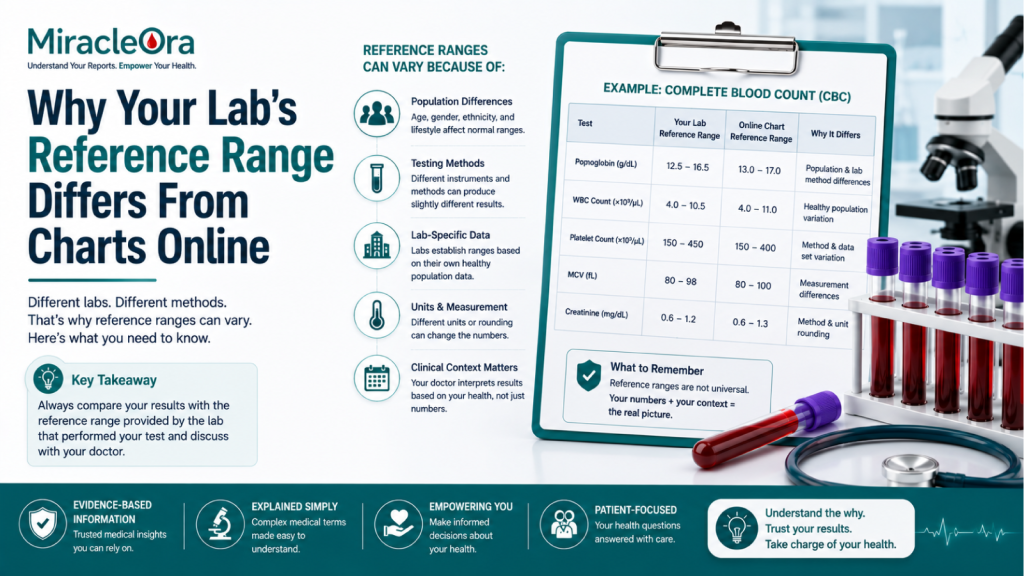
- Check whether the two ranges differ. They often do, because ranges belong to the laboratory. That is covered in why two labs can give you different numbers and in why your lab's reference range differs from charts online.
- Bring both reports to the same clinician. Comparing results is a clinical task that depends on why the tests were ordered in the first place.
Reference ranges do not shift with the clock
One thing that does not change through the day is the printed range. Laboratories establish or verify a single reference interval for each measurement, generally without separate morning and evening bands for a routine blood count. Your result is compared against that one band whatever time it was collected, which is another reason time-of-day effects are handled through clinical judgment rather than through the report itself.
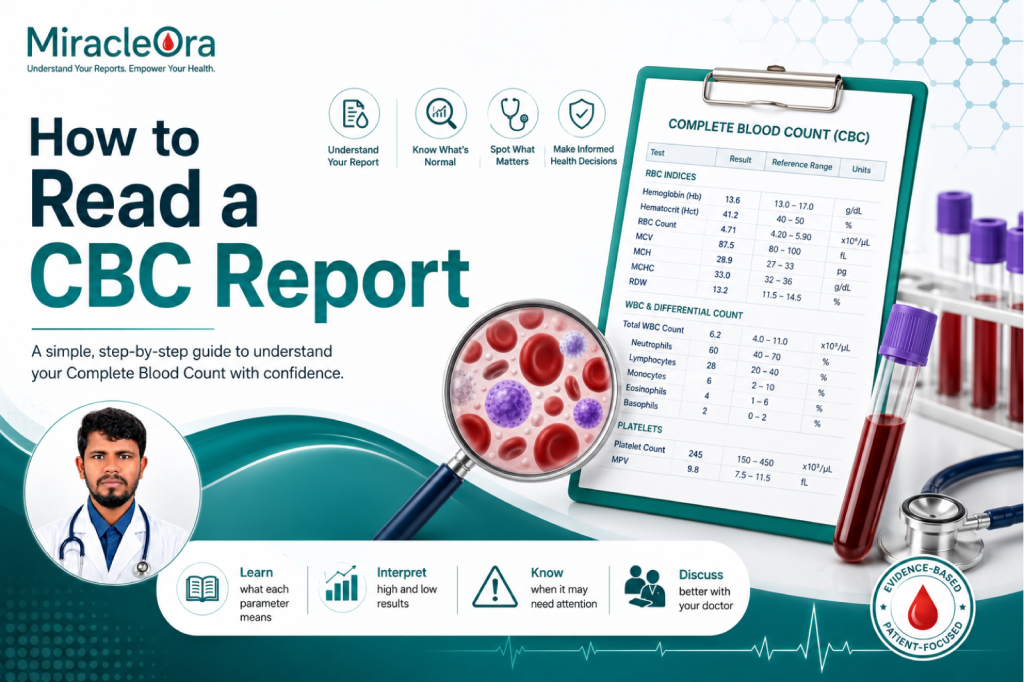
So read the range column on your own report, not a chart online, including ours. If you want the full walkthrough of what each line means first, start with how to read your CBC report.
When to contact your doctor rather than wait
Contact your doctor promptly if:
- A result was reported to you as critical, or you were asked to act on it.
- A value sits markedly outside the range printed on your own report.
- Several related values moved in the same direction at once.
- You are pregnant, immunosuppressed, receiving chemotherapy, or being monitored for a known blood condition.
- You have symptoms alongside the result: unusual bruising, tiny red spots on the skin, persistent fever, marked breathlessness, fainting or a racing heart.
Seek urgent care immediately for chest pain, difficulty breathing, confusion, fainting or uncontrolled bleeding, whatever any result says.
Frequently asked questions
Is a morning blood test more accurate than an afternoon one?
Not more accurate. Both are accurate measurements of your blood at that moment. Some values genuinely differ by time of day, so a morning draw and an afternoon draw are measuring a slightly different point on a daily curve. Certain hormone tests do have real time requirements, and your clinic will tell you if yours does.
Which blood count values change most through the day?
The systematic review presented in SLEEP reported red cells, hemoglobin and hematocrit peaking in the morning, platelets and several white cell types peaking in the late afternoon or evening, and lymphocytes and eosinophils peaking late at night. Different lines, different peaks.
Should I always book my repeat test at the same time of day?
That is a reasonable thing to ask the clinician monitoring you, because consistent timing makes results easier to compare. It is their call, not a rule to apply yourself, and it should never be a reason to delay a test you have been asked to have.
Can time of day explain why my result was flagged?
It is one of several everyday influences on a measurement, but the daily swing is generally small compared with the width of a reference range. A flagged value is interpreted by the person who ordered the test, alongside your symptoms, your history and your previous results.
Does fasting matter more than timing?
For a complete blood count, fasting is usually not required at all, though other tests on the same request may require it. Follow the instruction you were given.
Medical disclaimer: This article is provided by MiracleOra for general educational purposes only. It is not medical advice, diagnosis or treatment, and it does not interpret any individual person's results. Reference ranges vary by laboratory, age, sex, pregnancy status and testing method, so always compare your results to the range printed on your own report and discuss what they mean with a qualified healthcare professional who knows your medical history. If you have severe or worsening symptoms, seek urgent medical care. See our full Medical Disclaimer.