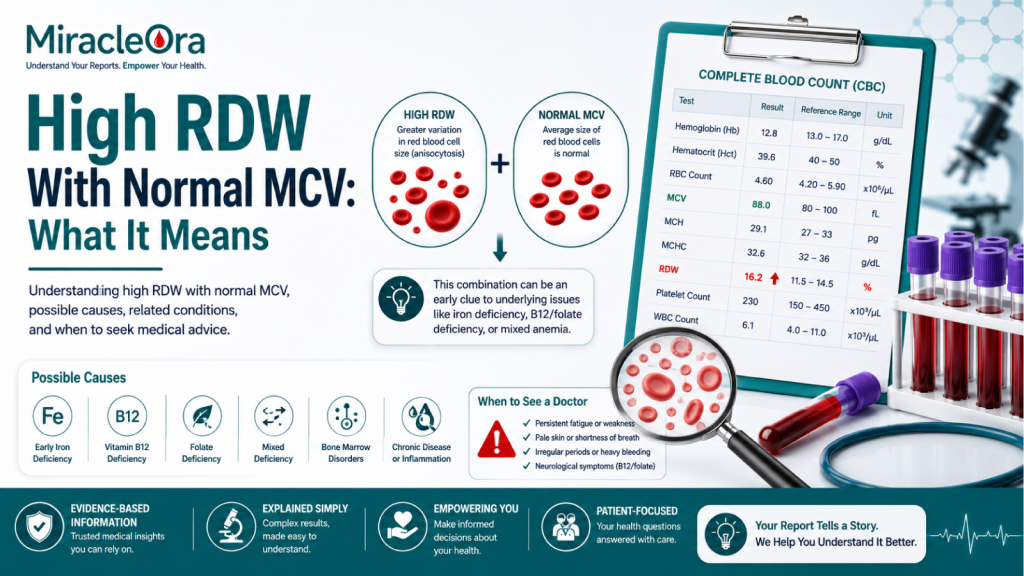
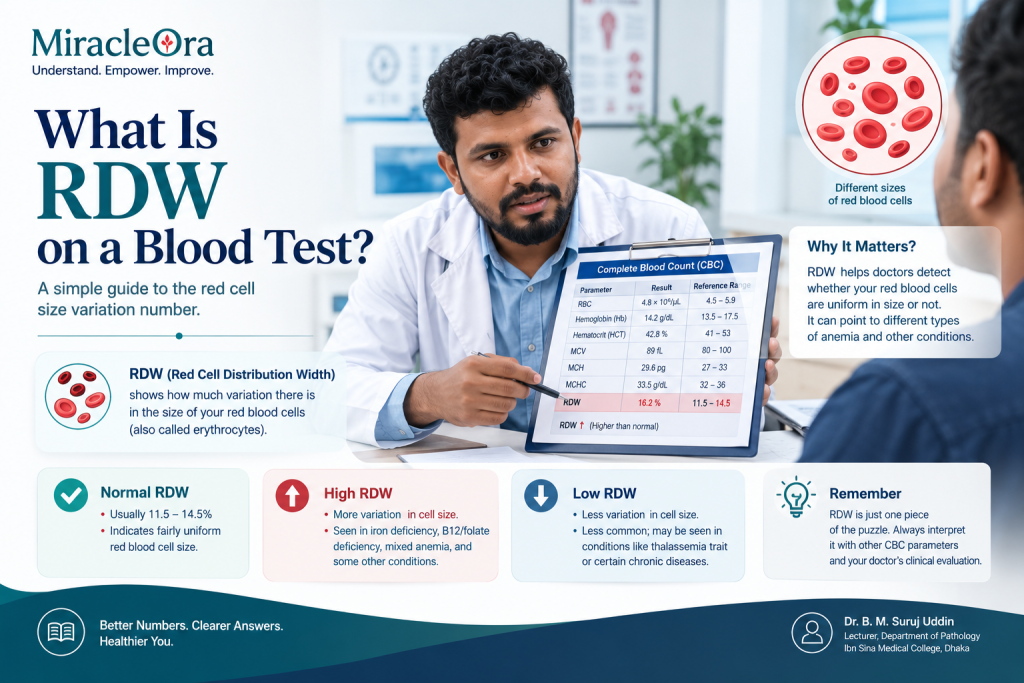
A high MCHC means the calculated concentration of hemoglobin inside your red blood cells is above the laboratory's range. MedlinePlus, in the page we read (updated October 7, 2024), lists only diseases for it. The StatPearls chapter "Normal and Abnormal Complete Blood Count With Differential" (last updated June 8, 2024) gives a different emphasis: real causes exist, such as spherocytosis, but "More commonly, high MCHC represents an artifact" of the sample. So the first question about the high MCHC meaning on your report is often not which disease it points to, but whether the measurement was right.
This page sets out why the number can be thrown off, the real causes the sources list, and how the rest of your report helps tell the two apart.
High MCHC meaning: why is it so often a measurement problem?
Because there is a ceiling on how concentrated hemoglobin normally gets inside a red cell. StatPearls states that red cell hemoglobin "is regulated and is normally limited to an optimal density of approximately 34% Hb/cell." The older Clinical Methods chapter "Red Cell Indices" (3rd edition, 1990) went further: "There are no hyperchromic anemias," although its next sentence says that in spherocytosis "the MCHC is increased."
MCHC is also not measured directly. StatPearls says it "is calculated by dividing the hemoglobin by the hematocrit." So anything that pushes the measured hemoglobin up, or the measured hematocrit down, pushes the MCHC up, even when your cells are normal.
Here is a calculated illustration of how much that matters. These are made-up numbers, not a real patient's report: with a hemoglobin of 13.6 g/dL and a hematocrit of 40%, MCHC is 34.0 g/dL. If clumped cells made the analyzer report a hematocrit of 32% while the hemoglobin stayed 13.6, the calculated MCHC would be 42.5 g/dL. Nothing about the cells changed; only one input did.
Which sample problems raise MCHC?
StatPearls lists five artifacts. Four are below; the fifth, hyperbilirubinemia, is discussed after the table because the chapter contradicts itself on it.
| Artifact | What StatPearls says happens | Which input moves (our reading) |
|---|---|---|
| Lipemia (fatty plasma) | "spuriously elevates Hb and consequently MCHC" | Hemoglobin falsely up |
| Hemolysis in the tube | "Hb is disproportionally elevated to Hct within the sample" | Hemoglobin high relative to hematocrit |
| Red cell agglutination (clumping) | "spuriously lowers the red cell concentration and elevates MCV" | Red cell count falsely down (StatPearls); Clinical Methods adds a low hematocrit with normal hemoglobin |
| Leukocytosis (very high white count) | "spuriously elevates MCV" | MCV falsely up |
The Clinical Methods chapter adds a recognizable fingerprint for cold agglutinins, antibodies that make red cells clump when the sample cools: "the combination of low hematocrit, normal hemoglobin, and high MCV and MCHC is characteristic of cold agglutinins." For red cell agglutination it states that "Prewarming the sample eliminates these spurious values." That chapter adds that hyperlipidemia, high bilirubin, a very high white count and high serum protein can falsely raise the hemoglobin reading.
One disagreement worth recording. On bilirubin, the StatPearls chapter is inconsistent with itself: one passage lists hyperbilirubinemia among interferents that "may spuriously elevate the Hb," while its MCHC list says hyperbilirubinemia "spuriously lowers Hb." The Clinical Methods chapter lists it as raising hemoglobin. We report both and cannot settle it from these sources.
Our reading of the fingerprint: if your report shows a high MCHC together with a high MCV and a hematocrit that looks low for your hemoglobin, that is the pattern these sources associate with clumping in the tube. It is a reasonable question for the laboratory or your clinician whether the sample was rerun warmed or checked on a smear.
What are the real causes of a high MCHC?
Real causes exist, and they matter. The sources we read name:
| Source | Causes listed |
|---|---|
| MedlinePlus, red blood cell indices (updated October 7, 2024) | Hemolytic anemia; hereditary spherocytosis, which it calls "a rare genetic disorder that causes anemia and gallstones" |
| StatPearls CBC chapter (2024) | Red cell shape abnormalities "such as spherocytosis and xerocytosis or hemoglobinopathies" |
| Clinical Methods (1990) | Spherocytosis, where "the MCHC is increased due to loss of membrane and the consequent spherical shape assumed by the cell" |
Spherocytes are small, round red cells without the usual pale center. Our page on target cells, spherocytes and other smear findings explains how they look on a blood film.
Our reading of the two kinds of source: MedlinePlus lists only disease causes, while StatPearls says artifacts are the more common explanation. Both can be right at once: the diseases are the meaningful causes, and the artifacts are the frequent ones. None of the three sources we read gives a figure for how often each explanation occurs.
How the rest of your report helps
StatPearls says that "Examination of a peripheral blood smear is useful in such a case to evaluate red blood cell morphology and exclude other contributing factors." Our reading: the smear can help with both questions. StatPearls' Macrocytosis chapter (last updated September 26, 2022) says clumping-related changes "are easily seen on a blood smear," and spherocytes are themselves a smear finding. Our blood film report glossary explains the terms that may appear.
Other lines on the same report also give context. A low hemoglobin points toward anemia, which our page on microcytic, normocytic and macrocytic anemia explains. The same Macrocytosis chapter describes a rise in young red cells as a response to hemolytic or blood loss anemia, which our page on the reticulocyte count explains. Reading these together is the clinician's job, and StatPearls says CBC results "must be interpreted in the clinical context."
When does a high MCHC need prompt attention?
In the sources we read, the MCHC itself is not an emergency marker. MedlinePlus lists symptoms of anemia that can lead to red cell index testing, including shortness of breath, weakness or fatigue, headache, dizziness, a problem with the rate or rhythm of the heartbeat, pale skin, and cold hands and feet. The clinician who ordered the test is the person to tell about symptoms like these, or about a flagged result that worries you. They can see your symptoms, history and the rest of your blood count, which no web page can.
This page is general information, and our medical disclaimer explains its limits.
Frequently asked questions
What does a high MCHC mean on a blood test?
It means the calculated hemoglobin concentration in your red cells is above your laboratory's range. StatPearls says this more commonly reflects a sample artifact, such as lipemia, hemolysis or clumping, than a disease, though spherocytosis and some hemoglobin disorders are real causes.
Can a high MCHC be a lab error?
Yes. StatPearls lists lipemia, hemolysis in the sample, red cell agglutination and a very high white count as artifacts that can raise MCHC, and says a blood smear helps check for them.
Is high MCHC a sign of hereditary spherocytosis?
It can be. MedlinePlus lists hereditary spherocytosis and hemolytic anemia as possible causes of a high MCHC. A blood smear and other tests ordered by your clinician help decide.
Why would my lab repeat a test with a high MCHC?
The Clinical Methods chapter states that prewarming the sample eliminates the false values caused by red cell agglutination, so a laboratory may rerun or recheck a sample before reporting. Your laboratory can tell you what it did.