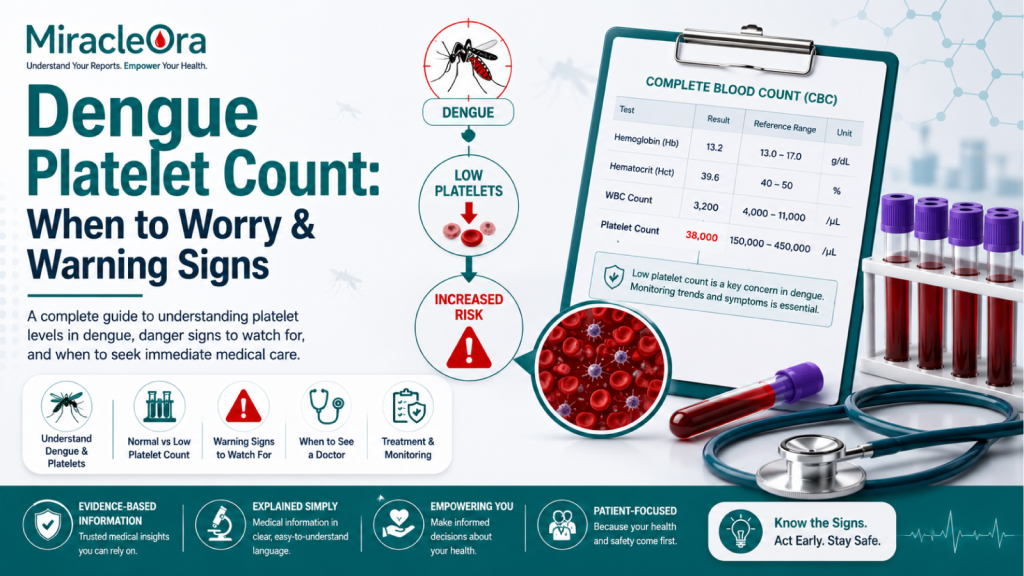
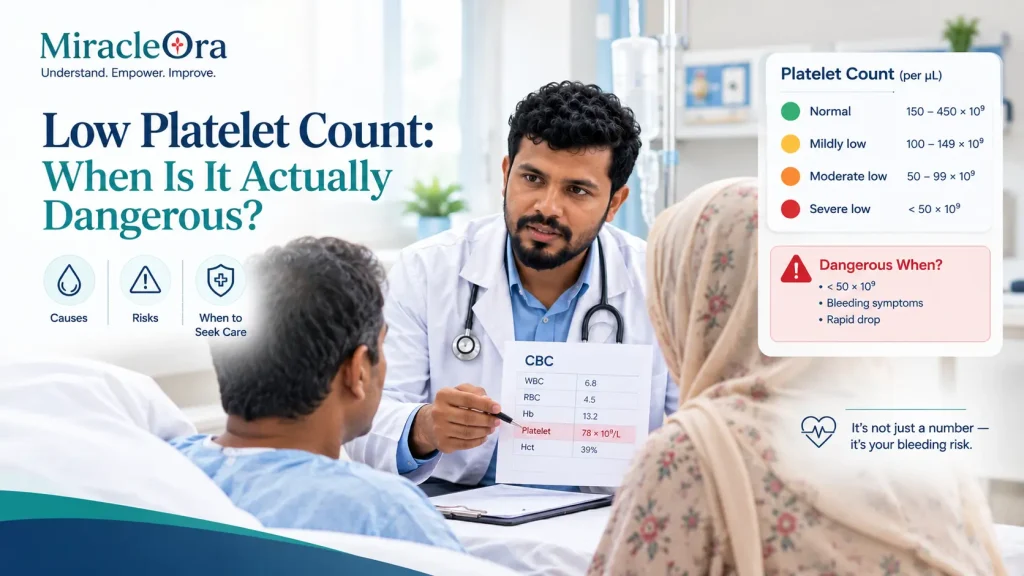
In dengue, the platelet count usually starts to recover after the critical phase, and it is typically not the first number on the blood report to turn. WHO's 2009 dengue guidelines state that the white blood cell count "usually starts to rise soon after defervescence but the recovery of platelet count is typically later than that of white blood cell count." The CDC describes the same order. So during dengue platelet count recovery, a rising white count with platelets still low is the expected sequence in these sources, not a sign that something has stalled.
This page reads the recovery phase the way a series of daily blood counts shows it: which line usually moves first, what the hematocrit does, and which signs still mean urgent care.
Warning signs that still mean go to hospital now
Recovery is not the moment to stop watching. The CDC's patient page on dengue symptoms (dated October 19, 2026) says to go immediately to a local clinic or emergency room for any of these warning signs:
- belly pain or tenderness
- vomiting at least 3 times in 24 hours
- bleeding from the nose or gums
- vomiting blood, or blood in the stool
- feeling extremely tired or restless
The CDC adds that warning signs "usually begin in the 24–48 hours after fever has gone away," and that "Symptoms of dengue can become severe within a few hours." WHO's dengue fact sheet (dated August 21, 2025) lists severe symptoms that "often come after the fever has gone away," including rapid breathing, pale and cold skin and being very thirsty, and says people with them "should seek care immediately."
Our article on dengue platelet count: when to worry covers the critical phase and the platelet numbers people ask about in detail. This page starts where that one ends.
Dengue platelet count recovery: which number rises first?
The guidance we read describes the recovery phase as a sequence, and each step shows up on a different line of the complete blood count (CBC):
| Report line | What WHO 2009 and CDC describe in the recovery phase | What it looks like across daily reports (our reading) |
|---|---|---|
| White blood cells (WBC) | WHO: "usually starts to rise soon after defervescence." CDC: "the white cell count usually starts to rise" | Often the first count to turn upward |
| Platelets | WHO: recovery "is typically later than that of white blood cell count." CDC: the WBC rise is "followed by a recovery of platelet count" | Can still be low after the white count has started rising |
| Hematocrit | WHO: "stabilizes or may be lower due to the dilutional effect of reabsorbed fluid." CDC: "stabilizes or may fall" | Stops climbing; may drift down as fluid returns to the bloodstream |
Our reading: a platelet count that is still low, or even lower, on the day the fever has gone and the white count has started to rise can look alarming. In both sources that order is described as typical. What the sources do not give is a fixed number of days between the two, so the trend across tests, read by your clinician, matters more than any one day.
The hematocrit row needs one caution. A falling hematocrit in recovery is described as dilution. But WHO also describes the hematocrit falling in severe shock because of bleeding, and the CDC's clinical care guidance says a hematocrit that falls "despite adequate fluid replacement" suggests hidden bleeding. Telling those apart needs the full clinical picture, which is why this line is for the treating team, not for self-reading. Our page on what the hematocrit measures explains the number itself.
What does recovery look like apart from the numbers?
WHO's 2009 guidelines describe the recovery phase as a gradual reabsorption of leaked fluid "in the following 48-72 hours" after the critical phase, during which "General well-being improves, appetite returns, gastrointestinal symptoms abate, haemodynamic status stabilizes and diuresis ensues," meaning urine output increases. The same section notes that some people get a rash described as "isles of white in the sea of red," some have generalized itching, and that a slow heart rate is common at this stage. The CDC's clinical page adds that the recovery-phase rash "may desquamate and be pruritic," meaning it may peel and itch.
After recovery, WHO's fact sheet says people "may experience fatigue for several weeks." WHO's 2025 guidelines for arboviral diseases state that "Most patients will recover in 1 – 2 weeks."
Recovery has its own risk in hospital: too much fluid
The recovery phase is not risk-free for people who were given intravenous fluids. WHO's 2009 guidelines list hypervolemia (fluid overload) as the clinical problem of the recovery phase, "only if intravenous fluid therapy has been excessive and/or has extended into this period," and warn that excessive fluid in the critical or recovery phase is linked with fluid in the lungs or heart failure. The CDC's clinical care page says fluid rates should be "progressively decreased" as the blood vessels stop leaking, "often around 48 hours after defervescence, though this can vary."
Our reading: for a family watching a hospital stay, a team slowing or stopping the drip as the patient improves is part of this guidance, not a sign of neglect. New breathlessness during recovery is something to tell the ward staff about at once.
When is someone well enough to go home?
WHO's 2009 guidelines set out discharge criteria, all of which must be present:
| Type | Criterion (WHO 2009, Textbox F) |
|---|---|
| Clinical | No fever for 48 hours |
| Clinical | Improvement in clinical status (general well-being, appetite, hemodynamic status, urine output, no respiratory distress) |
| Laboratory | Increasing trend of platelet count |
| Laboratory | Stable hematocrit without intravenous fluids |
Two points about this table. First, it asks for an increasing trend in platelets, not a return to a normal range. Our reading: as written, the criteria do not require the count to be back inside the laboratory's normal range; whether a particular person goes home is the treating team's decision. Second, the 2009 document carries an "Expiry date: 2014," which has long passed. WHO's 2025 arboviral guidelines say their specific recommendations "supersede those from previous documents." In the sections of the 2025 guidelines we searched on November 11, 2026, we did not find discharge criteria, and they refer readers to prior WHO guidance for more detailed clinical management. Hospitals also follow local protocols, so the treating team's criteria are the ones that apply.
What about remedies that claim to raise platelets?
None of the WHO or CDC pages we read recommends any remedy to speed platelet recovery, and the CDC's clinical guidance says prophylactic platelet transfusions are not recommended. Our article on dengue platelet count: when to worry covers what research says about popular remedies, and our page on platelet transfusion thresholds explains how doctors approach that decision. Any medicine or remedy during dengue is a question for the treating clinician first.
How long until the platelet count is back in range?
The sources we read describe recovery of the platelet count after the white count, but give no fixed date for reaching a normal range. If the count stays low well after the illness has settled, that is a reason for a follow-up test arranged by your clinician; our page on why a blood test gets repeated explains how repeat tests are usually read. Dengue is not the only infection that lowers platelets, and our page on malaria, typhoid and low platelets covers the regional differential.
Only the clinician treating you can say whether your recovery is on track. This page is general information, and our medical disclaimer explains its limits.
Frequently asked questions
When does the platelet count rise after dengue?
WHO's 2009 guidelines and the CDC describe platelet recovery in the recovery phase, after the critical phase that begins around the time the fever goes, and typically later than the rise in white blood cells. Neither gives a fixed day.
Why are my platelets still low when my white cell count is rising?
Both WHO and the CDC describe the white cell count recovering first, followed by the platelet count. A short lag between the two is the order these sources describe.
Do platelets need to be normal before discharge from hospital?
WHO's 2009 discharge criteria (from a document past its listed 2014 expiry date) ask for an increasing trend of platelet count, not a normal count, along with no fever for 48 hours, clinical improvement and a stable hematocrit without intravenous fluids. Hospitals apply their own protocols.
Can dengue warning signs appear after the fever is gone?
Yes. The CDC says warning signs usually begin in the 24 to 48 hours after the fever has gone away, and WHO says severe symptoms often come after the fever has gone. Any warning sign needs urgent care.