If you are wondering why repeat blood test requests happen, the short answer is that one blood sample is a single snapshot, and a second one shows whether the first was telling the true story. Clinicians ask for repeats to confirm a value near the edge of the range, to rule out a problem with the sample itself, to see whether a number is changing over time, or to check a result that does not fit how you feel. A repeat request is a routine part of careful testing. On its own, it is not a sign that something serious has been found.
The rest of this article walks through those reasons one by one, including a blood count quirk that most explanations leave out, and the signs that mean you should not wait for the repeat appointment.
Why repeat blood test requests are so common
Blood is not a fixed substance. The values on a report move a little from day to day and even hour to hour, and the measuring process has its own small margin of error. A single result captures one moment, under one set of conditions, measured once.
MedlinePlus, the U.S. National Library of Medicine's consumer health site, lists factors that can affect lab results in its guide to understanding results (updated September 4, 2025, read on October 2, 2026). These include certain foods and drinks, certain medicines or supplements, hard exercise before the test, having a menstrual period at the time of the test, and whether preparation instructions such as fasting were followed. Our articles on whether you need to fast for a CBC and on exercise before a blood test look at two of those factors in more detail.
When a result looks unexpected, the simplest way to separate a passing circumstance from a real pattern is to measure again. That is the logic behind almost every repeat request.
Reason 1: the first value sat near the edge of the range
The most common trigger is a result just above or just below the reference range. Reference ranges are statistical. Testing.com, a patient education site on laboratory testing (read on October 2, 2026), explains that ranges for many tests cover the middle 95% of a healthy reference population, which means about 5% of healthy people fall outside them. Testing.com also notes that for a result just outside the range, a provider may "reorder the test."
A 2006 paper in the Journal of Clinical Pathology by W. S. A. Smellie, on dealing with slightly out-of-range results, explains why this works. It describes "regression towards the mean": a value that happened to be caught at a high or low moment tends to drift back toward the middle when measured again. The paper notes that "many slightly out-of-range results" return to normal on retesting, and that in a person with no symptoms and no clinical signs of disease, interval retesting is a reasonable approach for mildly abnormal results.
So a repeat after a borderline value is often the expected, measured response, not a sign of alarm.
Reason 2: the sample itself may have misled the machine
Sometimes the question is not your body but the tube. Automated analyzers are very good, but they count what is in front of them, and occasionally what is in front of them does not reflect what is in your bloodstream.
A clear example in blood counts is a falsely low platelet count caused by platelets clumping together in the collection tube. Most CBC samples are drawn into a tube containing an anticoagulant called EDTA. In a small number of people, EDTA allows platelets to stick together after the blood leaves the body. The analyzer counts a clump as one item, or misses it, so the reported platelet count looks low even though the platelet count in the body is normal.
A 2020 report in EJIFCC, the journal of the International Federation of Clinical Chemistry, by Collazo Abal and colleagues, titled "Pseudothrombocytopenia by ethylenediaminetetraacetic acid can jeopardize patient safety" (read on October 2, 2026), describes this effect. The authors note that its reported incidence ranges from 0.10 to 0.29 percent, that the analyzer often raises a "platelet aggregation" alert flag, and that the blood smear shows the clumps. They describe confirming it with a new blood sample using a different anticoagulant, such as sodium citrate or heparin, which shows a normal count. They also stress why it matters: mistaking the artifact for a true low count can lead to unnecessary procedures.
This is a good illustration of why a repeat can be the most careful step available. If your report shows a low platelet count and you were asked to come back for a new sample, possibly in a different tube, this is one of the reasons it may happen. Our guide on when a low platelet count is actually dangerous explains how true low counts are assessed.
Reason 3: a single number cannot show a trend
One result tells you where a value is. Two or more tell you which way it is going, and for many decisions the direction matters more than the position.
This is where a concept from laboratory medicine called the reference change value comes in. Callum G. Fraser, writing in Advances in Laboratory Medicine in 2020 in "Biological variation: a still maturing aspect of laboratory medicine" (read on October 2, 2026), describes how every person's values vary naturally around their own set point, and how measurement adds its own small imprecision. Reference change values are used, in Fraser's words, "in deciding the significance of changes in serial results in an individual."
Put simply, two results from the same person will almost never be identical. The question is whether the difference between them is bigger than ordinary day-to-day wobble plus measurement noise. A small difference may mean nothing. A larger one, especially in a consistent direction across several tests, may mean something worth attention. That judgment needs more than one data point, which is why a clinician may ask for a repeat even when the first value is only mildly off.
Fraser's paper also touches on a related idea: population reference ranges are broad, while an individual's own values often sit in a narrower band. Your previous results can therefore be more informative for you than the printed range.
Reason 4: the result does not match the picture
Clinicians interpret results alongside symptoms, examination and history. If a value is surprising given how you feel, or does not fit with the other numbers on the same report, a repeat is a sensible way to check before drawing any conclusion. The platelet clumping example above is one version of this: a very low count in someone with no bruising or bleeding is a classic prompt to look again.
Reason 5: monitoring over time
Some repeats are planned from the start. People with ongoing conditions, or people starting a treatment their clinician wants to follow, often have the same tests scheduled at intervals. In that setting a repeat is simply the next point on a graph, not a reaction to a worrying result.
Why the same lab may be preferred for the repeat
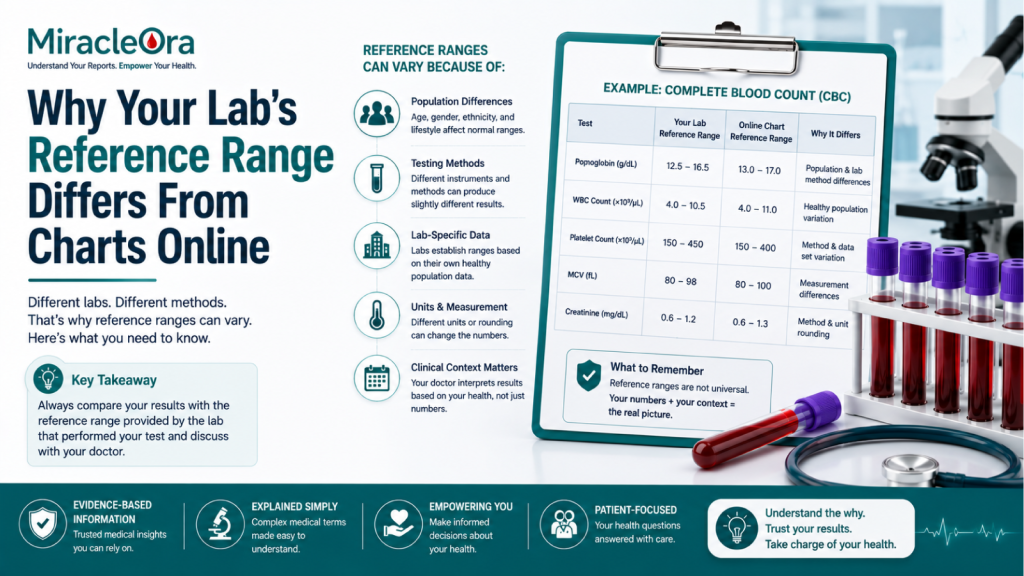
Testing.com notes that different laboratories use different equipment and methods, so each lab sets its own reference ranges and there are no universally standardized ones. A repeat at the same lab, using the same method, makes the two results easier to compare fairly. Our article on why two labs give you different blood test numbers explains how much results can differ between labs and why.
If your clinician gives preparation instructions for the repeat, such as timing, fasting or avoiding hard exercise beforehand, those instructions exist to make the two results comparable. If anything about the first draw was unusual, such as a recent illness, a hard workout or a long fast, it is worth mentioning it when you go back.
When not to wait for the repeat
A repeat test is planned for a reason, but it is not the right response to new or severe symptoms. MedlinePlus lists warning signs of a medical emergency in adults (page reviewed January 8, 2025, read on October 2, 2026), including:
- Bleeding that will not stop
- Breathing problems, such as difficulty breathing or shortness of breath
- Chest pain or discomfort lasting two minutes or more
- Fainting or loss of consciousness
- Coughing up or vomiting blood
- A change in mental status, such as confusion or unusual behavior
- Sudden dizziness, weakness or change in vision
These call for emergency care, whatever date the repeat test is booked for. Beyond emergencies, if symptoms are new or getting worse between the first test and the repeat, contacting the clinician who ordered the test is reasonable. And if the clinic asks you to come back sooner than planned, that request comes from someone who can see your whole record.
Questions that make a repeat request less mysterious
It is entirely reasonable to ask what the repeat is for. Useful questions include:
- Which result are we rechecking, and how far outside the range was it?
- Is this mainly to confirm the number, or to see how it changes over time?
- Could anything about the first sample or the day of the draw explain it?
- Is there any preparation I should follow before the repeat?
- What symptoms should prompt me to contact you before the repeat date?
Any decision about medicines, including whether a medicine might be affecting a result, belongs with your prescriber. A single result, or a repeat request, is not a reason to change a medicine on your own.
The calm way to read a repeat request
A request to repeat a blood test usually means your clinician is being careful with a number before acting on it. It can reflect a borderline value, a possible sample artifact, the need for a trend, a mismatch with your symptoms, or simple routine monitoring. A laboratory report should not create fear; it should create understanding, and a second result is often what turns an uncertain number into an understood one.
This article is general information and cannot interpret your own results. The clinician who ordered your tests is the right person to explain why a repeat was requested in your case.
Frequently asked questions
Does a repeat blood test mean something is wrong?
Not usually on its own. Repeats are commonly used to confirm a borderline value, check for a sample problem, or follow a trend. A 2006 Journal of Clinical Pathology paper by Smellie notes that many slightly out-of-range results return to normal on retesting. Your clinician can tell you which reason applies to you.
Why would a platelet count need a new sample in a different tube?
In a small number of people, platelets clump in the standard EDTA tube, making the count look falsely low. A 2020 EJIFCC report by Collazo Abal and colleagues describes confirming this with a new sample using sodium citrate or heparin, which shows the true count.
Can two results from the same person be different without anything changing?
Yes. Values vary naturally within each person, and measurement adds small imprecision. Callum G. Fraser's 2020 review describes reference change values as a way to judge whether a difference between serial results is significant rather than ordinary variation.
Should I wait for the repeat if I feel worse?
No. New or worsening symptoms are a reason to contact your clinician, and MedlinePlus lists emergency warning signs, such as bleeding that will not stop, chest pain or fainting, that call for urgent care regardless of when a repeat is booked.