This article is general health education, not medical advice. It does not interpret any individual result. See our Medical Disclaimer.
Can Dehydration Change Your Blood Test Results?
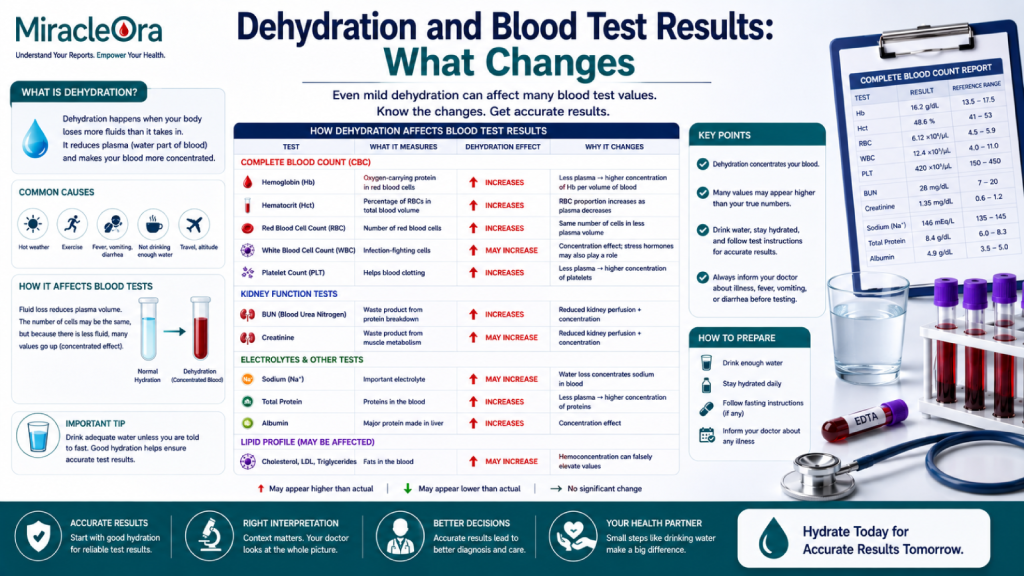
Yes. Being dehydrated at the time of the draw can raise several values on a complete blood count, because dehydration removes water from your plasma while leaving the cells alone. The same number of red cells sits in less fluid, so hemoglobin, hematocrit and red cell count all read higher per unit of blood. MedlinePlus lists dehydration among the causes of a higher-than-normal hematocrit. What dehydration cannot do is tell you what your own result means. Only the clinician who ordered the test can decide whether hydration explains your number, and reference ranges differ between laboratories, so the range printed on your own report is the one your value was judged against.
What dehydration actually does to a blood sample
Blood is cells suspended in plasma, and plasma is mostly water. When you lose more water than you take in, plasma volume falls first. The cells do not disappear and they do not shrink in any meaningful way. They simply end up packed into a smaller volume of liquid.
Laboratories measure most blood values as a concentration: how much of something is present in a given volume of blood. Concentrate the sample and every concentration-based number drifts upward together. Clinicians call this hemoconcentration.
Cleveland Clinic describes the version of this that shows up as a high red cell count as relative erythrocytosis, where the count is high only relative to the amount of liquid in the blood, and names not drinking enough fluids, vomiting, diarrhea and diuretic medicines among its causes. Its patient pages also make the point that some causes of a high red cell measurement, such as dehydration, are less concerning than others, such as polycythemia vera. That distinction is exactly why the decision is clinical rather than something to settle from a chart.
Which numbers move, and which barely notice
This is the part most articles on this topic skip, and it is the most useful thing to understand about your report.
| Type of value | Examples | Effect of dehydration |
|---|---|---|
| Concentration values (counted per volume of blood) | Hemoglobin, hematocrit, red blood cell count, white cell count, platelet count | Can read higher, because the same cells sit in less plasma |
| Average-cell values (calculated per cell, not per volume) | MCV (average red cell size), MCH (average hemoglobin per cell), MCHC | Largely unaffected, because they describe the cells themselves, not how many are in a given volume |
NIH/NCBI StatPearls defines MCV as the average volume of a red cell and MCH as the average mass of hemoglobin inside one. Losing plasma does not change the size of a red cell or how much hemoglobin it carries. So the red cell indices tend to hold steady while the concentration values rise.
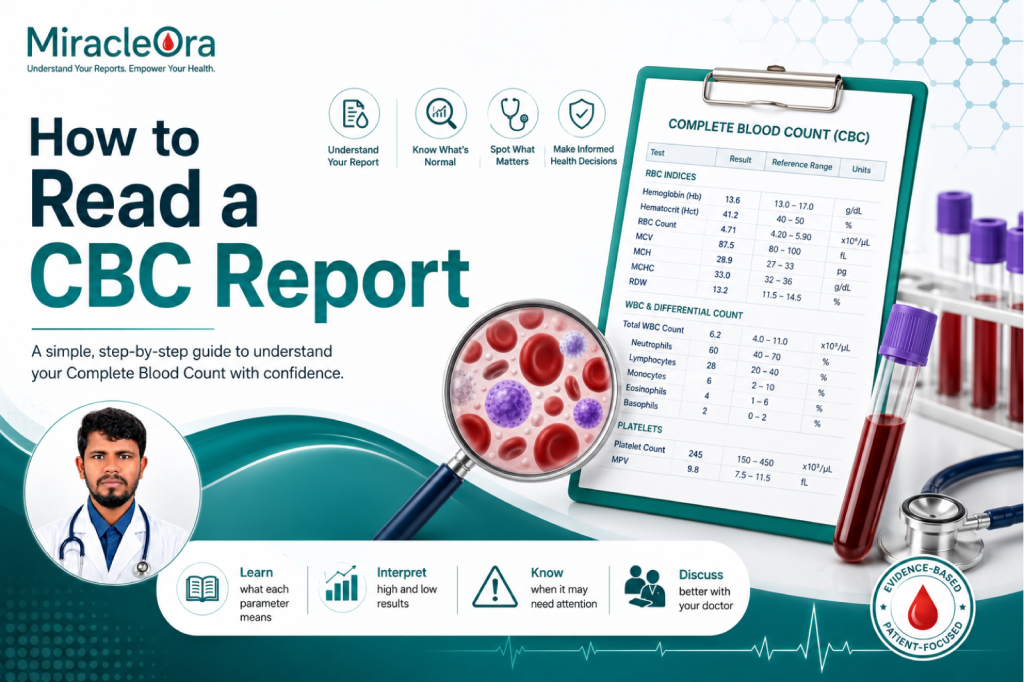
That is why a doctor reads your report as a set rather than one line at a time. A pattern where hemoglobin, hematocrit and red cell count have all moved in the same direction while the indices sit where they always sit looks different from a pattern where the indices have moved too. Neither pattern is a diagnosis, and neither is something to conclude for yourself. It is a reason your doctor may ask about the day of the draw, or repeat the test. The full walkthrough of how those lines relate is in how to read your CBC report.
The direction almost nobody mentions: dehydration can hide a low result
Every article on this topic warns that dehydration can push a value falsely high. Far fewer mention the mirror image, and it matters more.
If your red cell mass is genuinely low, hemoconcentration can lift the measured hemoglobin closer to, or into, the printed range. The underlying picture has not improved. The measurement has simply been taken in less fluid. Rehydrate, repeat the test, and the number can fall.
The practical consequence is that "I was dehydrated" is not a reassuring explanation on its own and it is not an alarming one. It is a reason the measurement may not represent your steady state in either direction. Which direction, and whether it matters, is a clinical judgment about your history, your symptoms and your previous results. This is also why a result that looks unremarkable does not close a question your doctor has already opened, a theme covered in when a blood test is abnormal but you feel fine.
How big is the shift?
Honest answer: it varies, and the size of the shift in an individual is not predictable from how thirsty you felt.
The degree of hemoconcentration depends on how much fluid you actually lost, how quickly, what caused it, your kidney function, your medicines and your baseline. Published figures floating around the web attach confident percentages to "mild" or "moderate" dehydration. We are not going to repeat a number we cannot trace to a named authority, because on a page about your own blood results a wrong number is worse than no number.
What can be said plainly: the effect is real, it is proportional across the concentration values, and it is usually modest rather than dramatic in someone who is otherwise well. Large shifts tend to come with the causes that produce large fluid losses, such as prolonged vomiting or diarrhea, which are medical situations in their own right.
What dehydration does not explain
Dehydration is a genuinely common and genuinely benign explanation for mildly high red cell values, which is why it gets reached for so quickly. It does not stretch to cover everything.
- It does not explain a value that is markedly outside your report's range rather than sitting just past the edge.
- It does not explain a change in cell size, shape or appearance, which is a different kind of finding. If your lab added a smear, that is a separate question, covered in what a peripheral blood smear means.
- It does not explain a pattern that has persisted across several well-hydrated draws.
- It does not explain symptoms. A number and a symptom are two pieces of information, and your doctor weighs both.
If a repeat test is worth doing, that decision belongs to the clinician who ordered the first one. Do not arrange a repeat, skip one, or treat your own hydration as a way to change a result before a draw.
Before your next blood draw
Nothing here is a preparation instruction. Your laboratory's own instruction always wins. Two general points are worth knowing:
- Fasting rules are usually about food, not water. Where a fast is required, plain water is typically allowed and often encouraged. Whether a CBC needs a fast at all is covered in do you need to fast for a CBC.
- Tell the person taking the sample if you have been unwell. Vomiting, diarrhea, fever or a long stretch without fluids is relevant information, and it is more useful to your doctor before the result is printed than after.
Reference ranges belong to the laboratory, not to you
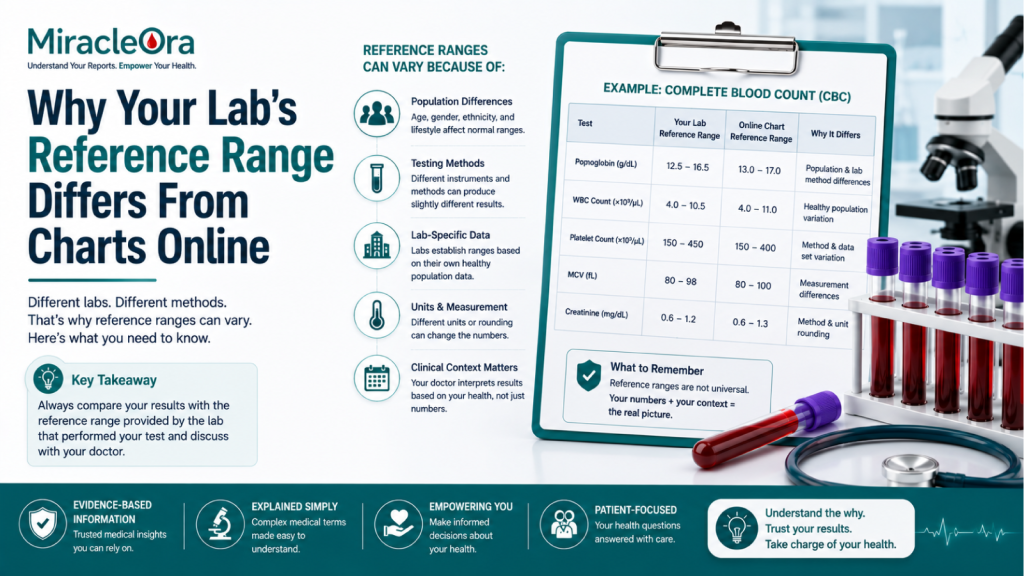
Every range you see on this site, or on any site, is a general population figure. Laboratories establish or verify their own reference intervals using their own instruments, reagents and reference populations, which is why two reports can print different bands for the same measurement. Read the range column on your own report, not ours. Why that happens in detail is in why your lab's reference range differs from charts online, and what to do when two labs disagree is in why two labs can give you different numbers.
When to contact your doctor rather than wait
Contact your doctor promptly if:
- A result was reported to you as critical, or you were asked to act on it.
- A value sits markedly outside the range printed on your own report.
- You cannot keep fluids down, or you have had persistent vomiting or diarrhea.
- You are pregnant, immunosuppressed, receiving chemotherapy, or being monitored for a known blood condition.
- You have symptoms alongside the result: dizziness, fainting, marked breathlessness, chest pain, confusion, very little urine output, or a racing heart.
Seek urgent care immediately for chest pain, difficulty breathing, confusion, fainting or uncontrolled bleeding, whatever any result says.
Frequently asked questions
Can dehydration cause a false high hemoglobin?
It can raise the measured hemoglobin, because hemoglobin is reported as a concentration and dehydration reduces the plasma the cells are suspended in. MedlinePlus lists dehydration among the causes of a higher-than-normal hematocrit, which moves for the same reason. Whether it explains a particular result is for the ordering clinician to judge.
Should I drink water before a blood test?
Follow the instruction your clinic or laboratory gave you. Where a fast is required it usually applies to food rather than plain water, and water is often encouraged. Do not change anything you were specifically told to do.
Does dehydration affect white blood cells and platelets too?
They are also reported per volume of blood, so hemoconcentration can nudge them upward alongside the red cell values. The effect is a concentration effect, not a change in the cells themselves.
Will drinking water fix my result?
It does not change a result that has already been printed. If your doctor thinks hydration may have affected the sample, they may repeat the test. That decision is theirs, not something to arrange yourself.
My hemoglobin was normal but I was very dehydrated. Does that mean something was missed?
It means the measurement was taken under conditions worth mentioning to your doctor. Concentration can lift a value as easily as it can exaggerate one. Tell the clinician who ordered the test, and let them decide whether anything needs repeating.
Medical disclaimer: This article is provided by MiracleOra for general educational purposes only. It is not medical advice, diagnosis or treatment, and it does not interpret any individual person's results. Reference ranges vary by laboratory, age, sex, pregnancy status and testing method, so always compare your results to the range printed on your own report and discuss what they mean with a qualified healthcare professional who knows your medical history. If you have severe or worsening symptoms, seek urgent medical care. See our full Medical Disclaimer.