This article is general health education, not medical advice. It cannot tell you why your own test was ordered. See our Medical Disclaimer.
What Is a CBC Test Actually For? Screening vs Diagnosis
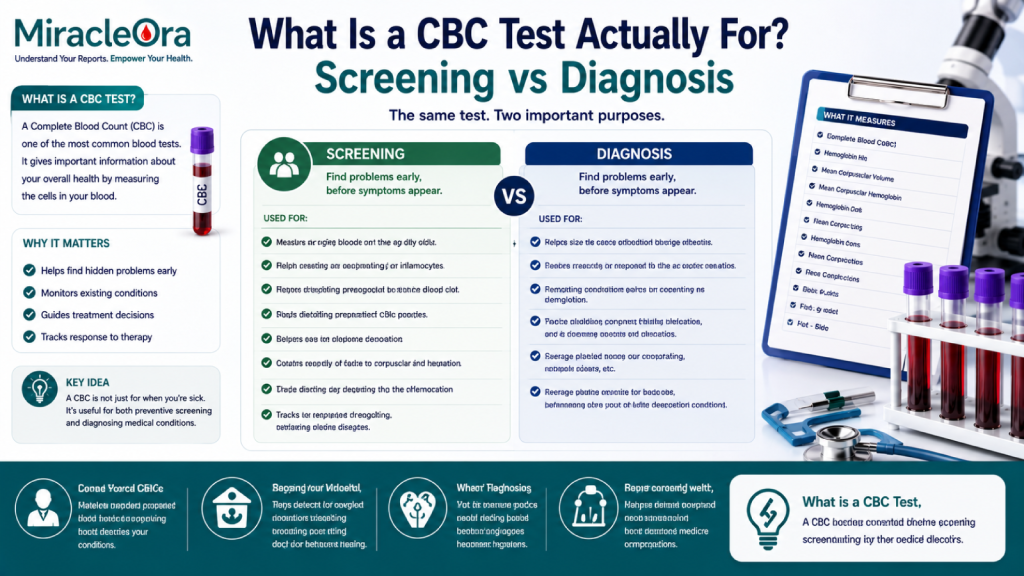
Short answer: a complete blood count is a wide-angle screening and monitoring test. It gives your doctor a broad picture of the cells circulating in your blood, which is useful for spotting where to look next. It is not, on its own, a diagnostic test for any particular condition. Cleveland Clinic describes it as a common test used to check overall health, and that framing is the accurate one.
The distinction between screening and diagnosis runs through everything else on this page, and it is the reason a blood count can be simultaneously very useful to a doctor and almost impossible to interpret alone.
What a CBC measures, in one paragraph
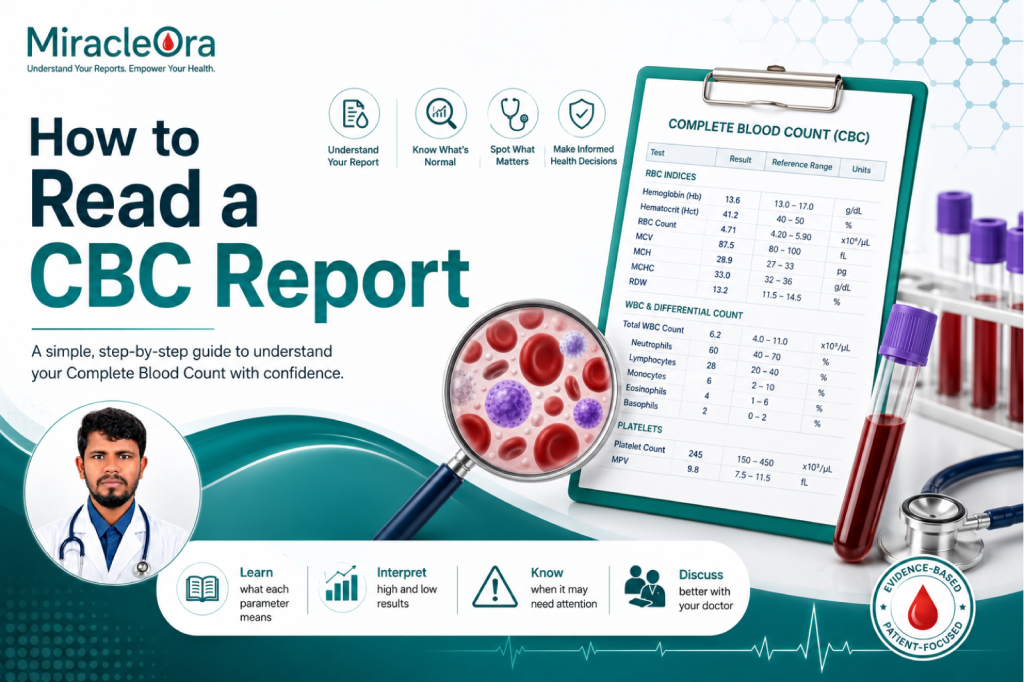
A complete blood count reports on three families of cells: red blood cells and the hemoglobin they carry, white blood cells and their subtypes, and platelets. It also reports calculated values describing the size and hemoglobin content of red cells, such as MCV, MCH and RDW. Each abbreviation is decoded in CBC abbreviations decoded, and the commonly cited adult values are collected in the complete CBC reference-range table.
The four jobs a CBC actually does
1. Routine screening. Checking general health, often as part of a periodic review or before a procedure, in someone with no complaint at all.
2. Investigating symptoms. When someone reports tiredness, weakness, fever, breathlessness, unexplained bruising or similar, a blood count is a reasonable first look because it covers a lot of ground cheaply and quickly. MedlinePlus and familydoctor.org both describe this use.
3. Monitoring a known condition or treatment. This is a large share of all blood counts performed. Where a condition or a medication is known to affect blood cells, repeated counts track the trend. Here the value of the test is almost entirely in the comparison with previous results rather than in any single sheet.
4. Pre-procedure and pre-treatment assessment. Before surgery, before certain treatments, and during pregnancy, a baseline blood count is standard practice.
Notice what all four have in common: in none of them is the CBC expected to name a condition by itself.
Screening versus diagnosis: the distinction that explains everything else
A screening test is designed to be broad. It casts a wide net, accepts that it will catch things that turn out to be nothing, and its job is to tell a clinician where to focus. A diagnostic test is designed to answer a specific question that has already been framed.
A complete blood count is firmly in the first category. That has three consequences worth understanding:
- Out-of-range values are common and often unremarkable. A reference range is a statistical band covering about 95 percent of a healthy reference group, so roughly one healthy person in twenty falls outside it on any given measurement. Across the many lines of a blood count, some flagging is expected rather than surprising. We give that its own page in blood test abnormal but you feel fine.
- The pattern carries the information, not the line. A low hemoglobin means something different depending on what MCV and RDW are doing beside it, which is why context takes as much reading as the number itself.
- A follow-up test is a normal outcome, not an escalation. Screening tests are supposed to generate follow-up questions. That is the design working.
Does ordering a CBC mean my doctor suspects something serious?
This is the question underneath most searches for this phrase, so it deserves a direct answer: no, you cannot infer a suspicion from the fact that a blood count was ordered.
The complete blood count is among the most commonly ordered tests in medicine. It is ordered for tiredness, for a fever, before an operation, during pregnancy, at an annual review, when starting or continuing certain medications, and for monitoring long-term conditions. The reasons are overwhelmingly routine, and a great many blood counts are ordered in people with no specific concern at all.
If you want to know why yours was ordered, the reliable route is short and unglamorous: ask the person who ordered it. "What question is this test meant to answer?" is a good sentence to bring to an appointment, and it produces a better answer than any amount of reasoning from the test name.
What a CBC cannot do
Being clear about the limits is not pessimism; it is what keeps the test useful:
- It cannot diagnose a condition on its own. No single blood count does. It contributes to a picture that includes your history, examination, other tests and time.
- It cannot confirm or rule out an infection. White cell counts shift with stress, exercise, recent illness, pregnancy and several medications. Whether a differential was included is explained in CBC versus CBC with differential.
- It cannot rule out serious disease. A normal blood count is reassuring in a general sense but is not a clean bill of health, and it does not replace symptom-directed assessment.
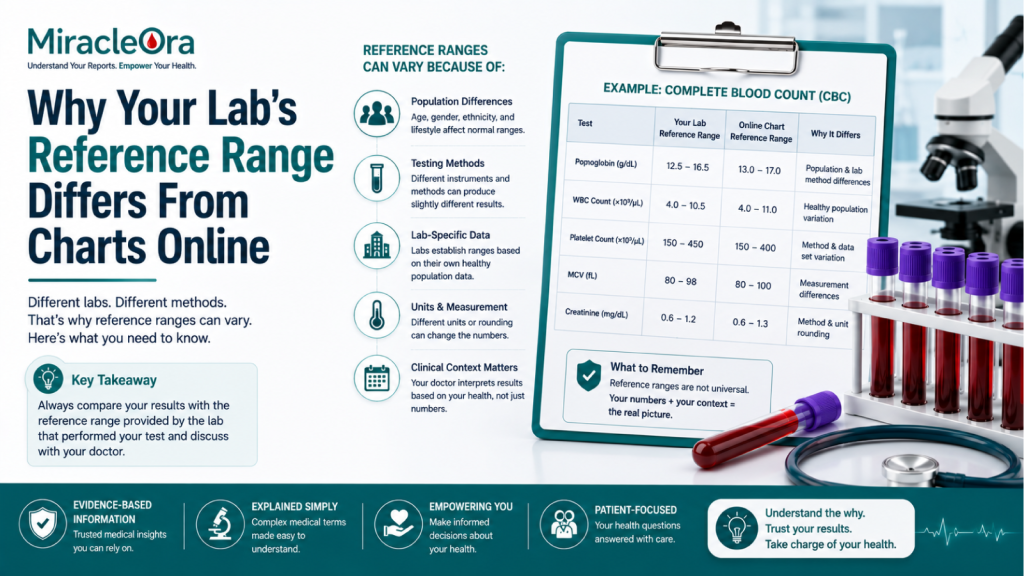
- It cannot be interpreted against a chart you found online. Compare your value only to the range printed on your own report, because a reference range belongs to the laboratory that produced it.
- It cannot tell you what your doctor is thinking. Only your doctor can.
What usually happens after the result
In practice, one of a small number of things:
- Nothing further, because the picture is consistent and unremarkable.
- A repeat count, often the single most informative next step, because it distinguishes a one-off from a trend.
- A look at the neighboring lines and previous results, reading the sheet as a set rather than a list.
- A targeted follow-up test aimed at a specific question the pattern raised.
- Monitoring over months, where the direction of travel is the information.
If your report has already arrived and you are reading it before your appointment, the calm way through it is our line-by-line walkthrough, how to read your CBC report.
When to see a doctor
Any blood count should be interpreted by a clinician who knows you. Contact your doctor promptly rather than waiting if:
- A result was reported to you as critical, or you were asked to act on it.
- You are being monitored for a known blood condition, are pregnant, are immunosuppressed or are receiving chemotherapy, since counts are judged against different thresholds in those situations.
- You have symptoms that prompted the test and they are getting worse.
- You have persistent unexplained tiredness, fever, night sweats, weight loss, unusual bruising, tiny red spots on the skin or bleeding that does not stop. Symptoms like these are assessed on their own merits, whatever the counts show.
Seek urgent care immediately for difficulty breathing, chest pain, confusion, fainting or uncontrolled bleeding.
Frequently asked questions
What does a CBC test check for?
It measures red blood cells and hemoglobin, white blood cells and their subtypes, and platelets, plus calculated indices describing red cell size and hemoglobin content. It is used to check general health, investigate symptoms, monitor known conditions and treatments, and assess someone before a procedure.
Is a CBC a diagnostic test?
Not on its own. It is primarily a screening and monitoring test. It narrows questions and points toward the next step rather than naming a condition.
Does a normal CBC mean I am healthy?
It is reassuring about the specific things the test measures. It does not exclude conditions that do not change blood counts, and it does not replace assessment of symptoms you actually have.
Why does my doctor keep ordering the same test?
Because the trend is the information. Repeated counts over time tell a clinician far more than any single result, especially when a condition or medication is being monitored.
Can a CBC be wrong?
Sample issues do occur, including clotting or platelet clumping in the collection tube, and laboratories have rules to detect and resolve them. That is one reason a repeat test is a common and unremarkable next step.
Should I ask for a CBC if I feel unwell?
Describe the symptoms and let your doctor choose the test. A blood count is sometimes the right first look and sometimes not, and choosing which question to ask is the clinical part.
Medical disclaimer: This article is provided by MiracleOra for general educational purposes only. It is not medical advice, diagnosis or treatment, and it does not interpret any individual person's results or explain why any individual test was ordered. Always discuss your results with a qualified healthcare professional who knows your medical history. If you have severe or worsening symptoms, seek urgent medical care. See our full Medical Disclaimer.