This article is general health education, not medical advice. It cannot interpret your specific result. See our Medical Disclaimer.
CBC Abbreviations Decoded: RBC, Hb, Hct, WBC, PLT and the Rest
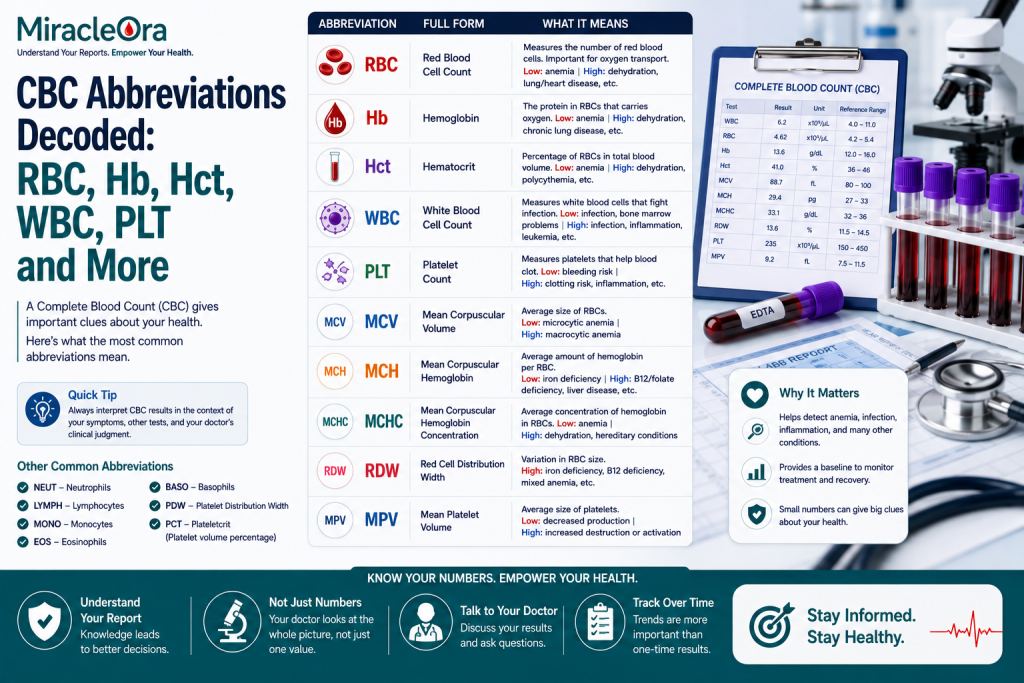
A complete blood count report is written in shorthand, and nobody explains the shorthand before handing it to you. This page is a decoder. Find your abbreviation, read what it measures, and move on. What a particular value means for you is a question for your doctor, because that answer depends on your history, your symptoms and the rest of your report.
Laboratories also spell these differently. Hemoglobin appears as Hgb, Hb or HB. White cells appear as WBC or TLC. None of that variation carries meaning; it is house style.
The red cell group
These lines are about oxygen-carrying capacity, and they usually move together.
| Abbreviation | Stands for | What it measures |
|---|---|---|
| RBC | Red blood cell count | How many red cells are in a measured volume of blood |
| Hgb, Hb, HB | Hemoglobin | The iron-rich protein inside red cells that actually carries the oxygen |
| Hct, PCV | Hematocrit, packed cell volume | The percentage of your blood made up of red cells by volume |
Cleveland Clinic and MedlinePlus describe all three as core components of the complete blood count. Hemoglobin is the number most people look at first, because it is the value used to identify anemia, a state in which the blood's oxygen-carrying capacity sits below the expected range. We take that number apart in is your hemoglobin low, and what it really means.
The red cell indices
These are calculated, not counted. They describe the size and hemoglobin content of your red cells, which is how doctors characterize an anemia rather than merely detect it.
| Abbreviation | Stands for | What it measures |
|---|---|---|
| MCV | Mean corpuscular volume | Average size of a red cell. Small is called microcytic, large is macrocytic |
| MCH | Mean corpuscular hemoglobin | Average amount of hemoglobin per red cell |
| MCHC | Mean corpuscular hemoglobin concentration | Hemoglobin concentration relative to cell volume |
| RDW, RDW-CV, RDW-SD | Red cell distribution width | How much your red cells vary in size from one another. CV and SD are two ways of expressing the same variation |
The indices are read as a set rather than one at a time. A raised RDW beside a normal MCV, for instance, describes a mixed population of cell sizes hiding behind an unremarkable average, and that combination is worth understanding on its own rather than as two separate flags.
The white cell group
| Abbreviation | Stands for | What it measures |
|---|---|---|
| WBC, TLC | White blood cell count, total leukocyte count | Total number of white cells, an overall marker of immune activity |
| NEUT, Neu | Neutrophils | The cell line that commonly rises with bacterial infection, inflammation and physical stress |
| LYMPH, Lym | Lymphocytes | Commonly associated with viral infections and immune responses |
| MONO | Monocytes | Can rise with certain infections and inflammatory conditions |
| EOS | Eosinophils | Often associated with allergic conditions and parasitic infections |
| BASO | Basophils | The smallest fraction, rarely raised alone |
| DLC | Differential leukocyte count | The name some reports give to the whole five-cell breakdown |
| ANC | Absolute neutrophil count | Neutrophils expressed as a number of cells, not a percentage |
Percent and absolute: the distinction most reports do not explain
Your differential usually appears twice: once as a percentage of total white cells, and once as an absolute count. These can move in opposite directions, and confusing them is the most common misreading of a blood count.
If your total white cell count falls while your neutrophil number stays the same, the neutrophil percentage rises even though nothing about your neutrophils changed. This is why clinicians generally work from the absolute numbers, such as the absolute neutrophil count, rather than from percentages. When you compare your report to anything, check which of the two columns you are reading. The relationship between the two most-watched lines is covered in high neutrophils and low lymphocytes.
Whether your report carries a differential at all depends on what was ordered, which we explain in CBC versus CBC with differential.
The platelet group
| Abbreviation | Stands for | What it measures |
|---|---|---|
| PLT | Platelet count | Number of platelets, the cell fragments involved in clotting |
| MPV | Mean platelet volume | Average platelet size |
| PDW | Platelet distribution width | How much platelet size varies |
| PCT | Plateletcrit | The proportion of blood volume occupied by platelets |
A low platelet count is called thrombocytopenia and a high one thrombocytosis. Both are descriptions, not diagnoses. Platelet numbers also move for reasons that have nothing to do with the body, including clumping inside the collection tube, which some analyzers read as a falsely low count. Where the platelet trend genuinely matters day to day, such as during an illness being monitored, doctors watch the direction of travel rather than any single reading.
Extras that appear on some reports
- nRBC, nucleated red blood cells: immature red cells that are not usually found in adult circulating blood.
- Retic, reticulocyte count: very young red cells, used to see how actively the marrow is producing them.
- ESR and CRP: not part of a CBC at all, but frequently ordered alongside it as general markers of inflammation.
- Comments or Remarks: free text from the laboratory, often noting a blood film review, a repeat, or a sample issue. Read this line. It is the only place a human wrote something specifically about your sample.
Units, and why the same value can look completely different
Units cause more false alarms than abbreviations do. The same platelet count is reported as 150,000/mcL by one laboratory and 150 x 10⁹/L by another. A reader comparing across those conventions concludes a thousandfold difference exists where none does.
Common conventions you will meet:
- g/dL or g/L for hemoglobin
- % or L/L for hematocrit
- /mcL, /µL, cells/mm³ or x 10⁹/L for cell counts
- fL for MCV and MPV, pg for MCH
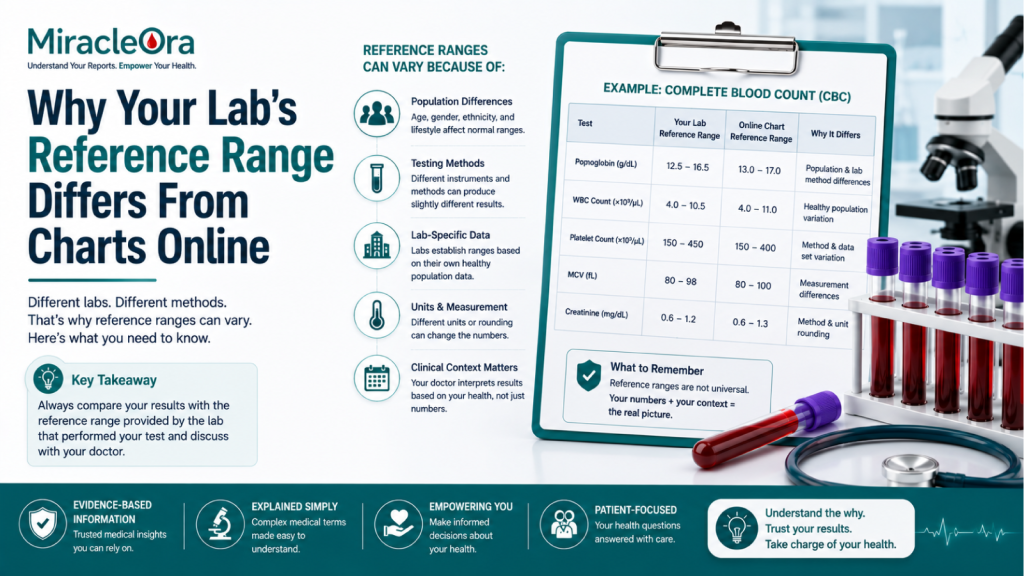
Before comparing any value to any chart, including ours, check that the units match. Then compare it to the range printed on your own report rather than to a generic chart, because a range belongs to the laboratory that produced it. Our own consolidated table of commonly cited adult values, with its sources and its limits stated, is at the complete CBC reference-range table.
When an abbreviation you do not recognize matters
Some situations are worth a call rather than a search:
- The laboratory printed a comment about your sample, a repeat test or a blood film review.
- A line is flagged as critical or panic, which is a different category from an ordinary high or low mark. The flag notation itself is explained in what an H or L flag means.
- An abbreviation appears that is not on this page and not on your lab's key.
- You are pregnant, receiving chemotherapy, immunosuppressed, or being monitored for a known blood condition, in which case counts are judged against different thresholds.
Seek urgent care for severe symptoms such as difficulty breathing, chest pain, confusion, fainting, uncontrolled bleeding, unexplained widespread bruising or tiny red spots on the skin, regardless of what any abbreviation on the report says.
Frequently asked questions
Is Hb the same as Hgb?
Yes. Hb, Hgb and HB are all hemoglobin. The spelling is house style and carries no difference in meaning.
What is the difference between WBC and TLC?
None. Total leukocyte count is another name for the white blood cell count. Reports in some regions favor TLC and DLC for the total and the differential.
Why does my differential show two numbers for each cell type?
One is the percentage of total white cells and one is the absolute count. Clinicians generally rely on the absolute numbers, because a percentage can change purely because the total changed.
Is MCHC the same as MCH?
No. MCH is the average amount of hemoglobin per red cell. MCHC is the concentration of hemoglobin relative to the cell's volume. They often move together but they answer different questions.
My report has RDW-CV and RDW-SD. Which one should I read?
Both describe variation in red cell size, expressed in two different ways. Which one a laboratory reports is a method choice. Compare each to the range printed beside it on your own report.
Which abbreviation tells me if I have an infection?
No single one does. White cell lines shift for many reasons, including stress, exercise and recovery from an illness, and a blood count alone cannot confirm or exclude infection. That is a clinical judgment made with your symptoms and examination.
Medical disclaimer: This article is provided by MiracleOra for general educational purposes only. It is not medical advice, diagnosis or treatment, and it does not interpret any individual person's results. Reference ranges vary by laboratory, age, sex and testing method. Always compare your results to the range printed on your own report and discuss what they mean with a qualified healthcare professional who knows your medical history. If you have severe or worsening symptoms, seek urgent medical care. See our full Medical Disclaimer.