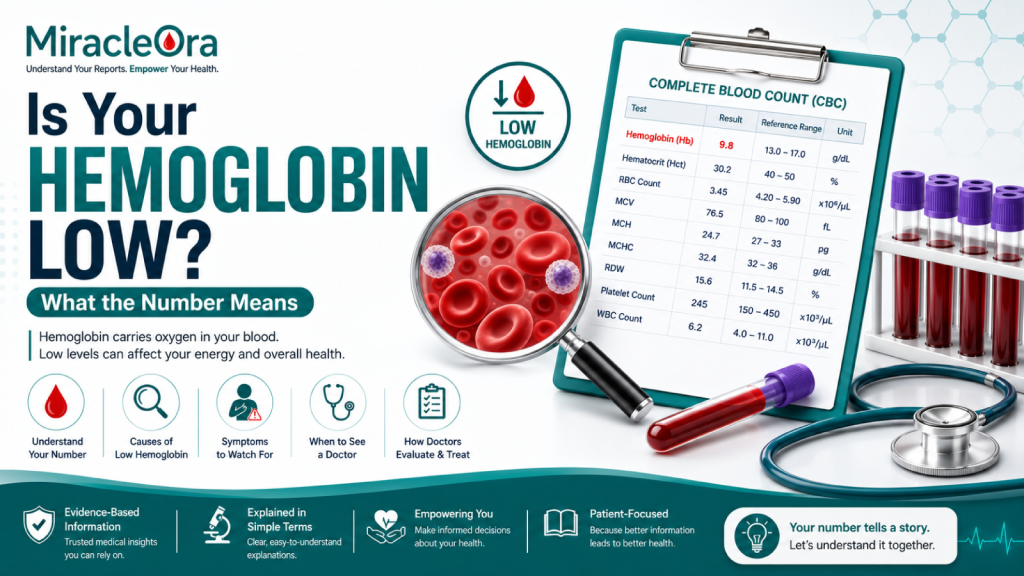
Hemoglobin is the protein in your red blood cells that carries oxygen from your lungs to the rest of your body. “Low” hemoglobin is not a single number that applies to everyone. It is measured against a reference range that changes with your sex, age, whether you are pregnant, the altitude you live at, and even the lab that ran your test. So a value that is low for one person can be normal for another. Whether a low reading matters depends on how low it is, how quickly it dropped, whether you have symptoms, and the underlying cause, which only your doctor can determine. This article explains how to read the number in context, not how to diagnose yourself.
This is general health education, not medical advice. It cannot tell you whether your result is a problem. Use your own lab’s reference range and talk to your doctor about your specific numbers.
What hemoglobin is and what “low” means
Every red blood cell is packed with hemoglobin, an iron-rich protein that binds oxygen and releases it to your tissues. When you have less hemoglobin than expected, your blood carries less oxygen, which is why very low levels can leave you tired or short of breath.
A low hemoglobin level is the main finding doctors use to identify anemia, which simply means your blood’s oxygen-carrying capacity is below the expected range for someone like you. Anemia is a description of a state, not a diagnosis on its own. The important question is always why the number is low, and that answer comes from your history, exam, and further tests, not from the hemoglobin value alone.
Normal ranges differ by group, so there is no universal cutoff
Because the “normal” range depends on who you are, the most useful reference points come from the World Health Organization, which in 2024 published its first major update to these thresholds since 1968. WHO defines anemia at or below the values in the table.
| Group | Hemoglobin below this suggests anemia (WHO) |
|---|---|
| Non-pregnant women (15+ years) | 12.0 g/dL |
| Men (15+ years) | 13.0 g/dL |
| Pregnant, 1st and 3rd trimester | 11.0 g/dL |
| Pregnant, 2nd trimester | 10.5 g/dL |
| Children 12 to 14 years | 12.0 g/dL |
| Children 5 to 11 years | 11.5 g/dL |
| Children 6 months to under 5 years | 10.5 g/dL |
Source: World Health Organization, Guideline on haemoglobin cutoffs to define anaemia in individuals and populations (2024).
Two things about this table matter. First, the thresholds move with sex, age, and pregnancy, which is exactly why a value like 11.5 can be normal for a young child and below range for an adult man. Second, your own lab report prints its own reference range next to your result, and that range can differ slightly from WHO figures because of the equipment and population the lab uses. Living at high altitude also shifts normal ranges upward, since the body makes more hemoglobin to cope with thinner air. Read the range your report gives you, not a number you saw online.
“My hemoglobin is 10 or 11, how concerned should I be?”
This is the question most people actually arrive with, and the honest answer is that the number alone does not settle it. A reading modestly below the reference range is common and is usually something a doctor investigates in an unhurried way rather than an emergency. What changes the picture is context:
- How far below range the value sits. A result just under the cutoff is read differently from one that is far below it.
- How fast it dropped. A slow decline over months often causes fewer symptoms than a sudden fall, because the body adapts.
- Your symptoms. Two people with the same number can feel completely different.
- The likely cause. Iron deficiency, recent blood loss, and a long-term condition are managed very differently.
That is the reasoning your doctor works through. It is also why “is hemoglobin low” is better treated as the start of a conversation than as a verdict you can reach from the number.
Read hemoglobin together with MCV and RDW, not on its own
A single hemoglobin value tells you less than the pattern around it. Your complete blood count (CBC) reports several other markers that give the low number meaning. Two of the most useful are MCV (mean corpuscular volume, the average size of your red blood cells) and RDW (red cell distribution width, how much your cell sizes vary).
Doctors read these together. Small red cells often point in a different direction than large ones, and a raised RDW can appear early when cell production is changing. A low hemoglobin with small cells suggests one set of possibilities, while a low hemoglobin with large cells suggests another. This is why a lab report is a pattern to interpret, not a row of pass or fail lines.
If you want to understand your full report, our guide on how to read a CBC report walks through each value in plain language, and our explainer on a high RDW with a normal MCV covers one of the more confusing combinations people ask about.
Common reasons hemoglobin runs low
The causes below are the broad categories doctors consider. This is educational context, not a way to decide which one applies to you.
- Iron deficiency. The most common worldwide cause. Iron is a building block of hemoglobin, so low iron stores mean less hemoglobin. It can follow blood loss, low dietary intake, or poor absorption.
- Vitamin B12 or folate deficiency. Both vitamins are needed to make healthy red blood cells; a shortfall can reduce hemoglobin and tends to produce larger cells.
- Blood loss. This can be obvious, such as heavy menstrual periods or an injury, or slow and hidden, such as bleeding in the digestive tract.
- Long-term (chronic) conditions. Ongoing kidney disease, inflammation, and some chronic illnesses can lower hemoglobin over time.
- Reduced or abnormal red cell production. Problems in the bone marrow, and some inherited conditions that affect hemoglobin itself, fall into this group.
- Red cells breaking down too quickly. In some conditions the body destroys red blood cells faster than it replaces them.
Because these causes are treated in completely different ways, identifying the right one is the whole point of the workup. Your doctor may order further blood tests to sort between them.
Symptoms and situations that warrant medical review
Low hemoglobin can be silent, especially when it develops slowly. When symptoms do appear, commonly reported ones include:
- Tiredness and weakness
- Shortness of breath, especially on exertion
- Dizziness or lightheadedness
- Pale skin
- A fast or pounding heartbeat
- Headaches or trouble concentrating
Book a non-urgent appointment if you have a low result on a report, if you notice these symptoms, or if you have ongoing heavy periods or any sign of bleeding.
Seek urgent or emergency care if you have chest pain, severe or sudden shortness of breath, fainting or near-fainting, a very fast or irregular heartbeat, or signs of significant bleeding such as vomiting blood or black, tarry stools. These can indicate that hemoglobin has dropped sharply or that something serious is causing it, and they should not wait.
The part most pages skip: the cause matters more than the number
Three honest points rarely make it into articles about low hemoglobin.
A slightly low value is common and often manageable. For many people, a mildly low reading turns out to have a straightforward, treatable explanation. It is a prompt to investigate, not usually a crisis. Panic does not improve the number.
Do not start iron supplements on your own to “fix” a low reading. Taking iron without knowing the cause can be the wrong move in two ways. If iron deficiency is not the reason, the supplements will not help and can cause side effects or, rarely, iron overload. Just as important, self-treating can mask a low hemoglobin that a doctor needed to see clearly in order to find the real cause, including causes that matter to catch early. Let the diagnosis come first.
The cause outranks the number. Two people can share the exact same hemoglobin value and need entirely different care, because one has simple iron deficiency and the other has bleeding that needs to be found. This is why chasing a single number, or comparing yours to a friend’s, is less useful than getting the reason identified. Your doctor treats the cause, and the number tends to follow.
If your report also shows changes in your white cells, our explainer on neutrophils versus lymphocytes explains what that part of the count describes, since a full picture reads several sections together.
Frequently asked questions
Is a hemoglobin of 11 low?
It depends entirely on who you are. Using WHO reference points, 11 g/dL is below the range for an adult man (below 13) and a non-pregnant woman (below 12), but it is at the threshold used in the first and third trimesters of pregnancy and can be normal for some children. Compare your result to your own lab’s reference range and discuss it with your doctor rather than judging the number alone.
Can low hemoglobin be normal for me?
Your report can read slightly below a generic online cutoff yet still be interpreted in context by your doctor, who considers your baseline, your sex and age, pregnancy, altitude, and previous results. This is why a value that looks low next to one reference may be read differently for you. Only your doctor can say whether your specific result is expected or needs follow-up.
Does a low hemoglobin always mean I have anemia?
A hemoglobin below the reference range is how anemia is identified, but anemia is a state, not a final diagnosis. The next step is finding out why the level is low, which determines what, if anything, needs treatment.
Should I take iron if my hemoglobin is low?
Not on your own initiative. Iron only helps if iron deficiency is the cause, and taking it blindly can cause side effects and hide the true reason from your doctor. Ask your doctor to identify the cause first, then follow their guidance.
How is the cause of low hemoglobin found?
Doctors combine your history and examination with the rest of your CBC, often reading hemoglobin alongside MCV and RDW, and may add further blood tests. The goal is to identify the underlying reason so it can be addressed directly.
Medical disclaimer: This content is for general education only and is not a substitute for professional medical advice, diagnosis, or treatment. It cannot interpret your individual results. Always talk to a qualified healthcare provider about your own hemoglobin level and symptoms, and seek urgent care for the emergency symptoms described above. See our full Medical Disclaimer.