This article is general health education, not medical advice. It cannot interpret your specific result. See our Medical Disclaimer.
What Does an "H" or "L" Flag on Your Blood Test Mean?
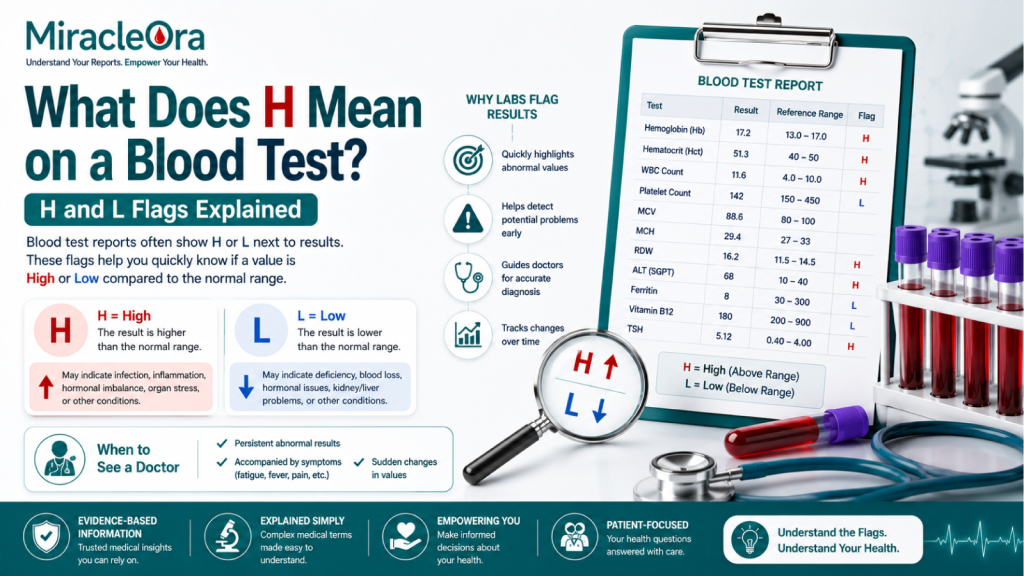
Short answer: an H next to a result means the value is higher than the reference range your laboratory prints on that report. An L means it is lower. That is the whole of what the letter tells you. It does not tell you why the value moved, whether it matters, or whether anything is wrong with you. The flag is placed automatically by the analyzer or the lab's software, by comparing your number to a band. A doctor who knows your history is the only person who can say what it means for you.
Most people meet these letters at the worst possible moment: alone, holding a printout, before any appointment. So it is worth slowing down on what the mark actually is.
Every mark you may see on the page
Lab report notation is not standardized. Two labs in the same city can use different symbols for the same idea. These are the conventions you are most likely to meet:
| Mark | Usual meaning |
|---|---|
| H | High: above the upper limit of that lab's reference range |
| L | Low: below the lower limit of that lab's reference range |
| A | Abnormal: outside the range, without saying which direction |
| HH, LL, C, !, "critical", "panic" | A value far enough outside the range that the lab telephones the ordering doctor rather than waiting for the report to be read |
| WNL or no mark at all | Within normal limits |
| * or an arrow (↑ ↓) | Some labs use these instead of letters; the arrow direction carries the meaning |
The Labcorp patient glossary and similar lab documents describe the same basic scheme, and this variation between providers is exactly why the key is printed somewhere on your own report, usually in small type at the bottom of the page. Read that key before you read anything on the internet, including this page.
One notation deserves separating out. A critical or panic flag is a different category from an ordinary H or L. Laboratories maintain a short list of values that trigger an immediate phone call to the doctor who ordered the test. If your result had been in that category, you would generally have heard from a clinician already rather than discovering it on a portal. An ordinary H or L carries no such urgency built into it.
Who puts the flag there, and why it is automatic
No one read your report and decided you were abnormal. In a modern laboratory, a hematology analyzer counts and sizes your cells, the result is compared against a stored reference interval for your age and sex, and the software prints a letter whenever the number sits outside the band. The step is arithmetic. It happens identically for a marathon runner, a person with a cold, and a person who is unwell, because at that moment the machine knows nothing about any of them.
That is a relief rather than a criticism of the process. It means the flag is a sorting mark that tells your doctor where to look first, not an opinion about your health. The interpretation step, the one that involves your symptoms, your history, your medications and often a repeat test, happens afterward and involves a person.
Why a perfectly healthy person can be flagged
This is the part most pages leave out, and it is the single most useful idea on this page.
A reference range is not a boundary between health and disease. It is a statistical interval built from a group of apparently healthy people, conventionally set to cover about 95 percent of them. The consequence is built into the arithmetic: roughly one healthy person in twenty will fall outside the range on any given measurement, with nothing wrong at all. Run enough separate tests on one healthy person and the odds that every single line lands inside its band become small.
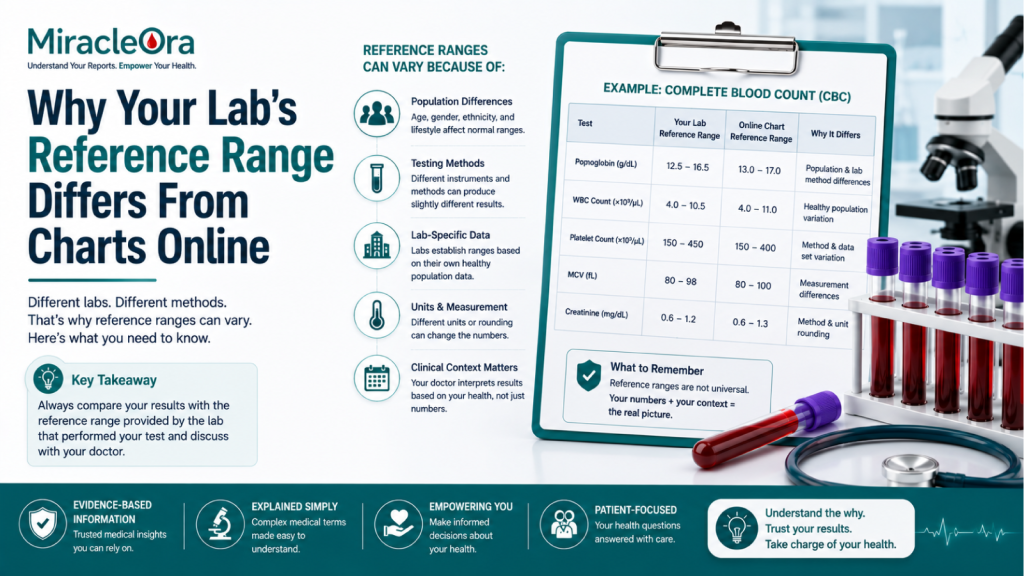
MedlinePlus, the patient education service of the U.S. National Library of Medicine, states the practical version of this directly: an abnormal level does not always mean you have a medical condition that needs treatment, and diet, activity level, medicines, having a menstrual period, and not drinking enough water can all affect results. Cleveland Clinic makes the related point that normal ranges vary with the laboratory performing the test and with your age.
So a single H sitting a little past the edge of a range, on a report where everything else is unremarkable, is a weak signal on its own. We look at why that happens in more depth in blood test abnormal but you feel fine, and at why the range itself moves from lab to lab in why your lab's reference range differs from charts online.
Everyday things that move a blood count across the line
A CBC measures cells, and cell counts respond to ordinary life. Widely described influences include:
- Hydration at the moment of the draw. Blood is mostly plasma. Less plasma concentrates everything measured against it, which can nudge hemoglobin and hematocrit upward; more plasma dilutes them.
- Recent physical exertion or acute stress. White cell counts, especially neutrophils, commonly rise temporarily.
- A recent infection, or recovery from one. White cell lines can stay shifted for a while after you feel better.
- Menstruation and pregnancy. Both change the red cell picture in expected ways. Pregnancy in particular has its own reference ranges.
- Medications. A number of common drug classes affect white cells or platelets.
- Which lab, and which machine. Two laboratories analyzing the same sample can report slightly different numbers and compare them to different bands.
None of these is a reason to dismiss a flag. They are reasons that a flag needs a person to interpret it rather than a search engine.
What a flag does genuinely change
It changes the conversation, not the diagnosis. In practice a flagged line usually leads to one of a small number of next steps, chosen by your doctor:
- Nothing at all, because the value is marginal and the clinical picture is clear.
- A repeat test, often the most informative option, because doctors read the trend across results far more confidently than any single snapshot.
- A look at the neighboring lines. Blood values are read as a set. A low hemoglobin is interpreted very differently depending on what MCV and RDW are doing beside it, which is the whole reason high RDW with a normal MCV is worth understanding as a pattern rather than as two separate flags.
- An additional test aimed at a specific question raised by the pattern.
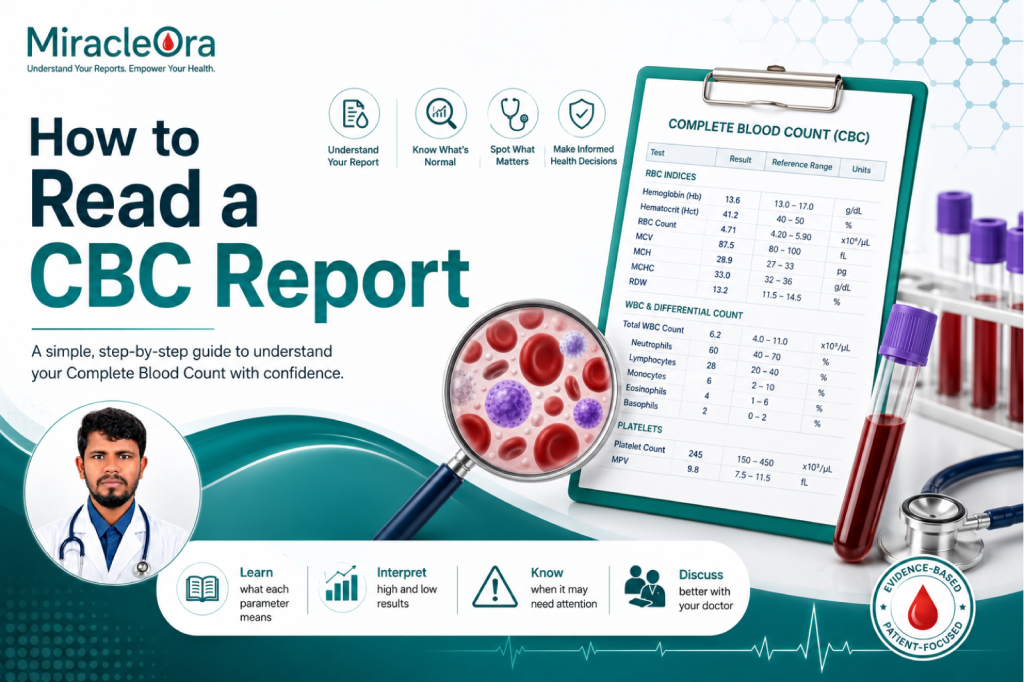
If you want to see the whole report in context rather than one line, start with our plain-language walkthrough, how to read your CBC report, and keep the complete reference-range table beside it for scale.
When a flagged result does need prompt attention
Most H and L marks are not emergencies. Some situations do warrant contacting your doctor promptly, and the following general list is not a substitute for clinical judgment:
- Any result your doctor or the laboratory has specifically told you to watch or act on, or any result reported to you as critical.
- A very low hemoglobin alongside chest pain, breathlessness, fainting or a racing heart.
- A markedly low or falling platelet count alongside unexplained bruising, tiny red spots on the skin, or bleeding that will not stop.
- A very high or very low white cell count alongside high fever or severe illness.
- Any severe symptom, including difficulty breathing, chest pain, confusion or uncontrolled bleeding, regardless of what the numbers say. That is a reason to seek urgent care immediately.
If you are unsure, call your doctor and describe both the flagged value and how you feel. That pairing, not the sheet alone, is what real decisions are made from.
Frequently asked questions
Does an H mean my result is dangerous?
No. It means the value is above your laboratory's reference range. Reference ranges are statistical intervals covering about 95 percent of a healthy reference group, so being outside one is common and often unimportant. Severity is a clinical judgment your doctor makes using your history and symptoms, not something the letter conveys.
Is L worse than H?
Neither letter carries a severity. L simply means below the range and H means above it. For some measurements the low direction prompts more follow-up, for others the high direction does, and for many the answer depends entirely on the rest of the panel.
Why do only some of my values have flags?
Because only those values fell outside their bands. Everything unmarked sat inside the range your lab uses for that test.
My value is flagged but the number looks close to the range. Does that matter?
How far outside a value sits is part of what a doctor weighs, along with the direction, the trend across previous tests and the neighboring results. A value a fraction past the edge and a value far outside the range are read very differently, but that reading is a clinical judgment rather than something you can do from the sheet.
My report uses arrows instead of letters. Is that different?
No. Some laboratories print an up or down arrow, an asterisk, or the letter A instead of H and L. The key printed on your own report tells you which convention it uses.
Should I compare my flagged value to a chart I found online?
Compare it to the range printed on your own report. That is the range your result was actually judged against, and generic charts are one of the most common reasons people worry over a value their own lab would read as unremarkable.
Medical disclaimer: This article is provided by MiracleOra for general educational purposes only. It is not medical advice, diagnosis or treatment, and it does not interpret any individual person's results. Reference ranges vary by laboratory, age, sex and testing method. Always compare your results to the range printed on your own report and discuss what they mean with a qualified healthcare professional who knows your medical history. If you have severe or worsening symptoms, seek urgent medical care. See our full Medical Disclaimer.