This article is general health education, not medical advice. It cannot interpret your specific result. See our Medical Disclaimer.
CBC vs CBC With Differential: What Is the Difference?
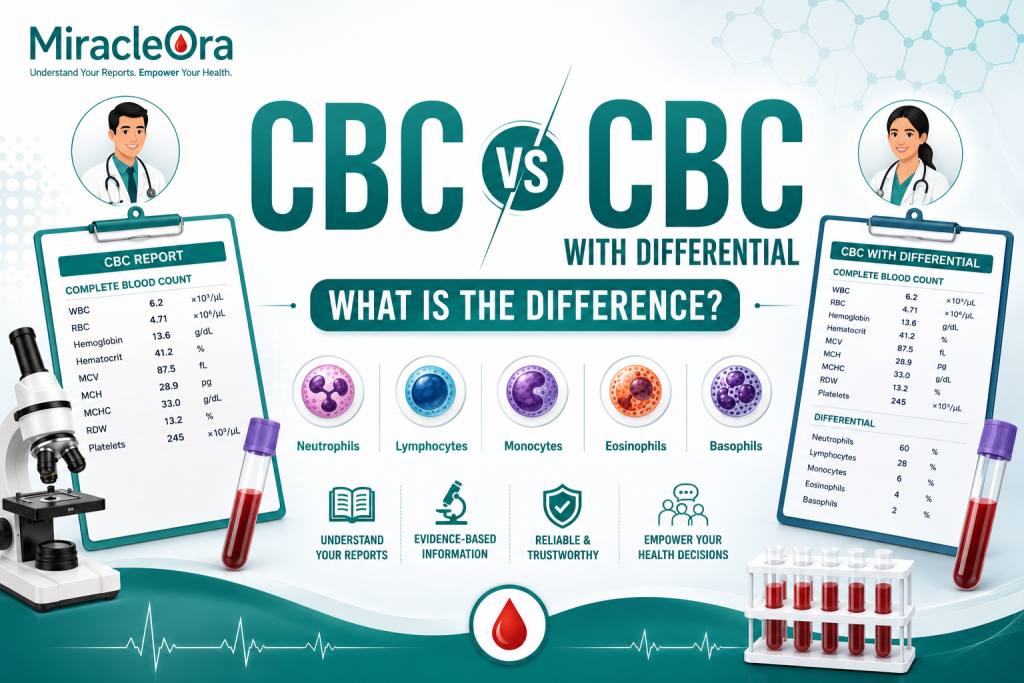
Short answer: it is the same blood draw, from the same tube, run on the same analyzer. A plain complete blood count reports your total white blood cell number. A CBC with differential additionally breaks that total into the five types of white cell and reports each one. Nothing extra was taken from you, and in most settings the differential is a routine ordering default rather than a sign that anything specific is suspected.
That last point is what people are usually asking. The phrase sounds like an escalation. It generally is not.
What a plain CBC reports
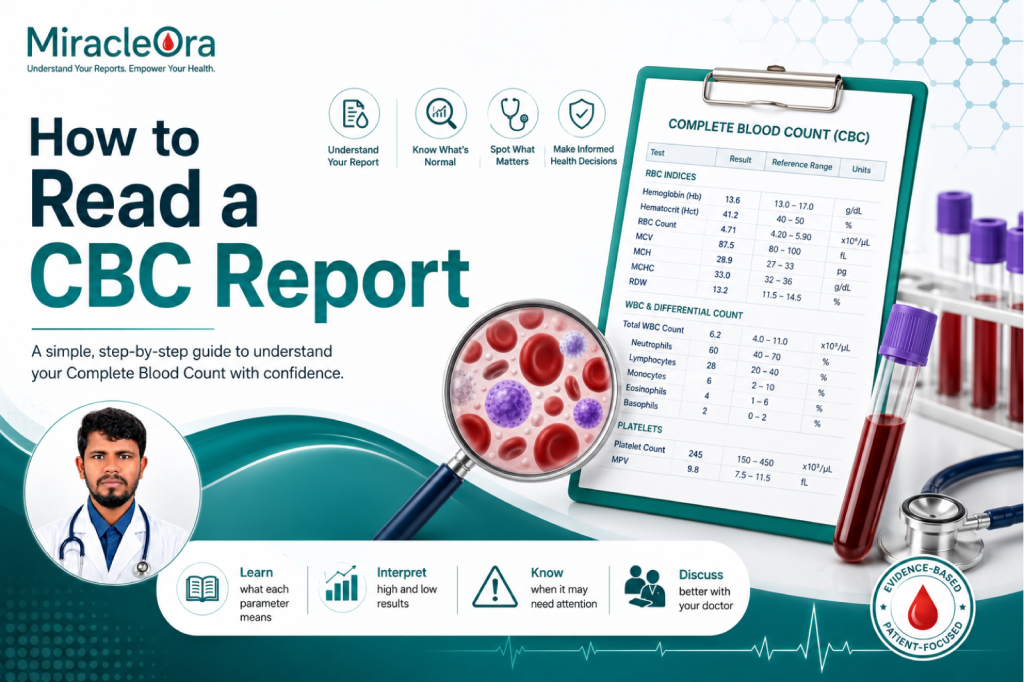
A complete blood count measures three families of cells: red cells, white cells and platelets. On a report without a differential you will typically see the red cell group (RBC, hemoglobin, hematocrit), the calculated red cell indices (MCV, MCH, MCHC, RDW), a single white blood cell number, and the platelet count. Each abbreviation is decoded line by line in CBC abbreviations decoded.
That single white cell number is an overall marker of immune activity. It tells you the size of the workforce. It does not tell you who is in it.
What the differential adds
The differential answers that second question. It reports the five white cell lines, and typically reports each one twice, as a percentage of the total and as an absolute count:
| Cell line | Broadly associated with |
|---|---|
| Neutrophils | Bacterial infection, inflammation and physical stress |
| Lymphocytes | Viral infections and immune responses |
| Monocytes | Certain infections and inflammatory conditions |
| Eosinophils | Allergic conditions and parasitic infections |
| Basophils | The smallest fraction, rarely raised on its own |
Many reports also carry the absolute neutrophil count, or ANC, which is the neutrophil number expressed as cells rather than as a share. The National Cancer Institute's dictionary describes the differential in the same terms: a measurement of the numbers of the different types of white blood cells within the total.
The percentage-versus-absolute distinction matters more than almost anything else on the page. If the total white cell count falls while the neutrophil number holds steady, the neutrophil percentage rises even though the neutrophils did nothing. That is why clinicians generally work from the absolute counts. We take the two most-watched lines apart in high neutrophils and low lymphocytes.
Does "with differential" mean something is suspected?
Usually not. There are several ordinary reasons the words appear on your report:
- It is the standing default. Many clinics, hospitals and laboratory order sets include the differential in their routine complete blood count, so the choice was made by a protocol rather than about you.
- It is part of a bundled panel. Where a CBC is ordered inside a broader panel, the differential often travels with it.
- The reason is generic. Fatigue, fever, a pre-operative check, a routine annual review and chronic-condition monitoring are all common contexts.
- The analyzer produced it anyway. Modern hematology analyzers generate the five-part differential as part of their normal run. Whether it is reported can be a reporting decision rather than an extra procedure.
Published health-services work has looked at how often the differential is ordered when it does not change a clinical decision, and found substantial routine ordering in general practice settings. That is an argument about efficiency, not about you. If you want to know why the blood count was ordered in the first place, that is the subject of what a CBC test is actually for.
Automated and manual differentials, and what a blood film comment means
Here is the part almost nobody explains, and it is the one that generates the most unnecessary worry.
The five-part differential is normally produced automatically by the analyzer. Laboratories set rules that flag certain results for a human to look at a stained slide under a microscope. That is called a manual differential, or a peripheral blood film review.
If your report carries a comment such as "smear reviewed", "film examined" or "manual differential performed", that is a quality step working as designed. Common triggers include a count outside a preset threshold, an unusual size distribution, a suspected clumping artifact in the tube, or the analyzer being unable to classify some cells confidently. A human looking at your slide is a routine part of laboratory practice, not evidence that something was found.
A manual review can also add descriptive observations about cell appearance that an analyzer does not produce. Those descriptions are written for your doctor, in vocabulary that is not meant to be read cold, and are best taken to the appointment rather than to a search engine.
Why doctors order one rather than the other
In broad terms, and this is a description of practice rather than a rule you can apply to yourself:
- A plain CBC suits routine monitoring in a stable situation, where the question is simply whether the main counts have moved.
- A CBC with differential suits situations where the white cell picture itself is the question, including suspected infection, monitoring of certain treatments, or following up an earlier abnormal count.
Both start from the same sample. Adding the differential does not require a second draw, and it does not delay the red cell or platelet results in any way you would notice.
What the differential cannot do
Set expectations honestly, because this is where over-reading starts:
- It cannot confirm or exclude an infection. The lines shift with stress, exercise, recent illness, pregnancy and several medications. A count is one input among many.
- It cannot reliably separate bacterial from viral illness on its own. The associations in the table above are tendencies across populations, not a decision rule for an individual.
- It cannot diagnose any condition by itself. No blood count can. It narrows questions; your doctor answers them using your history and examination.
- It cannot be read one line at a time. The pattern across the lines, and the trend across successive tests, carries the information. Our line-by-line walkthrough, how to read your CBC report, takes the whole sheet in order.
When to talk to your doctor
Contact your doctor promptly rather than waiting if:
- A value was reported to you as critical, or the laboratory or clinic asked you to act on it.
- Your report carries a laboratory comment you do not understand.
- Counts are markedly outside the range printed on your own report, rather than sitting near an edge. The flag notation itself is explained in what an H or L flag means.
- You are pregnant, immunosuppressed, receiving chemotherapy or being monitored for a known blood condition, since those situations use different thresholds.
Seek urgent care for high fever with severe illness, difficulty breathing, chest pain, confusion, fainting, uncontrolled bleeding or unexplained widespread bruising, whatever the counts show.
Frequently asked questions
Is a CBC with differential a more serious test?
No. It is the same sample with the white cells reported in five categories instead of one total. In many clinics it is the routine default.
Did they need extra blood for the differential?
No. It comes from the same tube and the same run.
Why does my report show percentages and absolute numbers for the same cell?
The percentage is the share of the total white count; the absolute number is the count itself. They can move independently, and clinicians generally rely on the absolute numbers.
What does it mean if my report says a smear or film was reviewed?
That a person examined a stained slide from your sample under a microscope, usually because a laboratory rule triggered a check. It is a standard quality step and is not by itself a finding.
Can the differential tell me whether my infection is bacterial or viral?
Not on its own. Certain patterns are broadly associated with each, but the overlap is wide and many non-infectious factors move the same lines. That judgment is clinical.
My doctor ordered a CBC without differential. Should I ask for the differential?
Ask what the test is meant to answer rather than asking for a specific add-on. If the question is about the total counts and the trend, the plain version may be exactly right.
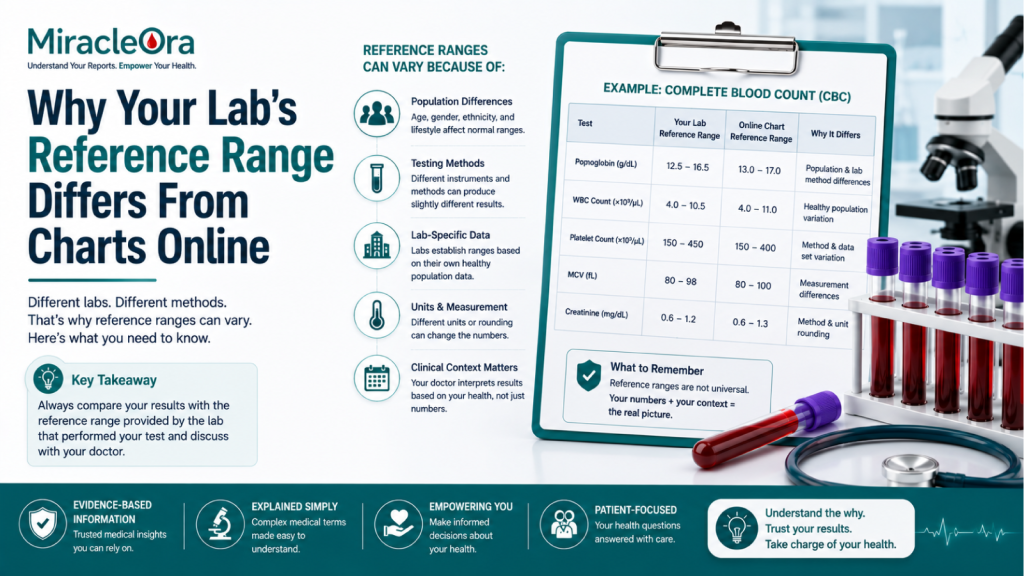
Medical disclaimer: This article is provided by MiracleOra for general educational purposes only. It is not medical advice, diagnosis or treatment, and it does not interpret any individual person's results. Reference ranges vary by laboratory, age, sex and testing method. Always compare your results to the range printed on your own report and discuss what they mean with a qualified healthcare professional who knows your medical history. If you have severe or worsening symptoms, seek urgent medical care. See our full Medical Disclaimer.