The short answer: there is no single platelet transfusion threshold that applies to everyone. The current international guideline, published in 2025 by AABB and the International Collaboration for Transfusion Medicine Guidelines (ICTMG), sets different numbers for different situations, and in some situations, including dengue without major bleeding, it recommends against transfusion altogether. A transfusion is a decision made by the treating team at the bedside, weighing the count, bleeding, the cause of the low count and any planned procedure. This page explains how that decision is framed. It is not a guide for deciding anything at home.
First: the signs that need care now
A platelet count on paper is never a reason to wait out a bleeding emergency.
The National Heart, Lung, and Blood Institute (NHLBI) states on its thrombocytopenia page (last updated February 18, 2025, read on September 25, 2026): "Call 9-1-1 to seek immediate medical care if you have bleeding that does not stop when you apply pressure." NHLBI lists bleeding signs that go with a low platelet count, including prolonged bleeding from small cuts, tiny red spots called petechiae, larger purple patches called purpura, nosebleeds or bleeding gums, blood in urine or stool, and heavy menstrual bleeding.
If someone with a known low count has bleeding that will not stop, blood in vomit or stool, a severe headache, or confusion, the right place is an emergency department or the care team's urgent line, not a search engine. Whether a transfusion is part of what happens next is the team's decision.
What a platelet transfusion is for
Platelets are the blood cells that help seal small breaks in blood vessels. A platelet transfusion gives a person donated platelets through a vein.
NHLBI describes the purpose on its platelet disorder treatment page (last updated March 24, 2022, read on September 25, 2026): "This procedure is used to quickly increase your platelet count when you are having serious bleeding." Transfusions are also given in some situations before bleeding happens, called prophylactic transfusion, for example in some people receiving chemotherapy or before certain procedures. The threshold question is mostly about those preventive transfusions.
A transfusion is not a cure. It raises the count for a while. It does not fix the reason the count fell, which is why the clinician's attention stays on the cause.
What the 2025 AABB and ICTMG guideline says
The guideline is "Platelet Transfusion: 2025 AABB and ICTMG International Clinical Practice Guidelines," by Metcalf, Nahirniak, Guyatt and colleagues, published in JAMA (published online May 29, 2025, read on September 25, 2026). Its abstract states that the panel applied the GRADE method to "21 randomized trials and 13 observational studies," and found that restrictive strategies, meaning fewer transfusions at lower counts, "probably did not cause increases in mortality or bleeding relative to liberal strategies across predefined clinical populations."
Its conclusion reads: "A consistent pattern of evidence supports the implementation of restrictive platelet transfusion strategies," which "reduce risk of adverse reactions, mitigate platelet shortages, and reduce costs."
AABB's own announcement (May 29, 2025, read on September 25, 2026) lists the recommendations it describes as strong. The counts are written the way the guideline writes them; 10 × 10³/µL is the same as 10,000 platelets per microliter.
| Situation named in the guideline | What the guideline says |
|---|---|
| Nonbleeding patients with low platelet production receiving chemotherapy or a stem cell transplant from a donor | Transfuse when the count is below 10 × 10³/µL |
| Newborns with platelet consumption and no major bleeding | Transfuse when the count is below 25 × 10³/µL |
| Before a lumbar puncture | Transfuse when the count is below 20 × 10³/µL |
| Dengue with low platelets and no major bleeding | Platelet transfusion is not recommended |
The guideline also includes further recommendations for other settings, such as some procedures and some critically ill adults, several of them graded on lower-certainty evidence. Those are written for the teams who manage those situations, and this page does not reproduce them.
The lead author, Ryan Metcalf, is quoted in the AABB announcement: "It is good practice to consider overall clinical context and alternative therapies in the decision to perform platelet transfusion." That sentence is the key to reading every number in the table.
Why a platelet transfusion threshold is not an alarm line
This is where most pages on the topic stop short, and where most worry comes from.
A threshold in a guideline is a decision aid for a clinician looking after a specific kind of patient. It is not a point on the scale where a reader should expect a transfusion, and it is not a line below which someone is automatically in danger. The same count can call for different decisions depending on:
- Whether there is active bleeding. NHLBI describes transfusion as a way to raise the count quickly during serious bleeding. A stable person with no bleeding is a different situation.
- Why the count is low. The guideline treats low production, as in chemotherapy, differently from platelet consumption, as in dengue.
- Whether a procedure is planned. Different procedures carry different bleeding risks, so the guideline gives them different numbers.
- Other conditions. NHLBI notes that in heparin-induced thrombocytopenia (HIT), "a platelet transfusion can raise your risk of forming blood clots." A transfusion is not a neutral top-up.
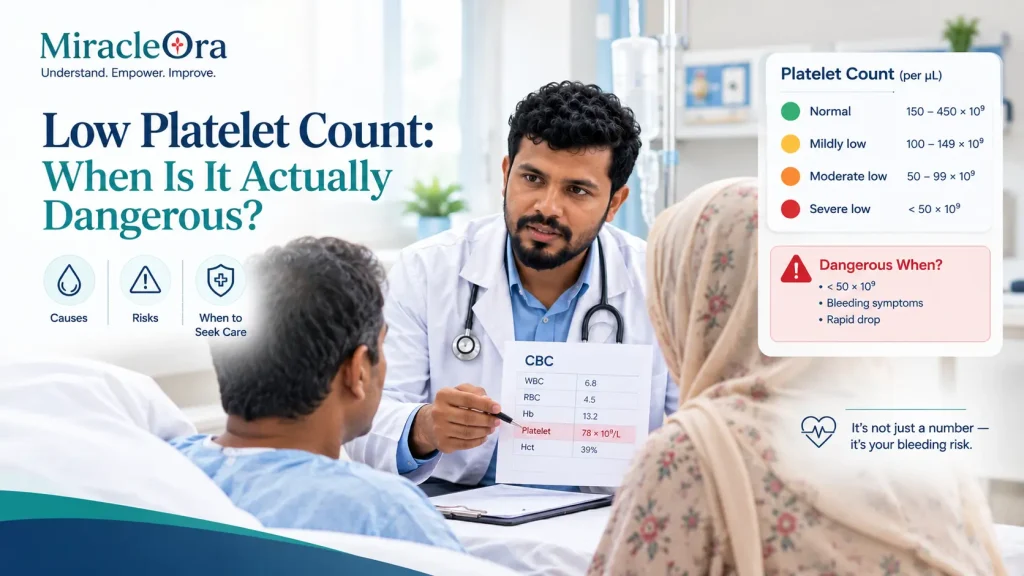
NHLBI also states that "You may not have serious bleeding until your platelet count is very low." That is part of why the guideline's preventive numbers are low. For how clinicians think about low counts outside the transfusion setting, low platelet count: when is it actually dangerous walks through the same question more broadly.
The lab's reference interval is a separate idea again. NHLBI gives an adult range of 150,000 to 450,000 platelets per microliter, but each lab sets its own interval, so the one printed on your report applies to you. Why your lab's reference range differs from charts online explains why. A count below the reference interval is flagged low long before any transfusion question arises.
The dengue question, specifically
In dengue season in Bangladesh and across South Asia, families often ask for platelets as soon as the count falls. It is an understandable request, made out of love and fear.
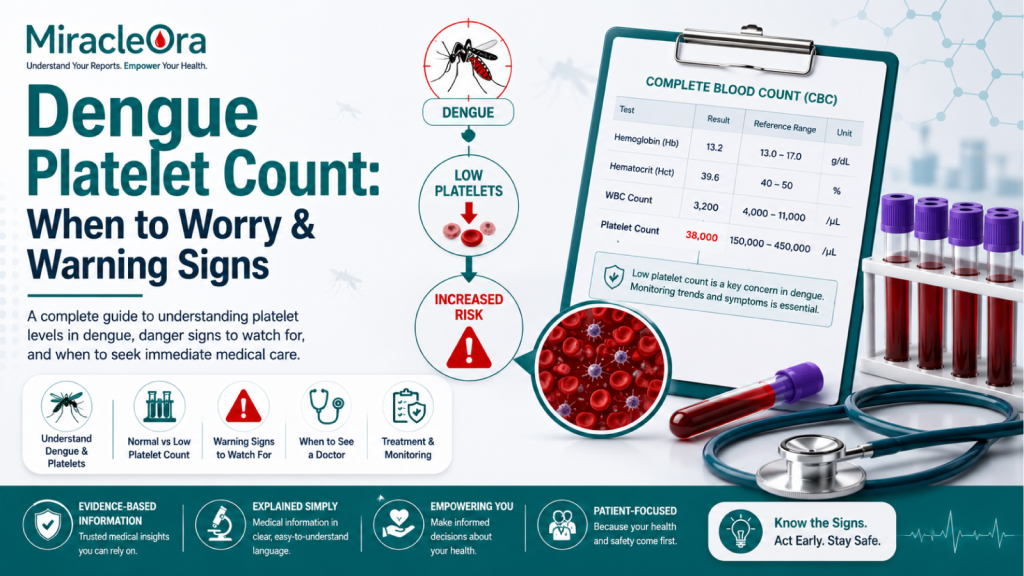
The 2025 guideline addresses it directly. Its abstract lists, among its key recommendations, "not recommending transfusion for Dengue-related thrombocytopenia without major bleeding," and AABB lists this among the recommendations it calls strong. The concern in dengue is the whole clinical picture, including the warning signs, fluid status and bleeding, rather than the platelet number alone. What those warning signs are, and why a falling count on its own is not the deciding factor, is covered in dengue platelet count: when to worry and the warning signs.
If the treating team decides against a transfusion in dengue, that is in line with the current international guideline. If they decide in favor, for example because of major bleeding, that is also within it. The decision is theirs, and asking them to explain it is always reasonable.
Transfusions carry their own risks
The guideline's case for fewer transfusions rests partly on risk. NHLBI lists possible complications of platelet transfusion as "risk of infectious disease, allergic reaction, and difficulty with future transfusions." Donated platelets are also a limited resource; AABB's announcement quotes its Chief Medical Officer, Claudia Cohn, saying the guidelines "prioritize patient safety and help conserve the limited platelet inventory."
None of this means a transfusion is a bad thing. When the treating team judges one necessary, it can be important care. It means the decision involves trade-offs, and those trade-offs are why the number alone does not decide.
Questions worth asking the care team
If a platelet transfusion is being discussed for you or someone you love, these questions can help the conversation:
- What is the transfusion meant to do in this situation: stop bleeding, prevent bleeding, or prepare for a procedure?
- What is causing the low count, and what is being done about the cause?
- What count, symptoms or events would change the plan?
- What reactions should we watch for during and after the transfusion?
- If a transfusion is not planned, what would make the team reconsider?
These questions are for understanding the plan. They are not a way to decide it. The clinicians caring for the patient hold that decision.
The honest limits of this page
A laboratory report should not create fear. It should create understanding. This page can explain how a guideline frames platelet transfusion and why the numbers in it are not alarm lines. It cannot say whether anyone needs a transfusion, and nothing here should be read as a reason to ask for or refuse one. That judgment belongs to the team that can examine the patient, see the whole report and follow the trend.
Frequently asked questions
At what platelet count is a transfusion given?
It depends on the situation. The 2025 AABB and ICTMG guideline recommends transfusion below 10 × 10³/µL for nonbleeding patients receiving chemotherapy or a donor stem cell transplant, below 25 × 10³/µL for newborns without major bleeding, and below 20 × 10³/µL before a lumbar puncture. Other settings have other recommendations.
Do dengue patients need platelet transfusions?
The 2025 AABB and ICTMG guideline recommends against platelet transfusion in dengue-related low platelets without major bleeding. Major bleeding is a different situation, and the treating team decides.
Is a platelet transfusion given automatically when the count is low?
No. The guideline's lead author is quoted as saying it is good practice to consider the overall clinical context and alternatives. Bleeding, the cause of the low count and planned procedures all shape the decision.
What are the risks of a platelet transfusion?
NHLBI lists infection risk, allergic reaction and difficulty with future transfusions, and notes that in heparin-induced thrombocytopenia a transfusion can raise the risk of blood clots. The care team weighs these against the expected benefit.
When is bleeding with low platelets an emergency?
NHLBI states that bleeding that does not stop when pressure is applied needs immediate medical care, including calling 9-1-1 where that service exists. Any heavy or unexplained bleeding with a known low count warrants urgent contact with a care team.