This article is general health education. It is not a diagnosis or a treatment plan. See our Medical Disclaimer.
Dengue Platelet Count: When to Worry
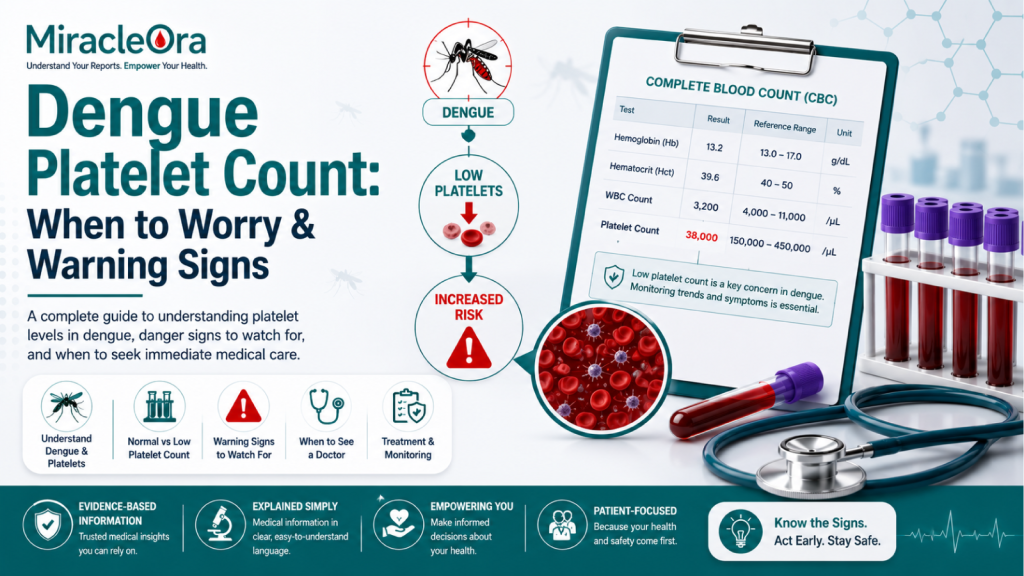
Short answer: In dengue, the platelet count usually falls for a few days, and that fall is expected. But the number by itself does not decide whether you are in danger. What decides danger is how the whole person is doing: the warning signs, the hematocrit, the blood pressure, and your doctor's assessment. A stable person with a low count can be less urgent than a symptomatic person with a higher count. Certain warning signs, such as bleeding, severe belly pain, constant vomiting, or drowsiness, mean go to a hospital right away, no matter what the platelet number says. When in doubt, get medical care.
Dengue is a serious illness that can worsen quickly, sometimes within hours. This page explains, in plain language, why platelets drop, what the numbers people ask about actually mean, and, most importantly, the signs that mean you should stop reading and seek emergency care.
Warning signs that mean go to a hospital now
If a person with dengue (or suspected dengue) shows any of the following, seek emergency care immediately. Do not wait for the next platelet result and do not wait for a scheduled appointment. These are the warning signs listed by the World Health Organization and the U.S. Centers for Disease Control and Prevention (CDC):
- Severe abdominal (belly) pain or tenderness
- Persistent vomiting (vomiting again and again, unable to keep fluids down)
- Bleeding from the gums or nose
- Blood in vomit or stool, or black, tarry stool
- Bleeding under the skin, easy bruising, or small red or purple spots
- Rapid or difficult breathing
- Restlessness, or the opposite: unusual drowsiness, confusion, or lethargy
- Cold, clammy, or pale skin
- Feeling very weak, or a sudden drop in condition, especially when the fever starts to come down
Any one of these can signal the severe phase of dengue and is a reason to reach the nearest emergency department without delay. When these signs are present, the exact platelet number does not change what you should do: get to a hospital.
Normal platelet count, in one sentence
A normal platelet count is roughly 150,000 to 400,000 platelets per microliter of blood, according to Cleveland Clinic and other clinical references. Platelets are the tiny cells that help blood clot, so when their number falls, the body can bruise or bleed more easily.
Why platelets fall in dengue, and the typical timeline
Dengue lowers the platelet count for a short period as part of how the infection affects the bone marrow and the blood. This is common and, on its own, expected. It does not automatically mean the illness is severe.
Based on clinical descriptions, the pattern usually runs like this:
- Days 1 to 3 (febrile phase): high fever, body aches, headache. Platelets are often still near normal early on.
- Around days 3 to 7: the platelet count typically begins to fall.
- Roughly days 5 to 7: the count often reaches its lowest point (the nadir).
- From about day 7 onward: as the body recovers, the platelet count usually starts to rise again on its own, without any special remedy.
Every person is different, and these ranges are general. Your doctor tracks the trend over repeat tests, not a single reading, which is why testing may be repeated daily or more often during the illness.
The numbers people ask about (and why they do not decide alone)
People search for a single cutoff, a magic number where they are "safe" or "in danger." Dengue does not work that way, and this is the most important thing this page can tell you. Doctors do watch the platelet count, and lower counts get closer attention, but they read that number alongside everything else. Here is how clinicians generally think about it, not as a home rulebook:
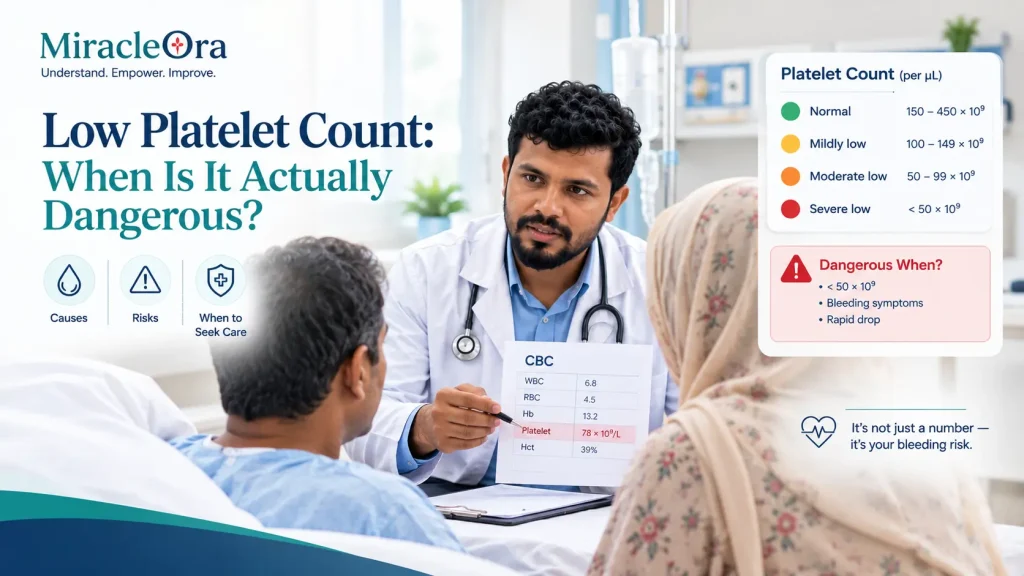
| Platelet range (per microliter) | How doctors generally view it |
|---|---|
| Above 100,000 | Often within a monitored range, but still requires follow-up if falling, and warning signs always override the number |
| 50,000 to 100,000 | Closer monitoring; the trend and warning signs matter more than the single value |
| 20,000 to 50,000 | A zone of caution; many clinicians observe closely, often in hospital, especially if the count is dropping fast |
| Below 20,000 | Generally treated as high concern and investigated urgently |
Read that table as reasons to involve a doctor, not as permission to stay home. A number above 100,000 does not mean you are safe if you are vomiting, bleeding, or in pain. And a low number without bleeding, in a stable patient, is not automatically an emergency by itself. The CDC and WHO both stress that warning signs and the clinical picture, not the platelet figure alone, guide care.
The critical phase: why danger often rises when the fever drops
This is the part many "just watch the number" pages bury, and it can save a life. According to the CDC, dengue's critical phase usually begins as the fever comes down (called defervescence) and lasts about 24 to 48 hours. It feels like the opposite of what you would expect: the fever breaks, everyone relaxes, and that is exactly the window when some patients quietly get worse.
During this phase, small blood vessels can start to leak fluid (plasma leakage). Doctors watch for a falling platelet count together with a rising hematocrit (the proportion of red cells in blood), because that combination can signal this leakage before obvious symptoms appear. This is why the moment the fever subsides is a time for more vigilance, not less. If the person seems drowsy, has belly pain, is vomiting, or shows any warning sign as the fever fades, treat it as urgent.
Why doctors watch the whole picture, not just the platelet line
The platelet count is one line on the report. A clinician managing dengue is also tracking:
- Hematocrit, for signs of plasma leakage
- Blood pressure and pulse, for early signs of shock
- Hydration and urine output
- Warning signs and how the person looks and feels, which often matter as much as, or more than, the count
CDC guidance recommends monitoring vital signs, fluid intake, urine output, and hematocrit every few hours during the critical phase. A single platelet value, read in isolation, cannot capture any of this. That is the honest reason no one can hand you a safe number over the internet.
If you are learning to read your blood report generally, our plain-language guide on how to read a CBC report walks through each line, including platelets, hematocrit, and hemoglobin.
What care generally involves
Dengue has no specific antiviral cure. Care is supportive and focuses on careful fluid management and close monitoring, which is why hospital observation is used when the situation warrants it. Two points patients often ask about:
- A low platelet count does not automatically mean a transfusion. Both the CDC and WHO advise against routine (prophylactic) platelet transfusions just because a number is low. Whether a transfusion is needed is a clinical decision a doctor makes based on active bleeding and the overall situation, not a number alone.
- Avoid medicines that raise bleeding risk unless a doctor directs otherwise. Pain and fever medicines such as aspirin and ibuprofen (NSAIDs) are generally avoided in dengue because they can worsen bleeding. Ask your treating doctor what is safe for you.
Myths about platelet-boosting remedies
In dengue season, home remedies spread fast, especially papaya leaf juice or extract. Here is the honest, evidence-based position: the research is mixed and inconclusive. At least one randomized controlled trial found no significant effect on platelet count, while some smaller studies suggested a possible rise. Importantly, platelets usually start climbing on their own around day seven as the body recovers, so it is easy to credit a remedy for what recovery was already doing.
None of these remedies is a proven cure, and none is a substitute for medical care and monitoring. Relying on a home remedy while ignoring warning signs is the real danger. If you want to try something a relative recommends, tell your doctor first, and never let it delay a hospital visit.
The honest part: never manage dengue by a home platelet number
If you take one thing from this page, take this: do not use the platelet count as a home traffic light. The number does not tell you when it is safe to stay home, and it does not, by itself, tell you when to panic. Warning signs override any number. The critical phase can arrive just as the fever fades. And what your doctor sees across the whole picture, hematocrit, blood pressure, hydration, and how you look, matters as much as the count.
Dengue is a condition to manage with a doctor, not with a chart on a website. Get tested, follow up as advised, and if any warning sign appears, go to the nearest hospital right away.
When to seek emergency care
Seek emergency care immediately, at any hour, if a person with dengue or suspected dengue has any warning sign listed above: severe belly pain, constant vomiting, bleeding from gums or nose, blood in vomit or stool, black stool, difficulty breathing, drowsiness or confusion, restlessness, cold or clammy skin, or a sudden worsening as the fever comes down. Go to the nearest emergency department or call your local emergency number. It is always safer to be checked and reassured than to wait at home.
Frequently asked questions
At what platelet count is dengue dangerous?
There is no single number that defines danger. Doctors watch lower counts more closely, and counts below 20,000 per microliter are generally treated as a serious concern, but the CDC and WHO stress that warning signs and the overall clinical picture decide urgency, not the platelet figure alone. A person with warning signs needs emergency care regardless of the number.
Do low platelets in dengue always need a transfusion?
No. Both the CDC and WHO advise against giving platelet transfusions just because the count is low. A transfusion is a clinical decision based on active bleeding and the patient's condition, made by the treating doctor.
When do platelets usually recover in dengue?
In many cases the count reaches its lowest point around days 5 to 7 of illness and then begins to rise on its own from about day 7 as the body recovers. This is a general pattern, not a guarantee, and it should be confirmed with repeat testing ordered by your doctor.
Why do I feel worse after the fever goes down?
The fever coming down can mark the start of dengue's critical phase, which lasts about 24 to 48 hours. This is a higher-risk window when fluid can leak from blood vessels. Feeling worse, or showing any warning sign, as the fever fades is a reason to seek care urgently, not to relax.
Does papaya leaf juice cure dengue or fix low platelets?
There is no proven cure from papaya leaf juice or extract. The evidence is mixed and inconclusive, and it is not a substitute for medical care. Do not let any home remedy delay a hospital visit when warning signs are present.
Related reading: Is my hemoglobin low? What the number means and Neutrophils vs lymphocytes: what the differential tells your doctor.
Sources: World Health Organization (dengue guidelines and 2009 warning signs), U.S. Centers for Disease Control and Prevention (Clinical Features of Dengue; Clinical Care of Dengue), and Cleveland Clinic (platelet count reference range). This content is educational and does not replace professional medical advice, diagnosis, or treatment.