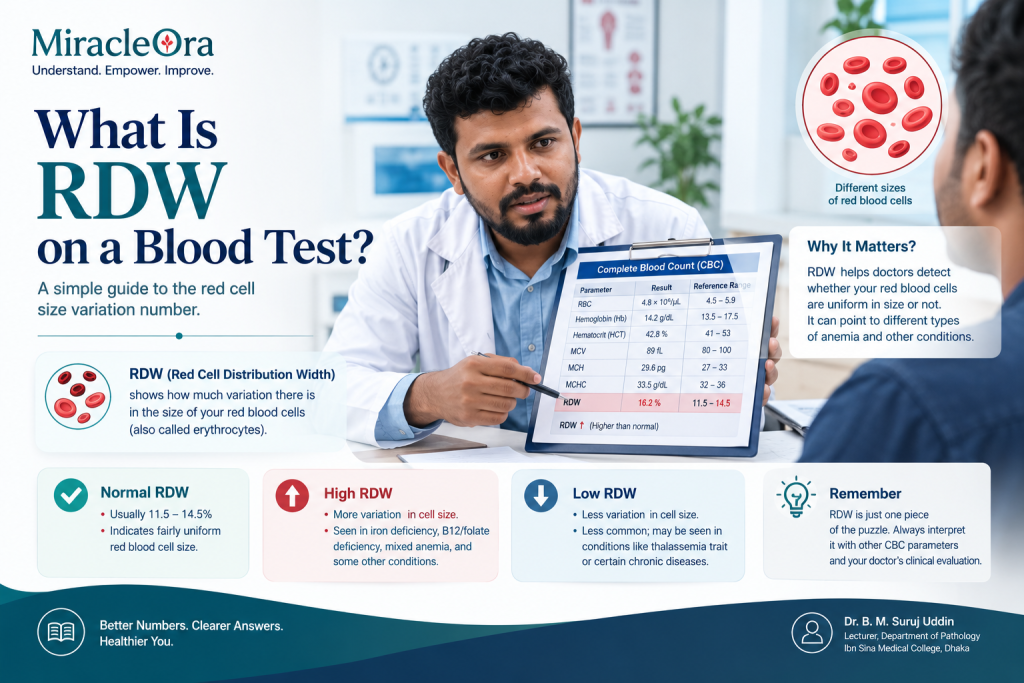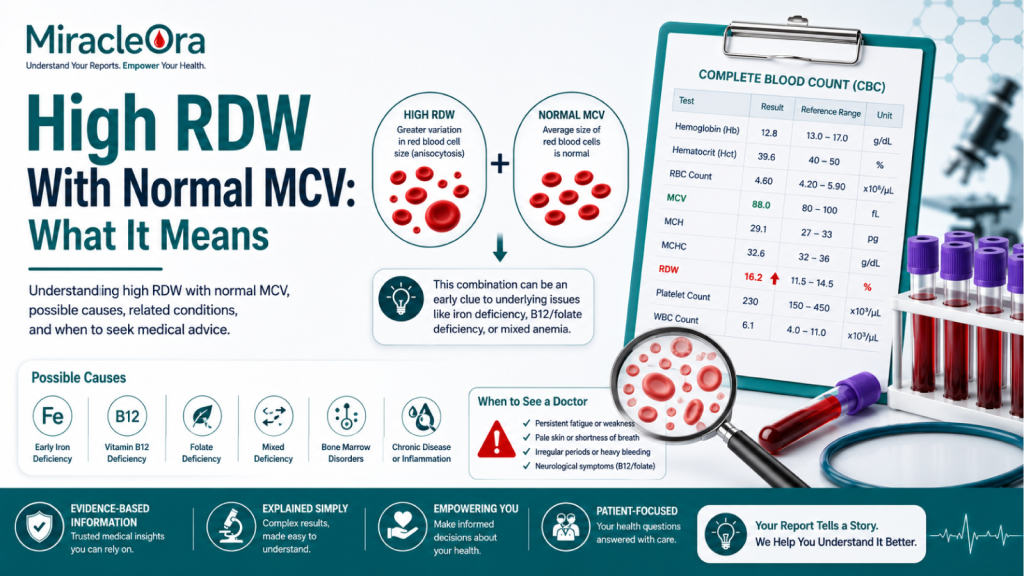
RDW (red cell distribution width) measures how much your red blood cells vary in size. A high RDW alongside a normal MCV generally means your body is making red cells of noticeably different sizes, even though their average size is still normal. In general medicine, this pattern can be an early or mixed signal, and it is often linked to the beginning of a nutritional change such as low iron, vitamin B12, or folate. It has many possible causes, though, and it is a clue, not a diagnosis. Only your doctor, reading it together with the rest of your results, can tell you what it means for you.
The goal of this page is to help you understand the general medicine behind the pattern so your next conversation with your doctor is calmer and clearer. It is educational only. It is not a diagnosis of your specific report, and it is not a substitute for professional medical advice.
What RDW measures
RDW stands for red cell distribution width. According to Cleveland Clinic, it "measures variations or differences in the size and volume of your red blood cells." MedlinePlus describes it the same way: it measures "how much the volume and size of your red blood cells (erythrocytes) varies."
Think of it as a uniformity score. If your red cells are all close to the same size, the RDW is low. If some are small and some are large, the spread is wider and the RDW is higher. Cleveland Clinic gives a normal range of roughly 12% to 15%, and notes that a result of 15% or more is generally read as high. That exact range varies from lab to lab, so the number that matters is the reference range printed next to your own result, not a range from any website.
An important point: RDW on its own does not name a disease. It tells your doctor that the size of your red cells is more mixed than usual, which is a reason to look closer, not a conclusion by itself.
What MCV adds to the picture
MCV stands for mean corpuscular volume, and it measures the average size of your red blood cells. Where RDW describes the spread of sizes, MCV describes the middle of that spread. The two answer different questions:
- MCV asks: on average, are the cells small, normal, or large?
- RDW asks: are the cells uniform, or all over the place in size?
This is why the numbers are read together. A normal MCV tells your doctor the average cell size is fine. A high RDW tells them the population is still mixed. Put together, "high RDW with normal MCV" describes red cells whose average size looks normal but whose sizes are more varied than expected. That combination is the whole reason this pattern gets its own conversation.
How "high RDW, normal MCV" is read as a pattern
Neither number is meant to stand alone. Cleveland Clinic states that providers "compare RDW results with mean corpuscular volume (MCV)" to help find the underlying cause, and MedlinePlus notes that RDW is interpreted alongside other results, not in isolation. The single most useful idea on this page is simple: RDW is never read by itself. It is read with MCV and with your hemoglobin.
The grid below shows how doctors generally frame the common combinations. It is a teaching tool for understanding the categories, not a way to score your own report.
| Pattern | What doctors generally consider (educational) |
|---|---|
| High RDW, low MCV | Iron deficiency is a common consideration. Thalassemia trait, by contrast, often shows a normal RDW. |
| High RDW, normal MCV | An early or mixed picture: the start of a nutritional change (iron, B12, or folate), a recovering blood count, or two things happening at once. |
| High RDW, high MCV | B12 or folate deficiency, or other causes of larger-than-average cells. |
| Normal RDW, normal MCV | Cells are uniform and average-sized. |
Sources for the general patterns above: Cleveland Clinic and the review "Three neglected numbers in the CBC" in the Cleveland Clinic Journal of Medicine, which notes that "a high RDW suggests iron-deficiency anemia while a normal RDW suggests thalassemia" when the MCV is low. This grid is one small part of reading a full count. For the wider view, see our guide on how to read your CBC report, which walks through every section rather than one index.
Common, non-alarming reasons this pattern shows up
For many people, a mildly high RDW with a normal MCV reflects something ordinary and treatable rather than something serious. Commonly considered explanations include:
- The early stage of iron deficiency. As iron runs low, the body starts making smaller cells while the older, normal-sized cells are still in circulation. The mix widens the RDW before the average size (MCV) has moved much.
- The early stage of B12 or folate change. The same logic works in the other direction, with some larger cells appearing in the mix.
- A mixed picture. If more than one thing is present at once (for example, a little iron deficiency together with a little B12 change), the small and large cells can average out to a normal MCV while the RDW stays wide.
- Recovery and turnover. A blood count that is recovering, for instance after a period of nutritional change and then treatment, can show a burst of new cells of varying sizes.
Because low iron, B12, or folate sit near the top of that list, a doctor's first questions are often practical ones about diet, recent blood loss, pregnancy, and general health. None of that means any single explanation applies to you. It means these are the common starting points a clinician weighs before ordering anything further.
Why this pattern can appear before anemia does
Here is the part that makes RDW genuinely useful, and the reason a normal MCV does not automatically mean "nothing to see." The Cleveland Clinic Journal of Medicine review notes that "in iron deficiency, the RDW often rises before the mean corpuscular volume falls, serving as an early diagnostic clue."
In plain terms: RDW can be one of the first numbers to move. When the body begins producing a new population of differently sized cells, the spread widens early, while the average size and even the hemoglobin can still read as normal. That is why a high RDW with an otherwise normal-looking count can flag a change that has not yet grown into full anemia. It is a head start, not an alarm.
The honest part: a clue, not a diagnosis
Most pages stop at "high RDW might mean iron deficiency." Two honest points rarely get said, and both matter.
First, this pattern can be completely benign or an early, easily corrected signal. A single mildly elevated RDW in a person who feels well, with a normal hemoglobin, is common and is rarely urgent on its own. It is a reason to look, not a reason to worry.
Second, and less intuitively, a normal RDW does not rule everything out. The same Cleveland Clinic Journal of Medicine review points out that "patients who have severe iron-deficiency anemia for months to years are expected to have a normal rather than a high RDW, as their red cells of normal size have all been replaced by microcytes." In other words, RDW is a snapshot of a moving process. It can be high early, then settle later, even while a problem continues. This is precisely why no single index, high or normal, decides anything by itself, and why your doctor reads the whole report against your history and how you feel.
If you want to understand the neighboring numbers this pattern is usually read against, our explainers on what a low hemoglobin can mean and on neutrophils versus lymphocytes cover the other lines on the same CBC page.
What a doctor may check next
This is general information about what clinicians commonly consider, not a to-do list and not a prescription. Depending on your history, symptoms, and the rest of your count, a doctor may choose to look at things such as:
- Iron studies (for example ferritin, serum iron, and related measures) to weigh iron status.
- Vitamin B12 and folate levels.
- A repeat CBC after some time, to see whether the pattern is stable, improving, or evolving.
- A review of the full blood film and the rest of your results, plus questions about diet, bleeding, pregnancy, and general health.
Whether any of these apply, and in what order, is a clinical judgment your own doctor makes with information a lab report cannot capture on its own.
When to seek medical review
Any flagged result on your report is worth discussing with the doctor who ordered the test, and you do not need alarming symptoms to ask. Seek prompt medical attention, rather than waiting for a routine appointment, if you have symptoms such as:
- Unusual or worsening tiredness, breathlessness, dizziness, or a racing heartbeat.
- Noticeable paleness, chest pain, or fainting.
- Signs of bleeding, such as blood in the stool or urine, or unusually heavy periods.
- Any symptom that feels serious or is getting worse.
These can have many causes and are general safety pointers, not a diagnosis. If something feels urgent, contact your doctor or local emergency service without delay.
Frequently asked questions
Is a high RDW dangerous?
Not by itself. A mildly high RDW is a common finding and is often linked to ordinary, treatable causes such as low iron, B12, or folate. It signals that your red cells vary in size, which is a reason for your doctor to look closer, not a diagnosis of anything serious. Only clinical review of your full results can judge its meaning for you.
Can RDW be high when hemoglobin is normal?
Yes. Because RDW can rise early, before the average cell size and hemoglobin change, a high RDW with a normal hemoglobin can appear. In general medicine this is often read as a possible early or mixed change rather than established anemia, but interpretation still depends on your whole report and your doctor.
Does a high RDW with normal MCV always mean iron deficiency?
No. Early iron deficiency is a common consideration, but the same pattern can come from early B12 or folate change, a mixed picture, a recovering count, or other conditions. That is why doctors run further tests, such as iron studies and B12 and folate levels, rather than concluding from RDW alone.
My RDW is only slightly above the range. Should I worry?
A single, slightly elevated RDW in someone who feels well is common and is rarely urgent on its own. Use the reference range printed on your own report, since lab ranges differ, and raise it with the doctor who ordered the test so it can be read in context.
Medical disclaimer: This article is for general education only. It explains the medicine behind a blood-count pattern in general terms and does not interpret your specific result, diagnose any condition, or recommend treatment. Reference ranges vary between laboratories, so always use the range printed on your own report and discuss your results with a qualified doctor. See our full Medical Disclaimer.