This article is general health education, not medical advice. Always follow the specific instructions your doctor or laboratory gave you. See our Medical Disclaimer.
Do You Need to Fast Before a CBC Blood Test?
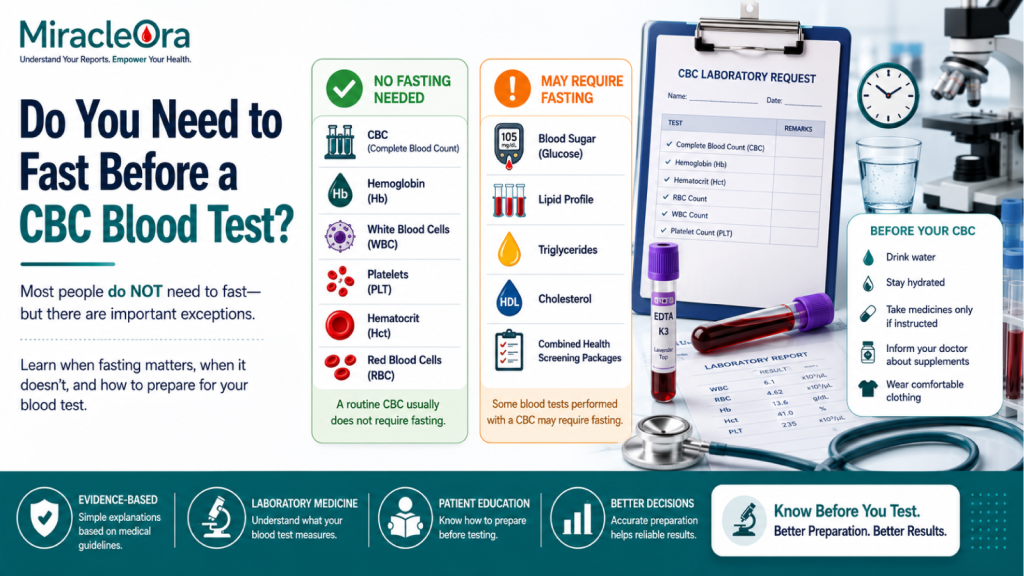
Short answer: no. A complete blood count on its own does not normally require fasting. You can generally eat and drink before it. If you were told to fast, the instruction almost certainly came from another test on the same requisition, not from the blood count.
If you have already eaten and your appointment is in an hour, that is the answer you needed. The rest of this page explains why, and how to work out whether the fasting instruction on your form applies to something else.
Why a CBC does not need fasting
A complete blood count is a physical count. The analyzer counts and sizes your red cells, white cells and platelets, and calculates the indices from those measurements. A meal does not meaningfully change how many red cells are circulating in a microliter of your blood, which is why health systems including UPMC and Texas Health list the complete blood count among the tests that do not require an empty stomach.
Peer-reviewed work has looked at this directly. A study published in Laboratory Medicine comparing complete blood counts from fasting and non-fasting capillary samples examined whether fasting status meaningfully alters the reported values. The general conclusion in the literature and in health-system guidance is the same: for a routine CBC, fasting is not required.
Compare that with a glucose or lipid measurement, where the substance being measured is directly and rapidly changed by what you just ate. That is the real dividing line: tests that measure something dissolved in your blood are often affected by a meal; a test that counts cells generally is not.
The real reason you may have been told to fast
Blood is usually drawn once and split across several tubes. One requisition form can carry a CBC alongside several other tests, and the preparation instruction is written for the strictest test on the form. So the honest answer to "why was I told to fast for my blood count" is normally: you were not. You were told to fast for whatever else was ordered with it.
| Commonly ordered alongside a CBC | Typically requires fasting? |
|---|---|
| Complete blood count (CBC) | No |
| Fasting blood glucose | Yes |
| Lipid profile (cholesterol and triglycerides) | Often, though practice varies and some guidance now accepts non-fasting samples |
| HbA1c | No |
| Thyroid function tests | Generally no |
| Liver or kidney function panels | Usually no, though instructions vary by laboratory |
| ESR or CRP | No |
| Ferritin and iron studies | Instructions vary; iron studies are sometimes requested in the morning or fasting |
Treat this table as orientation, not as permission. Practice genuinely varies between laboratories, and the instruction printed on your own form or given by your clinic is the one that counts. If your form says fast and you do not know why, call the clinic rather than deciding from a table on the internet.
What fasting actually means, and why water is usually allowed
Where fasting is required, it typically means no food and no caloric drinks for a stated number of hours before the draw, most often overnight. It does not usually mean going without water, and most instructions actively encourage plain water.
That distinction is worth taking seriously for a blood count in particular. Hemoglobin and hematocrit are measured against your plasma volume, so hydration status can nudge them. Someone who avoids water for twelve hours because they misread "fasting" may arrive relatively dehydrated, which is exactly the sort of everyday factor that can push a value across a reference range line for no medical reason. We look at how often ordinary factors explain a flagged value in blood test abnormal but you feel fine.
Two more points that are commonly misunderstood:
- Coffee and tea are not water. Even without sugar or milk, they are usually excluded during a fast unless your clinic says otherwise.
- Do not stop any prescribed medication to prepare for a blood test unless the person who prescribed it has told you to. Fasting instructions are about food, not about your treatment.
What to do if you already ate
- For a CBC alone: in almost all cases nothing changes. Go to your appointment.
- If other tests were on the form: tell the phlebotomist or reception when you arrive. They will know which tests are affected and whether to draw now, draw partially, or rebook. This is a routine situation and staff deal with it daily.
- Do not skip the appointment to avoid the conversation. A partial draw now is usually better than no draw at all, and that decision belongs to the laboratory rather than to you.
- Do not fast for longer than instructed to compensate. Longer is not better, and it can leave you dehydrated or lightheaded at the draw.
Other things that can affect a blood count on the day
Fasting is not the variable most likely to move your counts. These are the everyday factors more often involved:
- Hydration, as above, influencing hemoglobin and hematocrit.
- Recent vigorous exercise, which commonly raises white cell counts temporarily.
- Acute stress, with a similar effect.
- A recent or resolving infection, which can leave white cell lines shifted after you feel well.
- Time of day and posture at the draw, which can produce small shifts.
- Some medications, several classes of which affect white cells or platelets.
None of these is a reason to reschedule on your own initiative. They are reasons a single result is read cautiously and a trend is trusted more, which is the theme running through our line-by-line guide, how to read your CBC report.
When to check with your doctor or the laboratory
Call rather than guess if:
- Your form says fast and you do not know which test requires it.
- You have diabetes or another condition where a long fast is not safe for you. Fasting instructions should be adapted to you, not applied blindly.
- You are pregnant, unwell, or feel faint at the thought of fasting.
- You take medication whose timing you think may conflict with the instruction.
- You are unsure how long the fast should be. The standard periods differ between tests, and the number on your form is the one to follow.
Seek urgent care rather than attending a routine blood draw if you are acutely unwell, particularly with chest pain, difficulty breathing, confusion, fainting or uncontrolled bleeding.
Frequently asked questions
Do I need to fast for a CBC?
No. A complete blood count on its own does not normally require fasting, because it counts cells rather than measuring something a meal changes.
Then why does my form say to fast?
Because a fasting instruction is written for the strictest test on the requisition. Another test drawn at the same time, most often glucose or a lipid profile, is usually the reason.
Can I drink water before a CBC?
Yes, and it is generally encouraged, including during a fast for other tests. Plain water helps the draw and helps keep hemoglobin and hematocrit from being skewed by dehydration. Follow any specific instruction you were given.
Can I drink coffee or tea before the test?
For a CBC alone this is usually fine. If you are fasting for other tests on the same form, coffee and tea are normally excluded even without milk or sugar. Check with your clinic.
Will eating change my hemoglobin result?
A recent meal is not among the factors generally described as meaningfully changing a hemoglobin measurement. Hydration status is the more relevant everyday variable.
I fasted for eighteen hours by mistake. Is that a problem?
Tell the staff when you arrive. Over-fasting is not usually harmful for a healthy adult, but it can leave you dehydrated or lightheaded, and the laboratory should know. If you have diabetes or another condition affected by fasting, contact your clinic before the appointment rather than after.
Does fasting make my results more accurate?
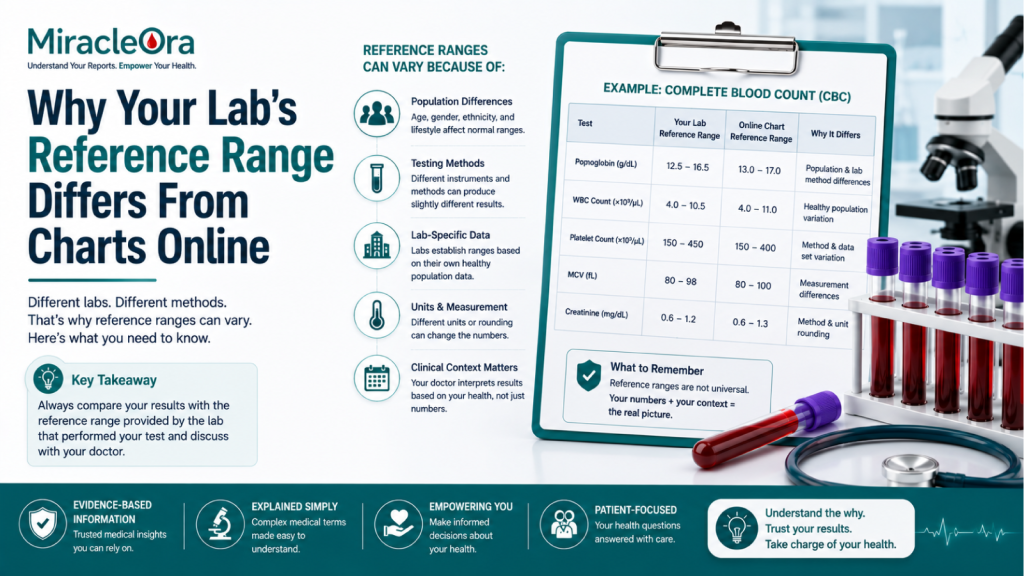
Not for a blood count. Preparing as instructed and being normally hydrated is what helps. The comparison that decides whether your value is flagged is against your own laboratory's range, and how those ranges work is explained in why your lab's reference range differs from charts online.
Medical disclaimer: This article is provided by MiracleOra for general educational purposes only. It is not medical advice, diagnosis or treatment, and it does not replace the preparation instructions given by your doctor or laboratory. Always follow the instructions printed on your own requisition. If you have severe or worsening symptoms, seek urgent medical care. See our full Medical Disclaimer.