This article is general health education, not medical advice. It cannot interpret your specific result or your clinic's process. See our Medical Disclaimer.
How Long Do CBC Results Take, and Why the Wait Varies
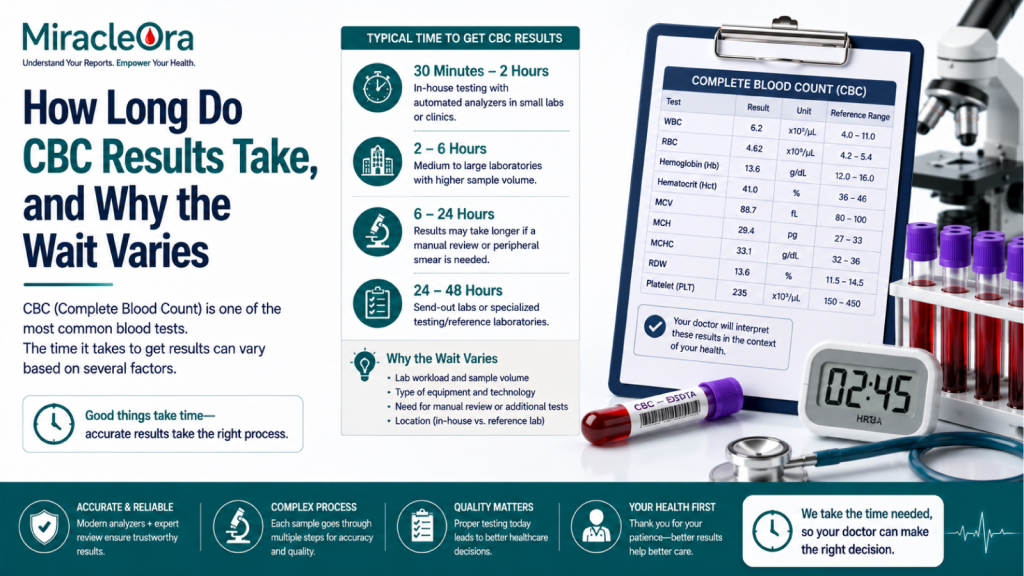
Short answer: the analysis itself is fast. Once your tube reaches a hematology analyzer, a complete blood count runs in minutes. Patient guidance from health systems commonly describes results being available to the ordering doctor within about a day for routine testing, and within roughly an hour where a sample is marked urgent. Almost all of the waiting you experience happens around the test, not inside it.
And the question underneath the question, the one people are really asking at two in the morning: a longer wait is not a signal that something is wrong. We come back to that below, with the reason it is not.
Three separate clocks between the needle and your phone
People experience one wait and assume it is all laboratory time. It is usually three different waits stacked on top of each other, and only the first is about the test.
- Analysis. Loading, running and producing the numbers. Minutes, once the sample is at the analyzer.
- Verification and release. The laboratory checks quality control, applies its rules, resolves anything the analyzer flagged, and releases the report. Usually the same working day for routine samples, and this is where a specific sample can gain hours.
- Clinical review and contact. Your doctor reads the report alongside your history and decides what to tell you, then someone has to reach you. This is normally the longest clock, and it runs on clinic scheduling, not on your result.
Add transport at the front if your blood was drawn at a collection point and sent to a central laboratory, plus weekends and public holidays, and a "two-day wait" is usually one busy day of laboratory time inside two calendar days of everything else.
What the laboratory actually does with your tube
Understanding the steps makes the pauses less mysterious:
- Accessioning. The sample is logged, matched to your requisition and checked for suitability. A tube that is underfilled, clotted or mislabeled is rejected here, and that means recollection.
- The run. An automated analyzer counts and sizes the cells and calculates the indices. If a differential was ordered, the five white cell lines come from the same run, which is why adding it does not slow anything down in a way you would notice. The difference between the two orders is explained in CBC versus CBC with differential.
- Rule checking. Laboratories set thresholds that route certain results for extra work before release.
- Manual review where triggered. A stained slide from your sample may be examined under a microscope by a person. This adds time and is a routine quality step.
- Verification and release. The report is authorized and sent to the ordering clinician, and often to a patient portal.
Why some samples legitimately take longer
None of these is a diagnosis. All of them are ordinary:
- A repeat run. If a value looks inconsistent with the rest of the picture, the laboratory may simply run the sample again.
- A platelet clumping check. Platelets can clump inside the collection tube, which some analyzers count as a falsely low platelet number. Resolving that can mean a blood film review or a fresh sample in a different tube type.
- A flagged result routed for a manual blood film review, as above.
- Transport. Samples collected at a clinic or camp and couriered to a central laboratory travel on a schedule.
- Volume and timing. A sample arriving late in the day, at a weekend or over a holiday waits for the next processing window.
- An add-on test. If your doctor adds a test to the same sample afterward, the report may be held until the full set is complete.
Does a delay mean bad news?
No, and it is worth naming the reason people believe otherwise, because the belief is almost exactly backwards.
Laboratories maintain a list of critical values, results so far outside the expected range that the laboratory telephones the ordering clinician immediately rather than waiting for anyone to read a report. That is a deliberate safety system. Its practical consequence for you is this: the results that genuinely cannot wait are the ones that travel fastest. A quiet inbox is far more consistent with routine handling than with a serious finding.
What a delay usually reflects is scheduling. Your doctor has a clinic list. Reports are reviewed in batches. Someone has to make the call. None of that is influenced by what your report says.
The same asymmetry applies to the numbers themselves. Most flagged values are marginal and unremarkable, which is why we spend a whole page on blood test abnormal but you feel fine rather than treating every flag as an event.
When your portal shows results before your doctor calls
This is now common, and it is a genuinely difficult few hours. Some practical framing:
- Portal release is often automatic, on a timer, and not a decision that your doctor made about you.
- You are seeing the same sheet your doctor will see, without the history, examination and context that turn it into meaning.
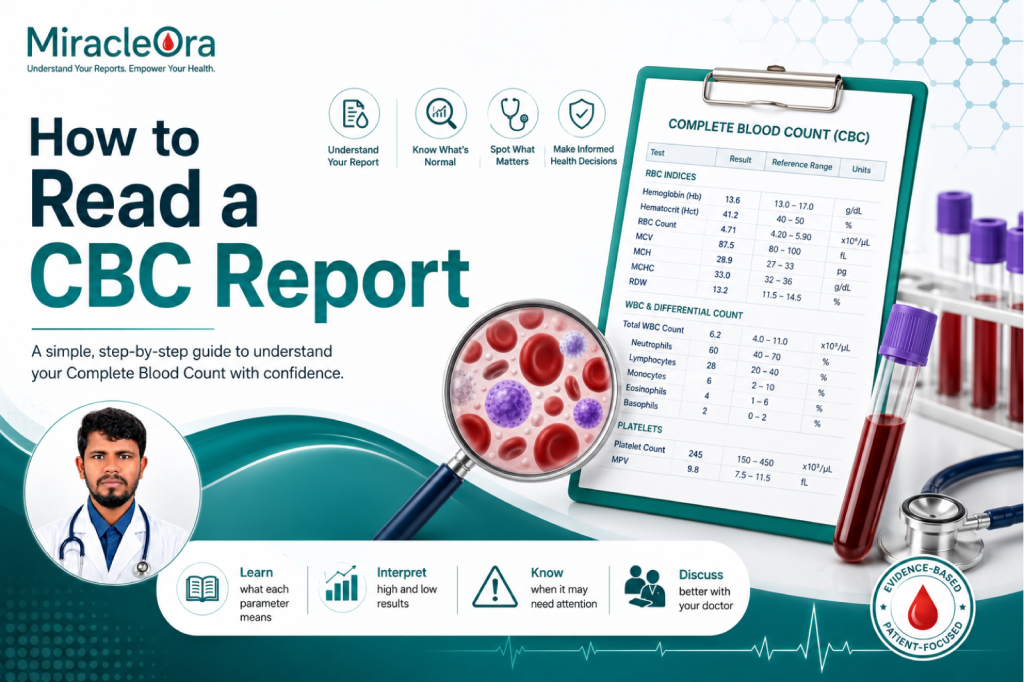
- Reading one flagged line at a time reliably produces the most frightening interpretation available, not the most likely one. If you are going to read it, read the whole report in order. Our walkthrough, how to read your CBC report, is written for exactly this moment, and the flag letters themselves are decoded in what an H or L flag means.
- Write your questions down instead of searching each value. You will get better answers from your doctor in five minutes than from an evening online.
When to chase your result
Contact the clinic rather than waiting if:
- You were told to expect results by a certain time and that time has passed.
- You were told the test would guide a decision, such as starting or adjusting a treatment, and you have heard nothing.
- Your blood was drawn at a collection site and you are not sure it reached the laboratory.
- You develop new or worsening symptoms while waiting. Symptoms change the urgency regardless of where the report is.
- You have been asked to attend an appointment to discuss results and want to know whether to bring anything.
Do not wait for a pending result if you become acutely unwell. Seek urgent care for difficulty breathing, chest pain, confusion, fainting, uncontrolled bleeding, unexplained widespread bruising, tiny red spots on the skin, or high fever with severe illness. Urgent symptoms are treated on their own merits, not on a pending report.
Frequently asked questions
How long does a CBC take to process?
The analysis itself takes minutes on an automated analyzer. Patient guidance from health systems commonly describes routine results reaching the ordering doctor within about a day, with urgent samples turned around in roughly an hour. Your own laboratory's stated timing is the one that applies.
Why has it been three days with no call?
Most often because of clinical review and scheduling rather than anything in the laboratory. Transport, weekends and holidays add calendar days without adding processing time.
Does a long wait mean my results are bad?
No. Results that genuinely cannot wait trigger an immediate telephone call to the ordering clinician under laboratory critical-value policies. A longer wait is more consistent with routine handling.
Why did my platelet result take longer than the rest?
One common reason is a check for platelet clumping in the collection tube, which can produce a falsely low count and may require a blood film review or a fresh sample. That is a quality step, not a finding.
Can I get my CBC result faster?
Ask the clinic. Urgency is a clinical decision, and marking a sample urgent is something the ordering doctor does, usually because the result will change what happens next.
My portal shows results but nobody has called. What should I do?
Portal release is often automatic and does not mean your doctor has reviewed the report yet. Note your questions and raise them at the appointment. If a value was reported as critical, or you have new symptoms, contact the clinic now.
Medical disclaimer: This article is provided by MiracleOra for general educational purposes only. It is not medical advice, diagnosis or treatment, and turnaround times vary by laboratory, region and how a test was ordered. Follow the timing and follow-up instructions given by your own clinic. If you have severe or worsening symptoms, seek urgent medical care rather than waiting for a result. See our full Medical Disclaimer.