This article is general health education, not medical advice. It does not interpret any individual result. See our Medical Disclaimer.
Can Exercise Before a Blood Test Change Your Count?
Yes, strenuous exercise shortly before a blood draw can raise the white blood cell count, and peer-reviewed research explains why: the extra cells are mostly cells you already had, swept into the flowing blood from vessel walls and internal reservoirs rather than newly made to fight anything. The effect is temporary. It does not mean your test is worthless, and it does not mean anything is wrong. Only the clinician who ordered the test can judge whether your activity that morning is relevant to your result, and reference ranges are laboratory-specific, so the range printed on your own report is the one your value was compared against.
What exercise does to the white cell count
The phenomenon has a name: exercise-induced leukocytosis, a temporary rise in circulating white cells after exertion.
The mechanism is the interesting part. Research on exercise and leukocyte counts describes demargination: at rest, a large share of your white cells are not floating freely in the bloodstream. They roll slowly along the inner walls of blood vessels, or sit in reservoirs in the lungs, liver and spleen. Exercise raises blood flow and releases catecholamines, the adrenaline family of stress hormones, and those cells are pushed into the main circulation. A review of catecholamine-induced leukocytosis indexed in PubMed covers this line of research directly.
The needle then samples blood that is temporarily carrying a larger share of your existing white cells. Your body did not manufacture an army. It rearranged where the soldiers were standing.
The timing, which is more specific than most articles admit
Peer-reviewed work published under the title "Brief exercise induces an immediate and a delayed leucocytosis" describes a two-stage pattern: an immediate rise driven by both neutrophils and lymphocytes, which subsides rapidly once exercise finishes, followed by a delayed neutrophil rise of greater magnitude peaking around three hours after the start of exercise. Other research attributes that delayed phase largely to cortisol rather than to adrenaline.
Two practical points follow from that.
- The rise is measured in hours, not days.
- There is more than one peak, so "I finished my run an hour ago" and "I finished my run three hours ago" are not the same sample.
None of this makes a result meaningless. It makes the timing of your session a piece of context worth mentioning to your doctor.
The information most pages miss: two different clocks
Most articles on this topic answer "does exercise affect blood tests" as if all blood tests behaved the same way. They do not, and the difference is the single most useful thing on this page.
| What is being measured | What exercise does | Roughly how long |
|---|---|---|
| White cell count and the differential (a CBC measure) | Cells redistribute into the circulation, so counts can read higher | Hours. Research describes an immediate phase and a delayed phase peaking around three hours after exercise starts |
| Muscle-derived enzymes such as creatine kinase (not part of a CBC) | Muscle cell membranes become more permeable after unaccustomed or damaging exercise, so enzymes leak into the blood | Considerably longer, and research uses these enzymes as markers of exercise-induced muscle damage precisely because they stay measurable |
So if you are asking about a complete blood count, the exercise window that matters is short. If your panel also included muscle or liver enzymes, the answer is different, and it is not a CBC question. Whether your report includes a differential at all is explained in CBC versus CBC with differential.
Why "high white cells" after the gym is not the same as "infection"
This is where readers frighten themselves. A raised white count is genuinely one of the things doctors look at when they suspect infection. It is also raised by exertion, by stress, by pregnancy, by smoking and by certain medicines, which is why nobody reads it alone.
The differential matters here. Exercise-related rises involve neutrophils and lymphocytes in a particular sequence, and the numbers move without the clinical picture that goes with an illness. What each of those cell lines does, and why their balance is read rather than either number by itself, is covered in neutrophils versus lymphocytes.
We are not going to tell you that your raised count is exercise. We cannot know that, and no page can. We can tell you that exertion is a recognized, documented, non-alarming reason for the count to move, and that it is worth telling the person who ordered your test what you did that morning.
What this does not cover
Honesty about limits is part of reading a lab report well.
- This is about a single bout of exercise before a draw. Long-term training patterns are a separate research question, and not something to infer from one report.
- It says nothing about your individual result. Two people can do the same workout and show different shifts.
- It is not a reason to change your routine around a test. Do not skip prescribed activity, do not add any, and do not reschedule a test on your own. If the test was ordered specifically to investigate a white cell abnormality, your doctor may give you a preparation instruction. Follow theirs, not ours.
- Dehydration often travels with exercise. A long session in heat can concentrate the blood as well, which raises several values for a completely different reason. That mechanism is covered in can dehydration change your blood test results.
What to tell your doctor
If you exercised before the draw and a value came back flagged, the useful information is specific:
- What you did, roughly how hard, and how long it lasted.
- How many hours before the draw you finished.
- Whether it was your normal routine or something unaccustomed.
- Whether you were unwell, feverish or dehydrated at the same time.
That is a far more useful message than "could this be exercise?", because it lets your clinician judge the context rather than guess at it. A value that sits outside a range while you feel completely well is common enough to have its own article: blood test abnormal but you feel fine.
Reference ranges are laboratory-specific
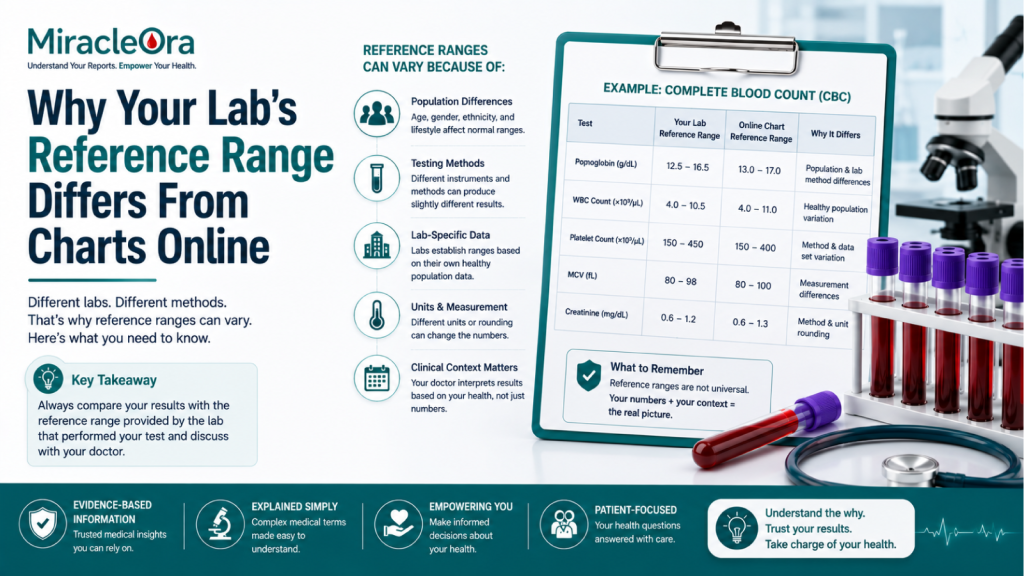
The white cell range printed on your report was established or verified by your laboratory using its own analyzers, reagents and reference population. A different lab can print a different band for the same measurement, and neither is wrong. Read the range column on your own report rather than any chart online, including ours. The reasons are set out in why your lab's reference range differs from charts online.
When to contact your doctor rather than wait
Contact your doctor promptly if:
- A result was reported to you as critical, or you were asked to act on it.
- A value sits markedly outside the range printed on your own report.
- You have a persistent fever, drenching night sweats, unexplained weight loss, or an infection that is not settling.
- You are pregnant, immunosuppressed, receiving chemotherapy, or being monitored for a known blood condition.
- You have severe muscle pain with dark urine after heavy exertion, which is a recognized medical emergency and needs same-day assessment.
Seek urgent care immediately for chest pain, difficulty breathing, confusion, fainting or uncontrolled bleeding, whatever any result says.
Frequently asked questions
Should I skip the gym before a blood test?
Follow whatever instruction your clinic or laboratory gave you. If they gave none and you are concerned, the honest answer is that a hard session in the hours before a draw can raise the white cell count temporarily, so mentioning it is more useful than deciding on your own to change your routine.
How long after exercise does the white blood cell count return to normal?
Research describes an immediate rise that subsides quickly after exercise ends and a delayed neutrophil rise peaking around three hours after exercise starts. The effect is measured in hours rather than days, but the exact course varies between people and with how hard the session was.
Does walking affect blood test results?
Light everyday activity is generally not treated the same way as strenuous exertion in this research. The documented shifts come from hard or prolonged effort. Your clinician is the one to ask about your own situation.
Can exercise make my hemoglobin look different?
Prolonged exercise, especially in heat, can leave you dehydrated, and dehydration concentrates the blood so hemoglobin and hematocrit can read higher. That is a fluid effect rather than a white cell effect.
My white count is high and I exercised that morning. Is that the explanation?
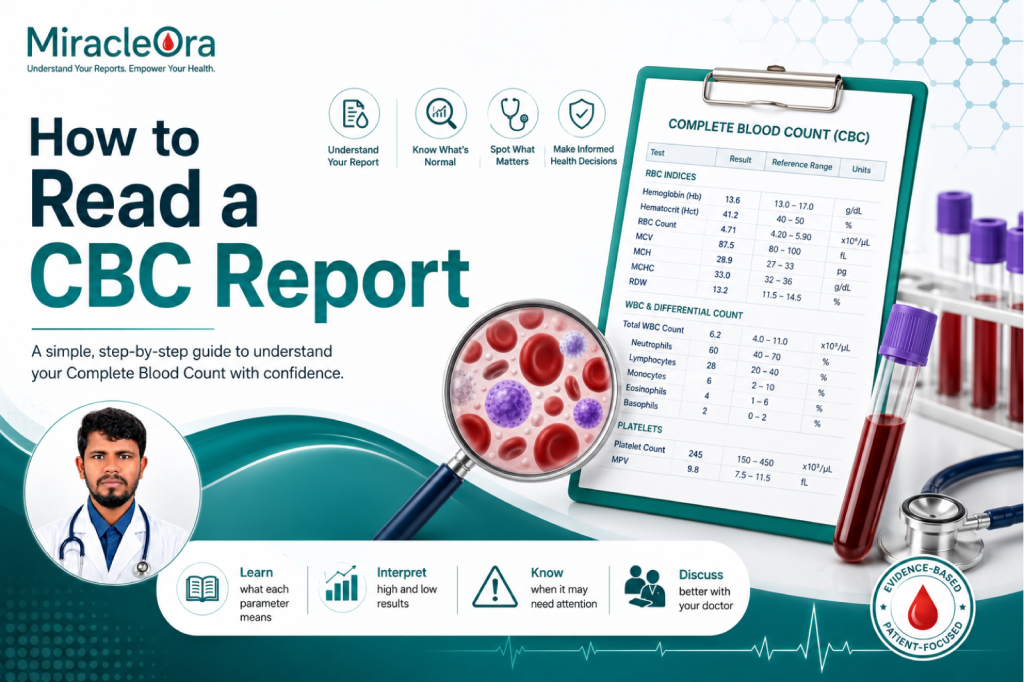
It may be a relevant piece of context, and it is worth telling your doctor. It is not something this page or any page can conclude for you, because a count is read alongside your history, your symptoms and your previous results. The line-by-line guide to the rest of the report is how to read your CBC report.
Medical disclaimer: This article is provided by MiracleOra for general educational purposes only. It is not medical advice, diagnosis or treatment, and it does not interpret any individual person's results. Reference ranges vary by laboratory, age, sex, pregnancy status and testing method, so always compare your results to the range printed on your own report and discuss what they mean with a qualified healthcare professional who knows your medical history. If you have severe or worsening symptoms, seek urgent medical care. See our full Medical Disclaimer.