This article is general health education, not medical advice. It does not interpret any individual result. See our Medical Disclaimer.
Why Two Labs Can Give You Different Numbers
Getting different results from two labs is normal, and in most cases neither laboratory is wrong. Three separate things can differ between two reports: the measurement itself, your body between the two draws, and the reference range each lab prints beside the result. Each clinical laboratory is expected to define its own reference intervals, using its own instruments, reagents and local reference population, so the same value can be flagged on one report and unflagged on another. Which of those three things explains your gap is a clinical question for the doctor who ordered the tests, not something to settle from a chart.
Separate the three things before you compare anything
This is the part the usual "why lab results vary" article never does cleanly, and it is the whole point of this page. When two reports disagree, one of three different things has changed, and they have completely different meanings.
| What differed | What it looks like on paper | What it means |
|---|---|---|
| The measurement | The numbers differ, both ranges are similar | Analytical variation: different analyzers, reagents, calibration, sample handling |
| You | The numbers differ, and the draws were on different days or at different times | Biological variation: hydration, time of day, recent exertion, illness, posture during the draw |
| The reference range | The numbers are close, but one report has an H or L flag and the other does not | The lab's own interval differs. Your blood did not change. The yardstick did |
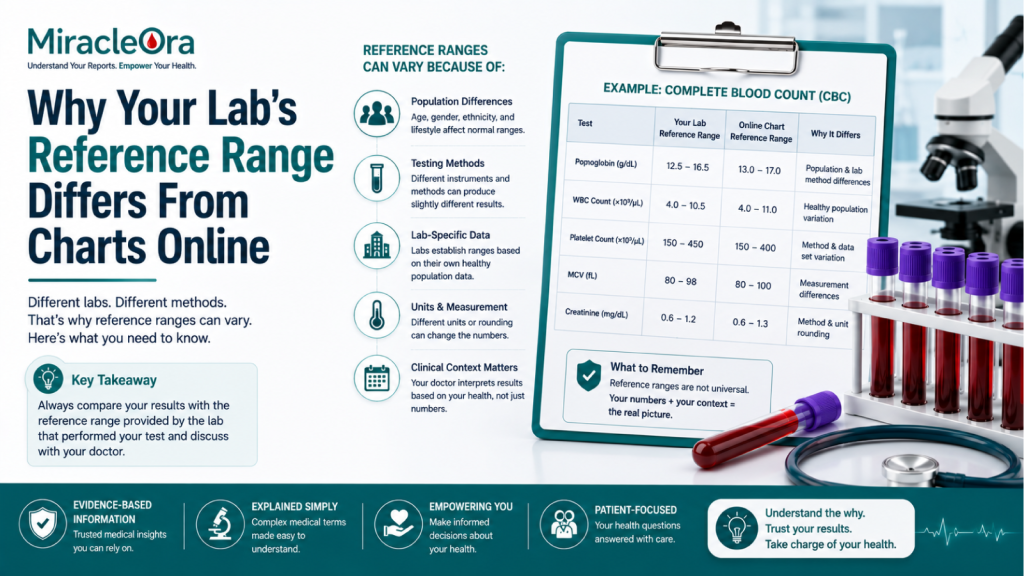
That third row is the one that catches people out, and it is worth stating plainly: a difference in flagging is not a difference in your blood. A hemoglobin of 12.4 can sit inside one laboratory's printed band and just below another's. Nothing happened to you between those two lines. What the H and L letters actually mean is covered in what an H or L flag on your blood test means.
Before concluding anything, put the two reports side by side and check the number column and the range column as two separate comparisons.
Why the measurement itself can differ
Laboratories are not interchangeable machines producing one true number.
- Different analyzers. Different manufacturers count and size cells using different technologies, and a value is partly a property of the instrument that produced it.
- Different reagents and different reagent lots. Chemistry varies between manufacturers and even between batches from the same one.
- Calibration. Laboratories calibrate against reference standards, but small differences between systems persist by design.
- Sample handling. Collection technique, the tube used, how long the sample waited, the temperature it waited at, and how it was transported all feed in. Platelet clumping in the tube is a familiar example: it can make a count read low for a reason that has nothing to do with your blood.
None of that is sloppiness. It is why laboratories run quality control, and it is why a small gap between two reports is expected rather than alarming.
Why your own blood genuinely differs between two draws
Even one laboratory testing you twice will not print identical numbers, because you are not identical from one morning to the next.
- Hydration status concentrates or dilutes the sample. See can dehydration change your blood test results.
- Time of day shifts different cell lines in different directions. See does the time of day affect your blood count.
- Recent hard exercise can raise the white cell count temporarily.
- Acute illness, stress, pregnancy, smoking and several medicines all move blood counts.
- How long you sat still before the needle went in, and whether you were lying down or upright, can shift concentration-based values slightly.
So part of the gap between two reports is often not a laboratory question at all. It is simply two snapshots of a moving system.
Why the printed ranges differ
A reference interval is not a statement about health. It is a statistical description of where most results fell in a group of reference individuals the laboratory studied or adopted, conventionally covering roughly the central 95 percent.
That construction has two consequences worth holding on to. First, healthy people fall outside reference intervals routinely, by design. Second, the interval depends entirely on which people were measured, on which instrument, with which reagents. International laboratory-standards guidance directs each laboratory to establish or verify its own reference intervals rather than adopt a universal set, and published work on reference intervals repeatedly finds that appropriate intervals differ between populations and methods.
That is why the ranges on this site, and on every site, are described as "commonly cited" rather than correct. The full explanation of that mismatch is in why your lab's reference range differs from charts online, and the sourced adult chart itself is in the complete CBC reference-range table.
What to do when you have two reports
A practical sequence, none of which involves deciding anything medical yourself.
- Check the units first. A platelet count of 250,000/µL and 250 x 10⁹/L are the same result written two ways. Unit differences produce the most dramatic false alarms of all.
- Compare number to number, then range to range. They are two separate questions, as the table above sets out.
- Check the collection dates and times. Two weeks apart is a different comparison from two hours apart.
- Note anything unusual about either day. Illness, vomiting, a long run, a very hot day, a missed night of sleep.
- Take both reports to the same clinician, ideally the one who ordered the first test. Comparing results is interpretation, and interpretation depends on why the test was ordered.
The honest limits of this page
Two things this article cannot do.
It cannot tell you which number is "right". Both may be accurate measurements taken under different conditions on different instruments. The clinically meaningful question is not which lab wins, it is what the pattern means for you, and that requires your history.
It also cannot rule out a genuine error. Laboratory errors do happen, most often in the pre-analytical stage: a mislabeled tube, a difficult draw, a delay in transport, a sample that clotted. If something looks seriously out of keeping with everything else about you, that is a reason to tell your doctor, who can ask the laboratory to check or repeat. It is not a reason to arrange your own third test at a third laboratory, which usually adds a third number rather than an answer.
A question worth asking your doctor
If you are being monitored over time, ask whether your repeat tests should be done at the same laboratory. Serial results produced on the same instrument with the same reagents and the same reference interval are easier to compare, which is why clinicians often prefer it for tracking a trend. Whether that applies to your situation is their judgment, and it should never delay a test you have been told to have.
When to contact your doctor rather than wait
Contact your doctor promptly if:
- A result was reported to you as critical, or you were asked to act on it.
- A value sits markedly outside the range printed on that report, rather than near an edge.
- The two reports differ by a large margin rather than a small one.
- You are pregnant, immunosuppressed, receiving chemotherapy, or being monitored for a known blood condition.
- You have symptoms alongside the results: unusual bruising, tiny red spots on the skin, bleeding that will not stop, persistent fever, marked breathlessness or fainting.
Seek urgent care immediately for chest pain, difficulty breathing, confusion, fainting or uncontrolled bleeding, whatever any report says.
Frequently asked questions
Why did two labs give me different blood test results?
Because three things can differ: the analyzer and reagents used, your own body between the two draws, and the reference interval each laboratory prints. All three are normal sources of variation, and a small gap between two reports is expected rather than a sign of error.
Which lab result should I believe?
Neither is automatically more correct. Each is a measurement of your blood at that moment on that instrument. Bring both to the clinician who ordered them, since the useful question is what the results mean together, not which laboratory wins.
Why is my result flagged at one lab and normal at the other?
Most often because the two laboratories print different reference intervals. Each defines or verifies its own using its own instruments and reference population, so the same value can fall inside one band and outside another. The number may barely have moved.
Should I get a third test to break the tie?
That is a decision for your doctor. A third independent result often adds another number rather than resolving anything, whereas a repeat arranged by your clinician is done for a specific reason and read in context.
Can a lab result simply be wrong?
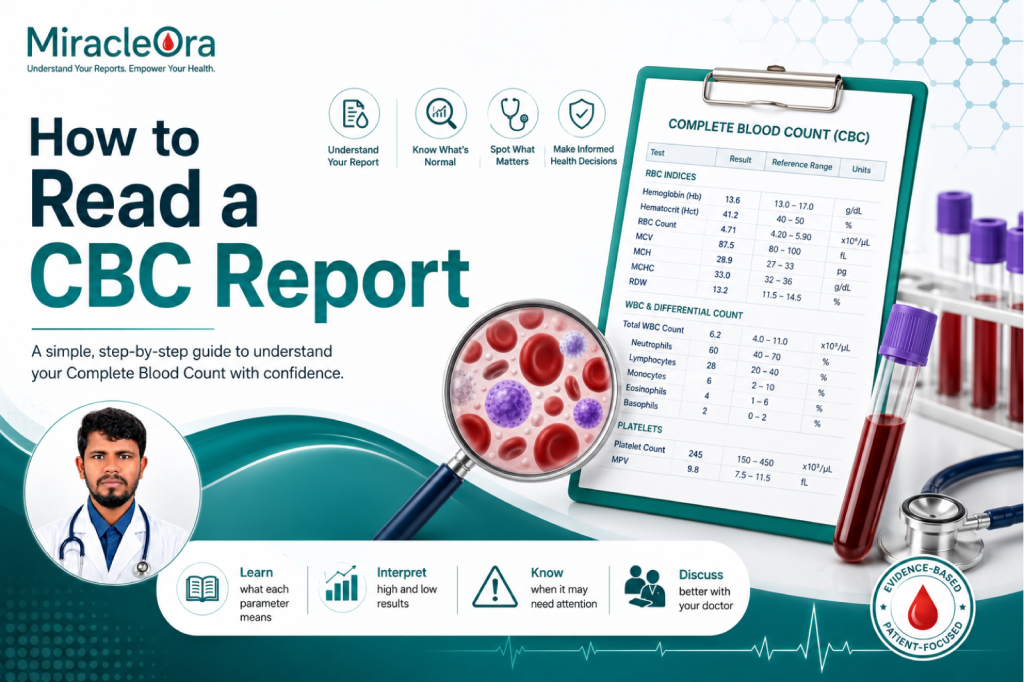
Errors are possible, and most occur before analysis: mislabeling, a difficult draw, a clotted sample, delayed transport. If a result looks seriously out of keeping with everything else, tell your doctor so the laboratory can check or repeat it. For the line-by-line meaning of the rest of your report, see how to read your CBC report.
Medical disclaimer: This article is provided by MiracleOra for general educational purposes only. It is not medical advice, diagnosis or treatment, and it does not interpret any individual person's results. Reference ranges vary by laboratory, age, sex, pregnancy status and testing method, so always compare your results to the range printed on your own report and discuss what they mean with a qualified healthcare professional who knows your medical history. If you have severe or worsening symptoms, seek urgent medical care. See our full Medical Disclaimer.