This article is general health education, not medical advice. It does not interpret any individual child's result. See our Medical Disclaimer.
Children's Blood Count Ranges vs Adults'
A child's complete blood count cannot be read against an adult chart. Blood values change substantially with age: hemoglobin is highest at birth, falls to a normal low point at around 10 to 12 weeks in healthy term infants, then climbs through childhood, while the white cell differential inverts twice, so lymphocytes outnumber neutrophils for most of early childhood before the pattern crosses back at around 5 years of age. Reference ranges are both age-specific and laboratory-specific, which is why the age band printed on your child's own report is the only one that applies, and why the pediatrician or clinician who ordered the test is the only person who can interpret it.
Why age changes everything on the report
A blood count is a snapshot of a system that is still under construction. In the first year of life the source of red cell production shifts, fetal hemoglobin is replaced, blood volume expands rapidly, and the immune system meets the world for the first time. Every one of those events moves a number on the report.
Comparing a two-month-old's hemoglobin, or a three-year-old's differential, against an adult reference band does not produce a mildly imprecise answer. It produces a wrong one, in a predictable direction, and it is the single most common reason a parent ends up frightened by a report that a clinician reads without concern.
The first thing parents misread: the infant hemoglobin dip
Hemoglobin is at its highest at birth and then falls. That fall is expected.
Research on neonatal anemia published in the National Library of Medicine's PMC archive describes it directly: in healthy term infants the lowest hemoglobin value rarely falls below 9 g/dL, with a mean of about 11 to 12 g/dL, at an age of roughly 10 to 12 weeks. Because that decline is universal and well tolerated in term infants, it is called the physiologic anemia of infancy. The same source notes that in preterm infants the decline happens earlier and is more pronounced.
Two things follow. A hemoglobin at three months that would be flagged in an adult may be part of an expected developmental pattern. And prematurity changes the pattern, which is one of many reasons a child's result needs a clinician who knows that child's history rather than a chart.
None of that means any individual low hemoglobin should be assumed to be physiologic. It means the comparison an adult chart invites is the wrong comparison, and the right one belongs to your child's clinician.
The information most pages miss: the differential crosses over twice
If you look at your child's white cell differential and see lymphocytes outnumbering neutrophils, an adult reference frame makes that look like a finding. In a young child, it is the normal state.
A study of age-dependent changes in total and differential white blood cell counts in children, published in PMC, describes neutrophil counts changing with age in the opposite direction to lymphocyte counts, with two intersections between the two lines: one during infancy and another at approximately 5 years of age. The same work describes the lymphocyte count reaching its highest level around 6 months of age and then declining steadily until around 9 years.
| Rough stage | Which line tends to lead | Why it confuses parents |
|---|---|---|
| Newborn period | Neutrophils | Looks adult-like, briefly |
| Infancy to around 5 years | Lymphocytes | A lymphocyte-predominant differential is normal here, but reads as abnormal against an adult chart |
| From around 5 years onward | Neutrophils again | The pattern converges toward the adult one through later childhood |
Based on the age-dependent white cell count research cited above. Individual laboratories band ages differently.
For scale, a published study of total and differential white cell counts in infants reported neutrophil ranges of roughly 0.7 to 4.7 x 10⁹/L at 2 months and lymphocyte ranges of roughly 3.3 to 10.5 x 10⁹/L at the same age. Those lymphocyte figures would look extraordinary on an adult report. In a two-month-old they came from a study of normal infants.
What neutrophils and lymphocytes each do, and why their balance is read rather than either number alone, is explained in neutrophils versus lymphocytes.
Why we are not printing a full children's chart
This is the part where most pages hand you a table of age bands, and where we are going to explain our refusal instead.
Children's reference intervals are published by hospital laboratories, and the major children's hospital laboratories maintain their own age-banded catalogs. They differ from each other. They differ by analyzer, by the population studied, by how the age bands are cut, and by whether the interval was established locally or verified from published data. A universal children's chart does not exist, and printing one as though it did would give a worried parent a yardstick that may not match their child's laboratory at all.
On an adult page, that mismatch produces unnecessary worry. On a page about a child's report, where the bands are narrower and change month by month in the first year, it produces worse. So:
Read the age-specific range column printed on your child's own report. It is there, beside each value, and it is the band your child's result was actually compared against.
The adult chart on this site, the complete CBC reference-range table, is labeled adult-only for exactly this reason, and pregnancy shifts the bands again, as covered in CBC in pregnancy.
What else moves through childhood
- Hemoglobin and hematocrit. Highest at birth, lowest around the physiologic nadir in early infancy, then rising through childhood. Adolescence introduces a divergence between males and females that is not present in younger children.
- White cell count. Runs higher in infancy and early childhood than in adults, and children mount larger and faster white cell responses to ordinary infections.
- Red cell indices. Average red cell size follows its own age curve, so an MCV read against an adult range can mislead in both directions.
- Platelets. Generally sit in broadly similar territory to adults through childhood, but the same rule applies: the printed range is the one that counts.
The H and L flags on a child's report
Flags are generated automatically by comparing a value with a printed band. Whether that band was the correct age band depends on the laboratory and on the information it was given about the child.
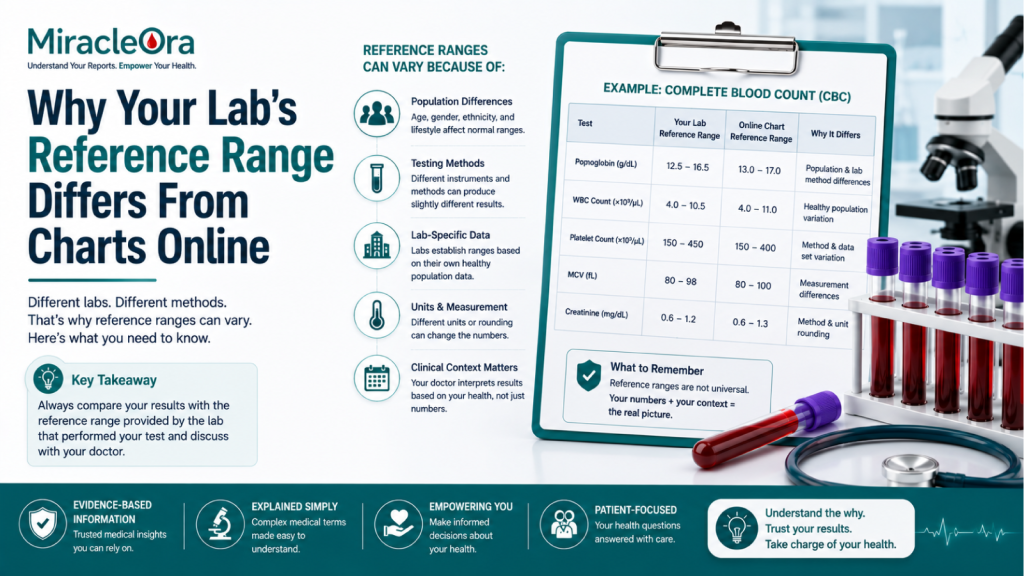
That means a flag on a child's report is a starting point for a conversation rather than a conclusion, in both directions. We are not going to tell you that a flagged value on your child's report is unimportant, because we cannot know that. What the letters mean mechanically is in what an H or L flag on your blood test means, and why printed bands vary between laboratories in why your lab's reference range differs from charts online.
What to do with your child's report
- Take it to the clinician who ordered it. They know the age band, the reason for the test and your child's history.
- Bring previous results if you have them. Trends across a child's growth carry information a single value does not.
- Note the exact age at the draw, in weeks for infants. The applicable band can change within months.
- Mention prematurity, recent illness, vaccination or fever, all of which are relevant context for a clinician.
- Do not start any supplement, including iron, on the basis of a number. In children this is a clinical decision with real consequences in both directions.
The general walkthrough of what each line measures is in how to read your CBC report, written against adult ranges.
When to seek care rather than wait
Contact your child's doctor promptly if:
- A result was reported to you as critical, or you were asked to act on it.
- A value sits markedly outside the age-specific range printed on the report.
- Your child has persistent or recurring fever, is unusually pale, or is much more tired or irritable than usual.
- Your child has unusual bruising, tiny red spots on the skin, bleeding gums or nosebleeds that will not stop.
- Your child was born preterm, has a known blood condition, or is receiving treatment that affects the blood count.
Seek urgent care immediately for a child who is difficult to wake, breathing with difficulty, has a rash that does not fade under pressure, is having a seizure, or is bleeding uncontrollably, whatever any blood result says.
Frequently asked questions
Are CBC normal ranges different for children?
Yes, substantially, and they change with age rather than being one children's set. Hemoglobin, white cell counts and the differential all follow age curves, so a child's result must be read against the age-specific band on their own report.
Why does my child have more lymphocytes than neutrophils?
Research on age-dependent white cell counts describes lymphocytes leading neutrophils through most of early childhood, with the two lines crossing during infancy and again at around 5 years of age. A lymphocyte-predominant differential that would prompt a question in an adult is the expected pattern in a young child. Your child's clinician reads it against the right age band.
Is a low hemoglobin normal in a baby?
Hemoglobin falls after birth to a low point at around 10 to 12 weeks in healthy term infants, a pattern called the physiologic anemia of infancy, and the decline is earlier and larger in preterm infants. That does not mean any particular low value is physiologic. It means the interpretation requires the child's age, birth history and clinician.
What age does a child's blood count become like an adult's?
The values converge gradually through later childhood rather than switching over on a birthday, and adolescence introduces differences between males and females in the red cell measurements. Laboratories handle this with age bands, which is why the band on the report matters more than any general statement.
Can I use an adult CBC chart for my child?
No. It is the most common way parents frighten themselves over a normal childhood result, and it can also produce false reassurance. Use the age-specific range printed on your child's report and ask the clinician who ordered it.
Medical disclaimer: This article is provided by MiracleOra for general educational purposes only. It is not medical advice, diagnosis or treatment, and it does not interpret any individual child's results. Children's reference ranges are age-specific and laboratory-specific, and they change rapidly during infancy, so always compare a child's results to the age-specific range printed on their own report and discuss what they mean with a qualified healthcare professional who knows the child's medical history. Never start, stop or change a supplement or medicine for a child based on a blood result alone. If your child has severe or worsening symptoms, seek urgent medical care. See our full Medical Disclaimer.