A complete blood count (CBC) cannot detect an infection. It detects your body's response to one. The test counts your own cells, not bacteria or viruses, so a raised or lowered white blood cell count is a clue that your immune system is doing something, not proof of what it is doing it about. A CBC can be abnormal for reasons that have nothing to do with infection, and it can be completely normal in someone who genuinely has one. Confirming an infection takes a test that looks for the organism itself, such as a culture, a PCR test, or an antigen test.
This is general health education, not medical advice. It cannot tell you whether you have an infection. Only a clinician who can examine you and see your full results can do that.
What a CBC actually measures when you are unwell
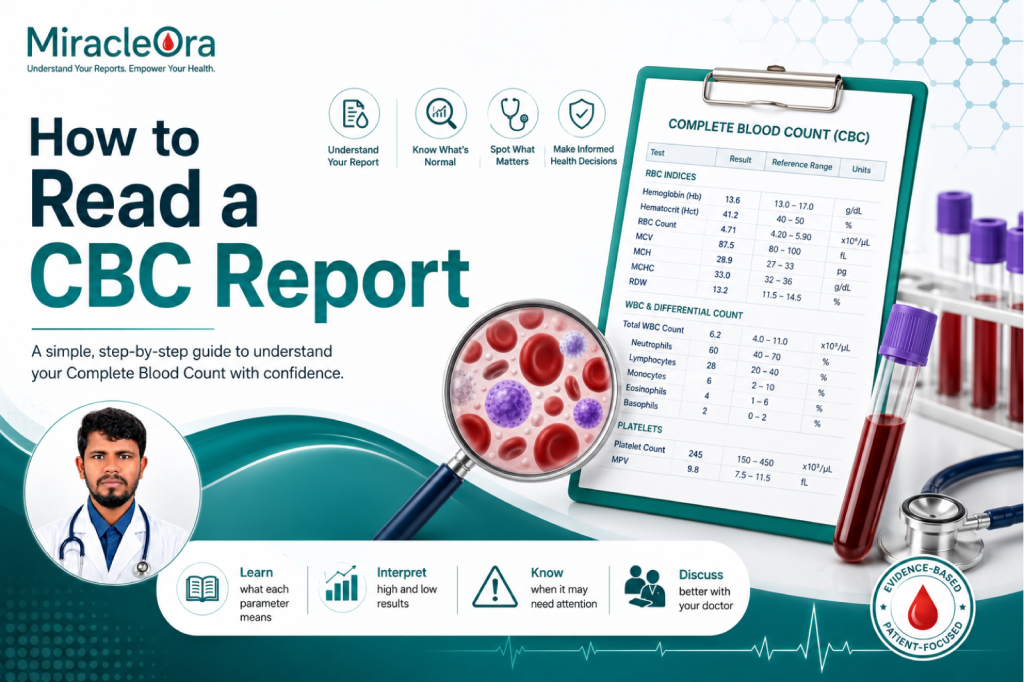
A CBC counts and describes the cells in a blood sample: red blood cells and hemoglobin, platelets, and white blood cells. White blood cells are the part of the count that shifts most during illness, because they are the cells your immune system deploys.
As reported by Cleveland Clinic, a CBC measures the amounts and sizes of your red blood cells, hemoglobin, white blood cells and platelets. Nothing in that list is a microbe. The analyzer never sees the bacterium in your throat or the virus in your airway. It sees that you are producing more neutrophils than usual, or that your lymphocytes have shifted, and a clinician reads that alongside your symptoms and examination.
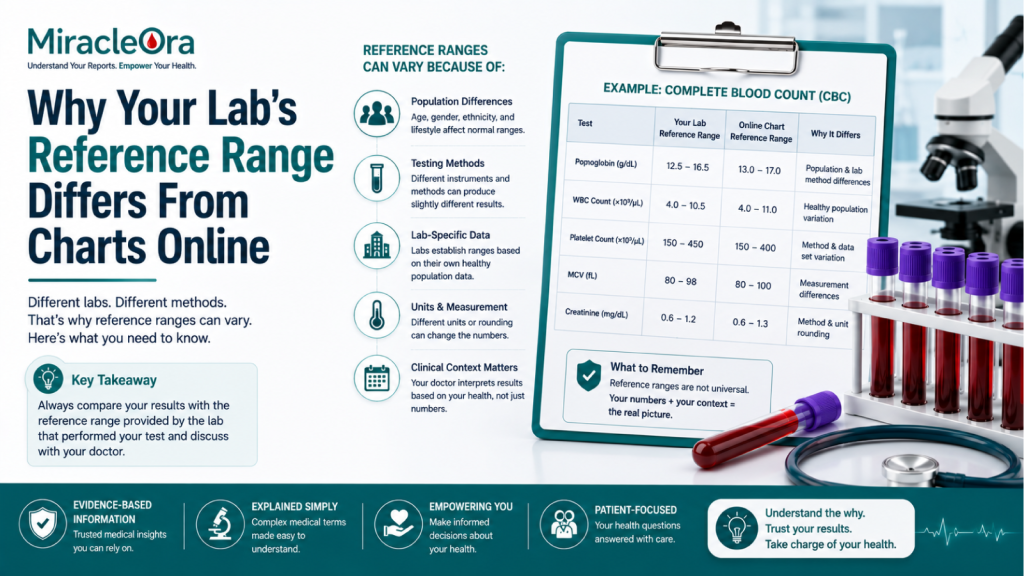
For general context, NIH/NCBI StatPearls gives a typical adult total white blood cell reference range of 4,500 to 11,000 cells/µL, though your own report prints the range its laboratory uses. A value outside that band is a prompt to look further, not a diagnosis. Our guide to reading a CBC report walks through every line on the page in plain language.
Bacterial versus viral: what the differential can and cannot suggest
If your report says "with differential", the laboratory has broken the white cell total into its subtypes: neutrophils, lymphocytes, monocytes, eosinophils and basophils. The pattern across those subtypes is where the infection clue actually lives.
The classic teaching is that neutrophils tend to rise in many bacterial infections, while lymphocyte-predominant patterns are more often seen with viral illness. That is a tendency, not a rule, and clinicians treat it as one input among many. Plenty of viral illnesses raise neutrophils. Plenty of bacterial infections do not. Some severe infections lower the white count instead of raising it.
Two related findings often appear in the same report. A "left shift" describes immature neutrophils (band cells) appearing in the blood, which suggests the marrow is releasing cells quickly. Atypical lymphocytes are sometimes noted with certain viral illnesses. Both are descriptions of appearance, not identifications of an organism. Our explainers on CBC versus CBC with differential and neutrophils versus lymphocytes cover this section of the report in more detail.
When the CBC is normal and the infection is real
This is the part the pages selling you a test tend to leave out, and it is the single most important thing to understand about using a blood count to answer an infection question. A normal CBC does not rule out an infection. There are mechanical reasons for that.
Timing. The white cell response takes time to develop and then it fades. A sample drawn very early in an illness, or well into recovery, can look unremarkable while the illness is entirely real.
Location. Many infections are local. A skin infection, a urinary tract infection, a dental abscess or a contained sinus infection may produce little or no change in a whole-body blood count, because the response is concentrated where the problem is.
A blunted response. Not everyone mounts a textbook white cell rise. Older adults, people on certain medicines including corticosteroids and chemotherapy, and people with conditions affecting the bone marrow may respond differently or hardly at all. In some serious infections the white count falls.
Low-grade and chronic infections. Slow, smoldering infections can sit below the threshold that moves a blood count noticeably.
The practical consequence is that a normal CBC is reassuring about some things and silent about others. It is never a reason to dismiss symptoms that are getting worse. Doctors weigh the count against how you look and what you report, and the clinical picture outranks the number in both directions.
Things other than infection that move the white count
The reverse error is just as common: reading a raised white count as proof of infection. Many non-infectious situations shift white cells, including:
- Physical stress, pain, and the period after surgery or an injury
- Corticosteroid medicines, which commonly raise the neutrophil count
- Smoking
- Strenuous exercise shortly before the blood draw
- Pregnancy
- Allergic and inflammatory conditions
- Some blood and bone marrow disorders
Because that list is long and mostly ordinary, an out-of-range white count usually leads to a conversation and sometimes a repeat test, not an immediate diagnosis. An H or L flag beside a value means only that the number fell outside the range that laboratory compares against. It is a comparison, not a verdict.
Which test answers which question
A CBC is a screening and monitoring tool. When the question is "is there an infection, and what is causing it", other tests carry that weight.
| Test | What it is for | What it cannot do |
|---|---|---|
| Complete blood count (CBC) | Shows whether cell counts have shifted, and how the immune response looks overall | Cannot identify any organism or locate the problem |
| Blood culture | Grows organisms present in the bloodstream so they can be identified | Takes time, and can be negative when infection is not in the blood |
| PCR or antigen test | Looks for the genetic material or proteins of a specific organism | Only finds what it is designed to look for |
| Urine culture, throat swab, wound swab | Identifies organisms at a specific site | Requires sampling the right site |
| CRP and ESR | Measure inflammation levels, used to gauge and track a response | Rise with many non-infectious causes; not specific to infection |
| Imaging (X-ray, ultrasound, CT) | Shows where a problem is, such as pneumonia or an abscess | Does not name the organism |
Read that table as a division of labor. The CBC contributes one type of evidence. It is ordered so often precisely because it is broad and quick, not because it is conclusive. Our page on what a CBC test is actually used for covers the screening role in full.
When to see a doctor
Whatever your blood count says, symptoms drive urgency. Book an appointment if you have a fever that persists or keeps returning, an area of skin that is spreading, red, hot or increasingly painful, pain or burning when passing urine, a cough that is not settling, or any illness that is getting worse rather than better.
Seek urgent or emergency care for a very high fever, confusion or unusual drowsiness, difficulty breathing or rapid breathing, a fast heartbeat with faintness, severe pain, a rash that does not fade under pressure, or fever in someone who is having chemotherapy, has a known low neutrophil count, or is otherwise immunosuppressed. As reported by Cleveland Clinic and Mayo Clinic patient resources, these features are treated as time-critical, and none of them should wait on a laboratory result.
If your CBC came back abnormal and your worry has moved past infection, our companion piece on what a blood test can and cannot show about cancer answers that question with the same honesty.
Frequently asked questions
Can a CBC tell if an infection is bacterial or viral?
It can suggest a direction and no more. Neutrophil-predominant patterns are more often associated with bacterial infection and lymphocyte-predominant patterns with viral illness, but both overlap heavily. Doctors use the differential as supporting evidence alongside your history and examination, not as a decider.
Can you have an infection with a normal white blood cell count?
Yes. Timing of the sample, a localized infection, a low-grade or chronic infection, and a blunted immune response in older or immunosuppressed people can all leave the count in range. A normal CBC does not rule out infection.
Does a high white blood cell count always mean infection?
No. Stress, pain, recent surgery, corticosteroid medicines, smoking, strenuous exercise, pregnancy, allergic and inflammatory conditions, and some blood disorders can all raise it. Your doctor interprets the value in the context of everything else.
What test confirms an infection?
Tests that look for the organism itself, such as blood or urine cultures, throat and wound swabs, and PCR or antigen tests. Imaging may be added to find the site. The CBC supports these but does not replace them.
Why did my doctor order a CBC if it cannot detect infection?
Because it is fast, broad and informative. It shows whether your counts have shifted, gives a baseline to compare later results against, and can reveal other things that need attention, such as anemia or a low platelet count. It narrows the question rather than answering it.
Medical disclaimer: This content is for general education only and is not a substitute for professional medical advice, diagnosis, or treatment. It cannot interpret your individual results or tell you whether you have an infection. Always talk to a qualified healthcare provider about your own symptoms and results, and seek urgent care for the emergency features described above. See our full Medical Disclaimer.