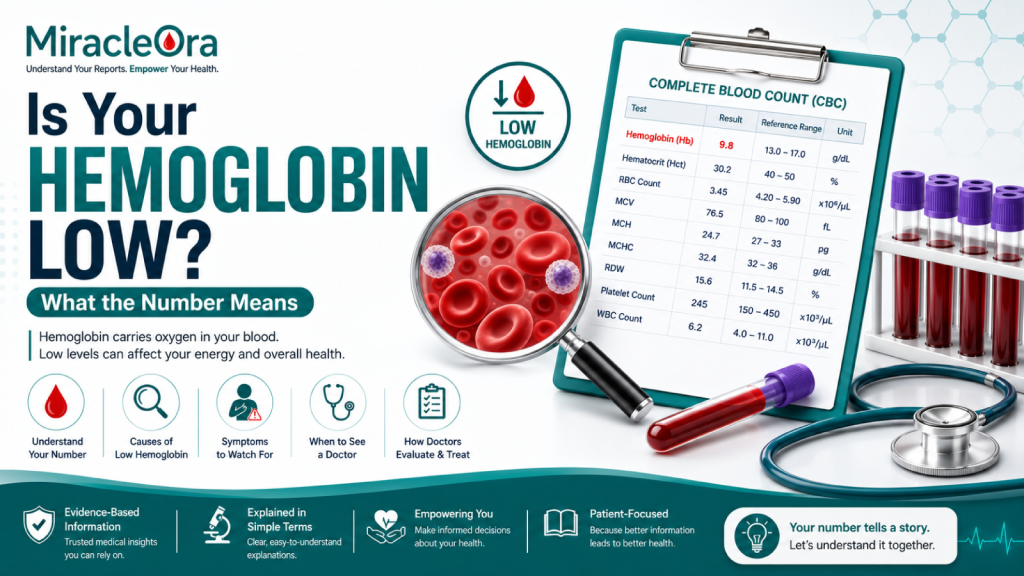
Hemoglobin runs low for one of three reasons: your body is not making enough red blood cells, you are losing blood, or your red blood cells are being destroyed faster than they are replaced. Almost every named cause fits into one of those three mechanisms. Worldwide the single most common cause is iron deficiency, and other frequent reasons include vitamin B12 or folate deficiency, chronic illness, kidney disease and blood loss, as reported by Cleveland Clinic and Mayo Clinic. A low reading can also reflect dilution rather than disease, which is why the cause matters more than the number.
This is general health education, not medical advice. It cannot tell you why your own hemoglobin is low, and it is not a reason to start any supplement. That belongs with your doctor.
Mechanism one: not enough red cells are being made
Your bone marrow builds red blood cells continuously. Production falls short when a raw material is missing, when the signal to produce is weakened, or when the marrow itself is affected.
Missing building blocks. Iron is needed for hemoglobin itself; vitamin B12 and folate are needed to build the cells. A shortfall in any of them reduces output. As reported by Cleveland Clinic, pernicious anemia is an autoimmune condition that prevents the body absorbing vitamin B12, so fewer red blood cells are produced.
A weakened signal. The kidneys produce erythropoietin, the hormone that tells the marrow to make red cells. As reported by Cleveland Clinic, chronic kidney disease disrupts that process, which is why anemia is common in kidney disease.
Suppressed production. Long-running inflammatory conditions, including some chronic illnesses, can dampen marrow activity and restrict the iron available to it. This is called anemia of chronic disease or anemia of inflammation.
The marrow itself. Less commonly, conditions affecting the bone marrow reduce the output of blood cells. These usually change more than one cell line, so white cell or platelet counts often shift too.
Thyroid and other systemic causes. Thyroid disease and several other conditions slow production, which is why thyroid function is often checked during an anemia workup.
Mechanism two: blood is being lost
Every lost red cell takes its hemoglobin, and its iron, with it. Bleeding is the most under-recognized cause among people reading their own results, because a large part of it is invisible.
Visible loss includes heavy menstrual periods, injury, surgery, childbirth and frequent blood donation.
Hidden loss is slow bleeding into the digestive tract from causes such as ulcers, inflammation, or growths in the bowel. It can be entirely silent, producing no pain and no visible blood, while quietly draining iron stores over months. This is why unexplained iron deficiency is investigated rather than simply supplemented, particularly in men and in women after menopause.
Recent, rapid blood loss looks different on a report from slow chronic loss. A sudden bleed produces anemia with normal-sized cells, because whole normal cells were lost. Only later, once iron stores are depleted, do the cells being built become small. Our page on low hemoglobin with a normal MCV covers that pattern and the tests that follow it.
Mechanism three: red cells are being destroyed too fast
Red blood cells have a limited lifespan and are normally replaced on schedule. In hemolytic anemias they are destroyed early, and the marrow cannot keep pace.
Causes include inherited conditions such as sickle cell disease and some enzyme or membrane disorders, autoimmune hemolytic anemia in which the immune system attacks the cells, certain infections, some medicines, and mechanical damage in specific medical situations. As reported by Cleveland Clinic, an enlarged spleen can also trap red cells and shorten their working life.
Because destruction usually prompts the marrow to work harder, this mechanism often shows a raised reticulocyte count, which is a large part of why that test is ordered.
Which causes are common in which situation
Doctors do not work through an alphabetical list. They weigh which causes are common for the person in front of them. The table below shows that reasoning. It is orientation only, and no row applies to any individual without assessment.
| Situation | Causes doctors commonly consider first |
|---|---|
| Menstruating women | Iron deficiency from menstrual blood loss; dietary intake |
| Pregnancy | Expanded plasma volume and increased iron demand; pregnancy has its own thresholds |
| Young children | Iron deficiency during growth; dietary intake |
| Adults over 60 | Hidden gastrointestinal blood loss; chronic disease; kidney disease |
| Known chronic kidney disease | Reduced erythropoietin signaling |
| Long-term inflammatory conditions | Anemia of inflammation, with iron restricted from the marrow |
| Vegetarian or restricted diets | Lower intake of absorbable iron and B12 |
| Families from thalassemia-endemic regions | Inherited hemoglobin disorders alongside, or instead of, iron deficiency |
| Recent surgery, injury or childbirth | Acute blood loss |
Pregnancy thresholds are set separately by the World Health Organization in its 2024 hemoglobin cutoffs guideline. The Cluster 2 pillar sets out how the thresholds work: see what a low hemoglobin number really means.
When the number is low but the blood is not
Most articles treat a low hemoglobin as necessarily a disease. Sometimes the reading is genuinely low while the total amount of hemoglobin in your body is unchanged, because hemoglobin is a concentration: an amount per volume of blood. Add more plasma and the concentration falls, even if you have exactly as many red cells as before.
Situations where this dilution effect matters include:
- Pregnancy. Plasma volume expands substantially, so hemoglobin readings normally fall. This is why pregnancy has separate reference thresholds rather than being judged against the general adult ones.
- Intravenous fluids. A sample taken after significant fluid administration can read lower than the same person’s baseline.
- Endurance training. Sustained aerobic training expands plasma volume, which can lower measured hemoglobin without reducing total red cell mass. Sports medicine literature describes this as athlete’s pseudoanemia.
- Posture and technique at the draw. Lying down for a period, and prolonged tourniquet time, can shift readings modestly in either direction.
The opposite effect is just as real: dehydration concentrates the blood and can make hemoglobin and hematocrit read higher than usual, sometimes masking a true anemia. Our page on how dehydration changes blood test results covers that direction in detail.
None of this means a low result should be dismissed. It means that a single reading is interpreted alongside your circumstances, and that a repeat test under ordinary conditions is sometimes the most informative next step.
The three questions that find the cause
Rather than matching yourself to a list, it helps to know the questions a clinician is working through.
- Is blood being lost? History does most of the work here: menstrual pattern, bowel changes, indigestion, recent surgery, visible bleeding. Tests for hidden blood loss follow if the history suggests it.
- Is a building block missing? Ferritin and iron studies, vitamin B12 and folate answer this directly. The pattern on the CBC (cell size and RDW) points to which is worth checking first. See iron deficiency anemia on a blood test for that signature.
- Is production suppressed, or are cells being destroyed? The reticulocyte count separates these, supported by kidney and thyroid tests, inflammation markers, and tests for hemolysis such as LDH, bilirubin and haptoglobin.
Those three questions are why an anemia workup looks like a long list of tests. It is not a search for something rare. It is an efficient way to identify which mechanism is at work, so treatment addresses the cause rather than the number. Our overview of the types of anemia shows how the mechanisms line up with the named types.
When to see a doctor
Any low hemoglobin on a report is worth reviewing with a clinician, even if you feel well. Book an appointment if you notice tiredness that is out of character, breathlessness on exertion, dizziness, pale skin, a fast or pounding heartbeat, or if you have heavy menstrual periods, changes in bowel habit, or persistent indigestion.
Seek urgent or emergency care for chest pain, severe or sudden shortness of breath, fainting or near-fainting, a very fast or irregular heartbeat, vomiting blood, black tarry stools, visible heavy bleeding, or yellowing of the skin or eyes with dark urine. As reported by Cleveland Clinic and Mayo Clinic patient resources, these features can indicate a rapid drop in hemoglobin or a serious underlying cause, and they are assessed without delay.
Finally, do not treat a number on your own. Iron helps only if iron is the problem, and taking it blindly can cause side effects and delay the discovery of a cause that needed finding.
Frequently asked questions
What is the most common reason for low hemoglobin?
Iron deficiency is the most common cause worldwide, and vitamin B12 or folate deficiency, chronic illness, kidney disease and blood loss account for much of the rest, as reported by Cleveland Clinic and Mayo Clinic. Which one applies is established by testing, not by matching symptoms to a list.
Can stress or lack of sleep lower hemoglobin?
Neither is an established direct cause. Fatigue has many explanations, and assuming stress is the reason can delay finding an actual cause. If your hemoglobin is genuinely below your laboratory’s range, that finding deserves its own explanation.
Can low hemoglobin happen without any bleeding?
Yes, frequently. Reduced production from a nutritional deficiency, chronic disease or kidney disease, and increased destruction of red cells, both produce anemia with no bleeding at all. Bleeding is only one of the three mechanisms.
Does a low hemoglobin always mean anemia?
A hemoglobin below the reference range is how anemia is identified, but the reading itself can be affected by dilution, such as in pregnancy or after intravenous fluids. Your doctor interprets the value in context and may repeat it before concluding anything.
How will my doctor find the cause?
By combining your history and examination with the rest of your CBC, particularly the MCV and RDW, then adding targeted tests: ferritin and iron studies, B12 and folate, a reticulocyte count, kidney and thyroid function, and investigations for blood loss where the history suggests it.
Medical disclaimer: This content is for general education only and is not a substitute for professional medical advice, diagnosis, or treatment. It cannot identify the cause of your own low hemoglobin and is not guidance to take any supplement. Always talk to a qualified healthcare provider about your own results, and seek urgent care for the emergency features described above. See our full Medical Disclaimer.