Short answer: If you are asking what is ITP blood disorder, the name stands for immune thrombocytopenia: a condition in which the immune system attacks and destroys the body's own platelets by mistake, leaving a low platelet count. The National Heart, Lung, and Blood Institute (NHLBI) (last updated July 24, 2025, read September 24, 2026) describes it as a platelet disorder in which blood does not clot as it should. Some people have no symptoms, while others notice easy bruising, tiny red spots or nosebleeds. In children it often clears within weeks or months. Your hematologist or ordering clinician confirms the diagnosis and explains what it means for you.
A laboratory report should not create fear. It should create understanding. "ITP" is often said quickly in a clinic, and many people leave the appointment unsure what it means. This page explains the name, what happens in the body, how doctors confirm it, what the words "acute", "persistent" and "chronic" mean, and which signs need care straight away.
When to get care right away
These signs come first because they matter more than any number on a report.
- Bleeding that will not stop. The NHLBI's ITP page advises seeking immediate medical attention for uncontrollable bleeding that does not stop when you apply pressure. Cleveland Clinic calls any bleeding that cannot be stopped with pressure a medical emergency that needs the emergency room.
- Severe bleeding or new symptoms. MedlinePlus's ITP page (review date January 29, 2026, read September 24, 2026) advises going to the emergency room or calling 911 if severe bleeding occurs or if other new symptoms develop. It lists sudden, severe blood loss from the digestive tract and bleeding into the brain as possible complications.
- Signs of a bleeding problem. MedlinePlus advises contacting your provider if you have symptoms of a bleeding disorder.
If you feel too unwell to wait for an appointment, go to the nearest emergency department. For everything else, the clinician managing your care is the right person to explain your results.
What is ITP blood disorder? What the letters mean
Cleveland Clinic's ITP page (last reviewed August 24, 2023, read September 24, 2026) calls ITP a rare blood disorder and breaks the name down:
| Word | What it means |
|---|---|
| Immune | The immune system is involved |
| Thrombocytopenia | A low platelet count |
| Purpura | Red or purple spots on the skin from bleeding under the skin |
The condition was once called idiopathic thrombocytopenic purpura, "idiopathic" meaning the cause was unknown. You may still see that older name, or "immune thrombocytopenic purpura", on letters and websites. They refer to the same condition.
What happens in the body
Platelets are tiny blood cells that help stop bleeding. The NHLBI explains that when you are injured, platelets "stick together to form a plug, called a blood clot, that seals your wound." In ITP, according to the NHLBI, "your immune system attacks and destroys your body's platelets by mistake." With fewer platelets available, bleeding can be harder to stop.
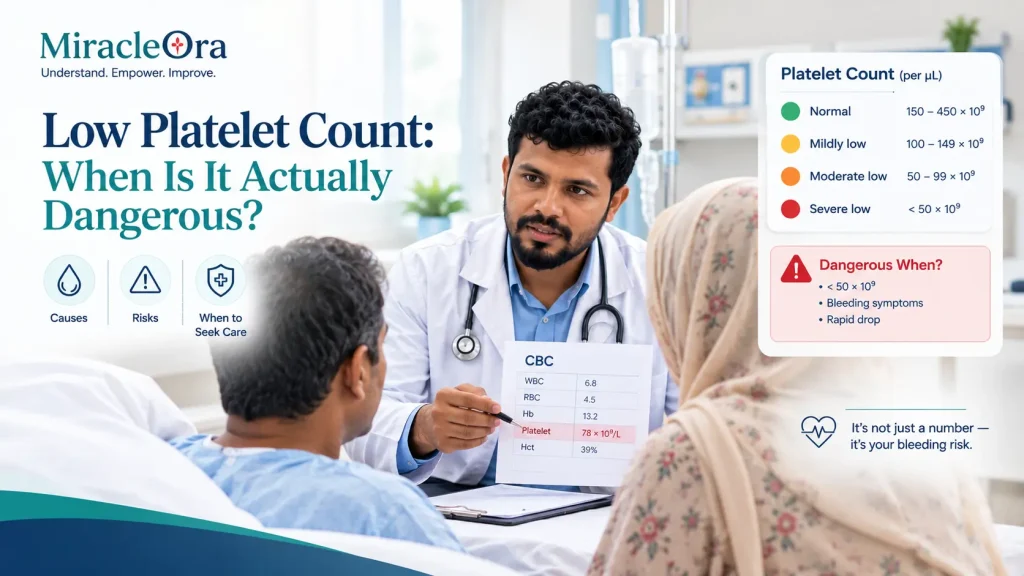
How low is low? The NHLBI's thrombocytopenia page (last updated February 18, 2025, read September 24, 2026) gives a normal adult platelet count of 150,000 to 450,000 per microliter, and each laboratory prints its own range beside your result. The same page notes that serious bleeding may not happen until the platelet count is very low. Our guide to when a low platelet count is actually dangerous explains how clinicians think about severity.
How common is it? Cleveland Clinic states that each year, about 4 in 100,000 children and 3 in 100,000 adults in the United States learn they have it.
Primary and secondary ITP
Cleveland Clinic states that about 80% of cases are primary ITP, where the immune system attacks platelets without another condition behind it. Secondary ITP is linked to an infection or another condition.
The NHLBI lists possible triggers, including viral or bacterial infections, certain antibiotics and antivirals, vaccines in rare cases, and autoimmune conditions such as lupus. Cleveland Clinic adds that doctors may test for HIV, hepatitis C and the stomach bacterium H. pylori when a person has risk factors for them.
On medicines: some medicines appear on the NHLBI's list of possible triggers. That is a question for the prescriber, not a reason to stop anything. No medicine should be started, stopped or changed because of a diagnosis name and a web page.
Acute, persistent, chronic: what the words mean
These words describe how long ITP has lasted. They are not a measure of how severe it is. Cleveland Clinic defines them this way:
- Acute ITP usually goes away within three months and affects more children than adults.
- Persistent ITP lasts between three and 12 months.
- Chronic ITP lasts a year or more.
The NHLBI draws the line a little differently: it describes acute ITP as often lasting less than 12 months and mainly affecting children, and chronic ITP as lasting 12 months or longer, mostly in adults, and occurring two to three times more often in women than in men. The American Society of Hematology's 2019 guidelines for ITP (Neunert and colleagues, Blood Advances, read September 24, 2026) organize their recommendations around newly diagnosed, persistent and chronic ITP.
If your doctor uses one of these words, it helps to ask which definition they mean. The difference between sources is a reminder that the label is about time, and your clinician is the one who applies it to you.
Symptoms, and why some people have none
The NHLBI states that ITP "may not cause any symptoms," so for some people the first sign is a low number on a blood test. When symptoms occur, the NHLBI lists:
- Petechiae, small red spots under the skin
- Purpura, bleeding under the skin that leaves colored spots
- Nosebleeds
- Blood in the urine or stool
- Heavy menstrual bleeding
- Fatigue
Cleveland Clinic's list also includes bruising and bleeding gums.
How doctors confirm ITP
A low platelet count alone does not make the diagnosis. Cleveland Clinic explains that ITP symptoms are like other bleeding disorder symptoms, and that ITP may be a complication of blood cancer, so "Your provider will eliminate other possible causes before making a diagnosis." In other words, ITP is confirmed partly by showing that other explanations do not fit.
The tests the NHLBI, Cleveland Clinic and MedlinePlus describe include:
- A complete blood count, which measures the platelet count and the other blood cells.
- A blood smear, where a sample is examined under the microscope. Our guide to what a peripheral blood smear is and why it is ordered explains the process.
- Tests for underlying causes, such as HIV, hepatitis C or H. pylori when risk factors are present.
- Bone marrow tests in some cases. The NHLBI says these can help confirm ITP rather than another platelet disorder, especially if treatment is not working.
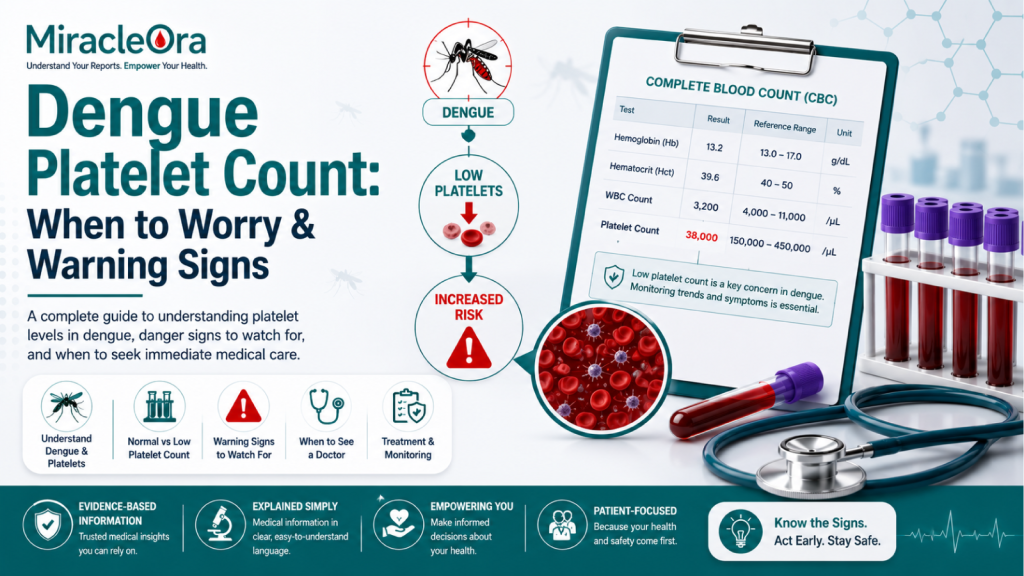
A low platelet count can have other explanations, which is why this checking step matters. If dengue is possible where you live or have traveled, our guide to the dengue platelet count and its warning signs covers that separate situation.
What treatment decisions are about
This section explains what the sources describe. It is not a recommendation, and it contains no doses. Whether any treatment is needed is a decision between you and your hematologist.
The NHLBI notes that "You may not need treatment if your platelet count reaches or stays in a healthy range." Where treatment is used, the NHLBI names several types: corticosteroids, intravenous immunoglobulin (IVIG), anti-D immunoglobulin, immunosuppressants, rituximab, thrombopoietin receptor agonists, and in some cases removal of the spleen. It describes platelet transfusion as a way to raise the count quickly during serious bleeding.
The American Society of Hematology's 2019 guidelines found "a lack of evidence to support strong recommendations for various management approaches" and emphasized "shared decision-making, especially with regard to second-line therapy." In plain terms, there is often more than one reasonable path, and your own circumstances and preferences are part of the decision. That is a good reason to bring your questions to the appointment.
The outlook
The sources are reassuring, especially for children:
- The NHLBI states that acute ITP "often goes away on its own within a few weeks or months and does not return."
- Cleveland Clinic says a child with ITP will probably get better within a few weeks or months without needing treatment.
- For chronic ITP, the NHLBI states: "Most people who have chronic ITP can stop treatment at some point and maintain a healthy platelet count."
- MedlinePlus says that in adults the chance of remission is good with treatment, although the condition can become chronic and may return after a symptom-free period.
Questions to bring to your hematologist
- Is this primary or secondary ITP, and were other causes ruled out?
- Which phase would you call this, and how are you defining it?
- What platelet count are we watching for, and how often will it be checked?
- Which symptoms should make me call you, and which mean going straight to the emergency room?
- Do any of my regular medicines or supplements need review with my prescriber?
Frequently asked questions
What is ITP blood disorder?
ITP, or immune thrombocytopenia, is a condition in which the immune system destroys platelets by mistake, leading to a low platelet count, according to the NHLBI. It was once called idiopathic thrombocytopenic purpura.
Can ITP go away on its own?
Often, in children. The NHLBI says acute ITP often goes away on its own within a few weeks or months and does not return, and Cleveland Clinic says a child will probably get better without needing treatment. The NHLBI notes that chronic ITP mostly affects adults, and your hematologist can tell you what to expect in your case.
What causes ITP?
The immune system attacks platelets by mistake. The NHLBI lists possible triggers including viral or bacterial infections, certain antibiotics and antivirals, rarely vaccines, and autoimmune conditions such as lupus. Cleveland Clinic states that about 80% of cases are primary, meaning no other condition is behind them.
Does everyone with ITP need treatment?
No. The NHLBI says treatment may not be needed if the platelet count reaches or stays in a healthy range, and that treatment for platelet disorders depends on the type of disorder and your symptoms. The decision is made with your hematologist.
The short version
- ITP means the immune system is destroying platelets by mistake, which lowers the platelet count.
- Some people have no symptoms; others notice bruising, petechiae, purpura or nosebleeds.
- Doctors confirm ITP by testing and by ruling out other causes of a low count.
- "Acute", "persistent" and "chronic" describe how long ITP has lasted, and sources define them slightly differently.
- Bleeding that does not stop with pressure is an emergency. Your hematologist interprets your results and any treatment choice with you.