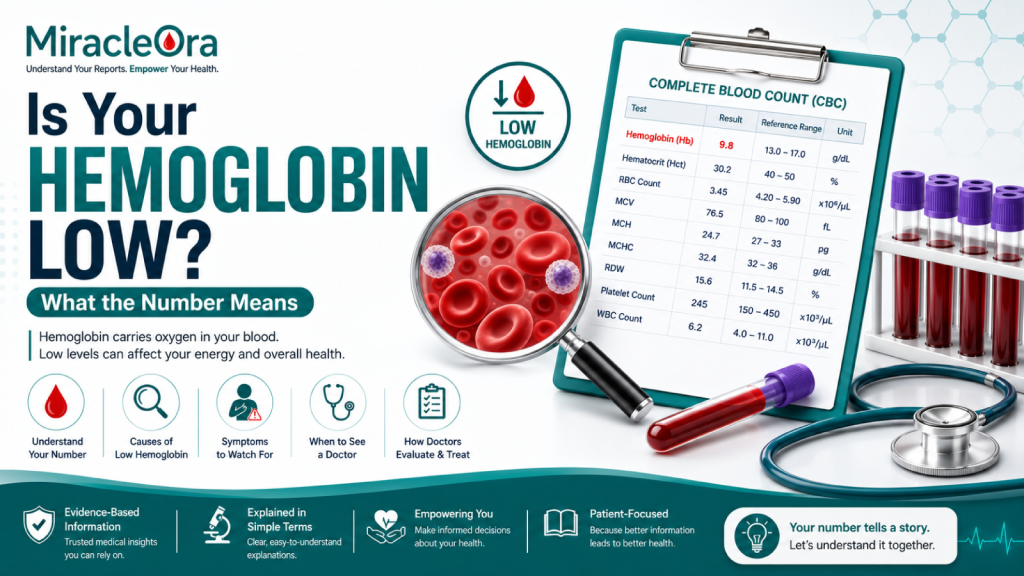
A low hemoglobin with a normal MCV is called normocytic anemia: there are not enough red blood cells, but the ones you have are a normal size. As reported by NIH/NCBI StatPearls, this is defined as a low hemoglobin and hematocrit with an MCV inside the usual 80 to 100 femtoliter range. That combination rules out the easiest explanations (it is not the classic small-cell picture of iron deficiency, nor the large-cell picture of B12 or folate deficiency), so the next step is usually not another hemoglobin test. It is a reticulocyte count, which tells your doctor whether the bone marrow is producing cells too slowly or whether cells are being lost or destroyed faster than they can be replaced.
This is general health education, not medical advice. It cannot tell you why your hemoglobin is low. Your doctor interprets this pattern alongside your history, examination and other results.
What “normal MCV” actually means on your report
MCV stands for mean corpuscular volume, the average size of your red blood cells. As reported by NIH/NCBI StatPearls, the normal range is generally 80 to 100 fL, though your report prints the range its own laboratory uses.
When the MCV sits inside that band while hemoglobin sits below it, the report is telling you something specific: the cells being produced look structurally normal, but there are too few of them in circulation. Doctors call this normocytic (normal size) and often normochromic (normal color, meaning normal hemoglobin content per cell).
That is genuinely useful information, because it removes two whole families of cause from the front of the queue. It does not narrow things to one answer. Normocytic anemia is the broadest of the three size categories, which is exactly why a structured next step exists. Our overview of the types of anemia explains how the three size families sit alongside the mechanism-based grouping, and the Cluster 2 pillar covers what a low hemoglobin number means in general.
The fork in the road: your reticulocyte count
Reticulocytes are your newest red blood cells, released from the bone marrow before they are fully mature. Counting them answers one question that nothing else on a standard CBC answers: is the factory keeping up?
As reported by NIH/NCBI StatPearls, a reticulocyte count must be obtained in normocytic anemia to determine the mechanism. The result splits the workup into two branches, and this fork is the single most useful thing to understand about this pattern.
- Reticulocytes low or not raised. The marrow is not compensating. Something is limiting production.
- Reticulocytes high. The marrow is working hard and replacing cells at speed, which means cells are being lost through bleeding or destroyed prematurely.
Laboratories report reticulocytes as a percentage, as an absolute count, or both, and the way the result is interpreted depends on how anemic you are. That is why this is a number your doctor reads in context rather than one you can score yourself against a chart.
Branch one: the marrow is not keeping up
If reticulocytes are not raised, the question becomes what is limiting production. The categories doctors consider include:
- Anemia of chronic disease, also called anemia of inflammation. Ongoing inflammation, infection or long-term illness suppresses red cell production and restricts the iron available to the marrow. This is one of the most common causes of normocytic anemia in adults.
- Kidney-related anemia. The kidneys produce erythropoietin, the hormone that signals the marrow to make red cells. As reported by Cleveland Clinic, chronic kidney disease reduces that signal, and the anemia that follows is typically normocytic.
- Endocrine and other systemic causes. Thyroid disease and some other conditions slow production. Thyroid function is often checked at this stage.
- Early or partial deficiency. Iron, B12 or folate deficiency can produce a normal MCV before it produces a characteristic one. The size change appears as the deficiency develops.
- Bone marrow disorders. Less common, and usually accompanied by changes in the white cell or platelet counts as well, which is one reason your doctor reads the whole report rather than one line.
Branch two: cells are being lost or destroyed
If reticulocytes are high, the marrow is responding normally and something downstream is removing red cells.
Bleeding. Acute or recent blood loss produces a normocytic anemia, because whole cells of normal size are leaving the body. The MCV only falls later, once iron stores are depleted enough to affect the cells being built. Bleeding can be obvious, such as heavy menstrual periods, surgery, injury or childbirth, or hidden, such as slow bleeding in the digestive tract. Hidden gastrointestinal blood loss is the cause most often missed by readers trying to interpret their own report, because there is nothing to see.
Hemolysis. In hemolytic anemias, red cells are destroyed before their normal lifespan ends. As reported by NIH/NCBI StatPearls, supporting evidence of increased destruction includes a raised LDH, a raised indirect bilirubin, and a reduced haptoglobin, and a peripheral blood smear is examined to look at cell shape directly. Causes include autoimmune hemolytic anemia, inherited red cell disorders, some infections and some medicines.
A blood film is often the quickest way to move this branch forward. Our page on the peripheral blood smear explains what a microscope adds that an analyzer cannot see.
A normal MCV is an average, not an all-clear
Here is the honest limitation that most pages skip, and it matters.
MCV is a mean. If one process is shrinking your red cells and another is enlarging them, the average can land comfortably in the normal range while both problems are real. The classic example is combined iron deficiency (small cells) and B12 or folate deficiency (large cells), which can average out to a perfectly ordinary MCV.
The usual clue is RDW, the red cell distribution width, which measures how much your cell sizes vary. A raised RDW with a normal MCV says the population of cells is mixed, even though the average looks unremarkable. That is why doctors read MCV and RDW as a pair rather than in isolation, and why a normal MCV never closes the question by itself. Our explainer on a high RDW with a normal MCV covers this combination directly.
The same blurring happens after a recent transfusion, when a deficiency is early, and when a chronic illness is layered on top of a nutritional deficiency. It is one of the strongest arguments for letting the workup run rather than reaching a conclusion from two numbers.
The tests that usually follow, and the question each answers
| Test | The question it answers |
|---|---|
| Reticulocyte count | Is the marrow keeping up, or not? |
| Ferritin and iron studies | Are iron stores depleted, or locked away by inflammation? |
| Vitamin B12 and folate | Is a building block missing, even without large cells? |
| Kidney function tests | Is the erythropoietin signal reduced? |
| Thyroid function | Is an endocrine cause slowing production? |
| LDH, bilirubin, haptoglobin | Is there evidence of red cells being destroyed? |
| Peripheral blood smear | What do the cells actually look like under a microscope? |
| Tests for occult blood loss | Is blood being lost where it cannot be seen? |
Sequence and rationale as described in NIH/NCBI StatPearls, “Normochromic Normocytic Anemia”. Which of these your doctor orders, and in what order, depends on your history and examination. Seeing a list of tests on a request form is not a sign that something serious is suspected; it is how this particular pattern is worked through efficiently.
If iron deficiency does turn out to be part of the picture, the classic laboratory pattern is worth understanding in its own right: see iron deficiency anemia on a blood test.
When to see a doctor
A low hemoglobin with a normal MCV should always be reviewed, because the branch it belongs to changes everything that follows. Book an appointment to discuss the result, and mention anything that could point to blood loss, including heavy periods, black or bloody stools, indigestion, or recent surgery.
Seek urgent or emergency care for chest pain, severe or sudden shortness of breath, fainting or near-fainting, a very fast or irregular heartbeat, vomiting blood, black tarry stools, visible heavy bleeding, or yellowing of the skin or eyes with dark urine, which can accompany rapid red cell destruction. As reported by Cleveland Clinic and Mayo Clinic patient resources, these features are assessed without delay.
Frequently asked questions
What does a low hemoglobin with a normal MCV mean?
It means normocytic anemia: too few red cells, of normal size. It points away from the classic small-cell and large-cell deficiency patterns and toward causes such as recent blood loss, chronic disease, kidney-related anemia, an early deficiency, or red cell destruction. The reticulocyte count is what separates those groups.
Can it still be iron deficiency if my MCV is normal?
Yes. Iron deficiency usually shrinks red cells eventually, but early in the process the MCV can remain normal, and a mixed picture can hold it there. Ferritin and iron studies answer the question directly rather than relying on cell size.
Why did my doctor order a reticulocyte count?
Because it separates the two mechanisms. A low or unraised count suggests the marrow is under-producing; a high count suggests cells are being lost or destroyed and the marrow is compensating. As reported by NIH/NCBI StatPearls, this is the standard next step in normocytic anemia.
Is normocytic anemia serious?
It ranges widely. Some causes are mild and easily corrected, others need prompt attention. Severity depends on how low the hemoglobin is, how fast it fell, your symptoms, and above all what is causing it. That is why the workup matters more than the label.
Should I start iron supplements while I wait for results?
Not on your own. If iron deficiency is not the cause, iron will not help and can cause side effects. Starting it can also blur the results your doctor is waiting on. Let the cause be identified first, then follow the guidance you are given.
Medical disclaimer: This content is for general education only and is not a substitute for professional medical advice, diagnosis, or treatment. It cannot interpret your individual results or tell you which cause applies to you. Always talk to a qualified healthcare provider about your own hemoglobin and MCV, and seek urgent care for the emergency features described above. See our full Medical Disclaimer.