A parent looking at a child's blood report and comparing it to an adult chart found online is doing something the numbers do not support, and the mismatch produces a lot of unnecessary fear.
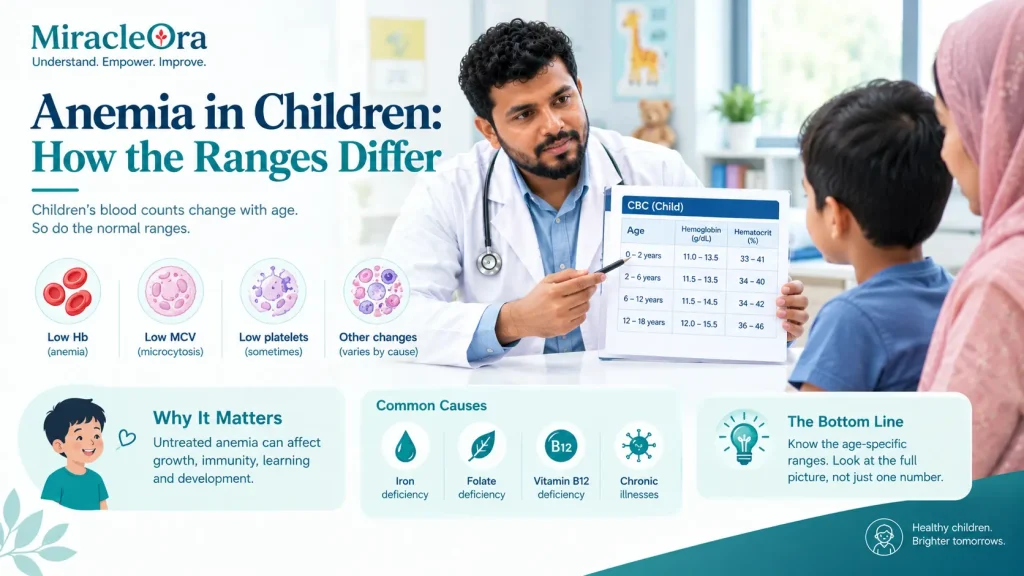
A child's hemoglobin is read against a child's interval, and that interval changes with age. It is not one paediatric range. It moves through infancy and childhood, which is why a value that is entirely expected at one age can be flagged at another.
Why the interval moves
The short version is that a child's blood is doing different things at different stages.
A newborn arrives with a red cell population built for life before birth, and that population turns over in the first months. What follows is a period in which the values are lower than they will later be, and then a gradual rise through childhood toward adult figures, with a divergence between boys and girls arriving later.
So the reference interval is not a fixed target that a child is growing toward. It is a moving line, and a laboratory's paediatric report is supposed to print the interval appropriate to that child's age beside the result.
This site covers the wider version of that in CBC normal ranges for children, which goes through the other lines on a child's report, and hemoglobin normal range by age covers how the hemoglobin line itself is banded.
Why no cutoff appears on this page
We opened WHO's "Guideline on haemoglobin cutoffs to define anaemia in individuals and populations" (published 5 March 2024) on 2026-08-28 and confirmed its title, publisher and date. The overview page did not carry the numeric thresholds, and our retrieval did not reach the full guideline document. No paediatric cutoff is published here as a result.
We also attempted a CDC data page on iron deficiency the same day. That request returned an HTTP 403 to our fetcher, so nothing on this page is attributed to CDC.
Both of those are our retrieval failing, stated plainly. It is worth being explicit about it rather than quietly filling the gap from memory, because a wrong haemoglobin cutoff applied to a child by a worried parent is precisely the harm this site exists to avoid.
There is also a reason beyond retrieval. The interval your laboratory printed beside your child's result is the one that laboratory established for its own method and its own paediatric bands, and why your lab's reference range is different explains why two correct laboratories can print two different intervals for the same age.
The number that matters is on your child's report, next to the result. Not on this page.
What WHO publishes about children
The WHO fact sheet "Anaemia", dated 10 February 2025, is explicit about who carries the burden.
On the most affected groups, WHO names "children under 5 years of age, particularly infants and children under 2 years of age, menstruating adolescent girls and women, and pregnant and postpartum women."
On scale: "Globally, it is estimated that 40% of all children aged 6–59 months, 37% of pregnant women and 30% of women 15–49 years of age are affected by anaemia." The fact sheet adds that anaemia "is estimated to affect half a billion women 15–49 years of age and 269 million children 6–59 months of age worldwide."
Two things a parent should take from that.
It is extremely common. A child found to be anaemic is in a very large group. That is not a reason to dismiss it, and it is a reason not to read the finding as rare or ominous.
Under-twos are singled out. WHO names infants and children under two specifically within the under-five group, which is why testing and monitoring in that period is routine in many health systems rather than a response to something being wrong.
The causes are not all dietary
The same WHO fact sheet states: "Anaemia may be caused by several factors: nutrient deficiencies, inadequate diet (or the inadequate absorption of nutrients), infections, inflammation, chronic diseases, gynaecological and obstetric conditions, and inherited red blood cell disorders."
MedlinePlus's "Anemia" entry (review/update 29 January 2026) lists iron deficiency, vitamin B12 deficiency, folate deficiency, certain medicines, destruction of red blood cells, chronic diseases, inherited forms, pregnancy, bone marrow problems and blood loss.
The reason to read those lists rather than skim them: inherited red cell disorders appear on both. In parts of the world where thalassaemia trait and other inherited conditions are common, a child's small red cells are not automatically an iron story, and the distinction is made with the numbers already on the report plus further testing. The types of anemia covers how that separation begins, and why hemoglobin might be low covers the wider set of explanations.
Infections and inflammation are also on WHO's list, which matters because a child tested during or shortly after an illness can produce a result that reflects the illness rather than a standing problem.
A flagged result and a well child
This combination is common and it is not a contradiction. Reference intervals are constructed so that a proportion of entirely healthy individuals fall outside them, which means a result slightly outside an interval is a statistical event before it is a medical one. An abnormal blood test when you feel fine works through the arithmetic.
For a child specifically, two further points:
A single reading is a point, not a direction. A repeat, and where the value sits relative to previous ones, tells a paediatrician far more than one figure.
A repeat test is not bad news. It is the ordinary way of distinguishing a transient finding from a persistent one.
What this page will not do
No supplement, no dose, no food list, no target level, for a child or anyone else.
The reason is stronger here than anywhere else on this site. A child cannot report symptoms reliably, a parent acting on a general recommendation is acting on someone else's behalf, and several of the substances involved are genuinely harmful in excess. MedlinePlus's iron pages carry that warning directly and this site's iron studies page already set the line.
The decision about whether a child's result needs anything, and what, belongs to that child's pediatrician, who has the growth record, the history, the examination and the full report.
The short version
- A child's result is read against a child's interval, and that interval moves with age.
- No cutoff appears here. Our retrieval did not reach WHO's 2024 guideline document, and the CDC page we tried returned a 403 to our fetcher.
- The interval that matters is printed beside your child's result.
- WHO (10 February 2025) estimates 40% of children aged 6 to 59 months are affected, and names under-twos specifically.
- Causes include inherited red cell disorders, infection and inflammation, not only diet.
- A flagged result in a well child is common. A repeat test is routine, not alarming.
- Nothing here is a treatment. Bring the report to your child's pediatrician.