There is no single hemoglobin range that applies to everyone. The World Health Organization’s 2024 cutoffs for defining anemia run from 10.5 g/dL for children aged 6 to 23 months up to 13.0 g/dL for men aged 15 and over, with separate values for each trimester of pregnancy. Those cutoffs are not the same thing as the reference range printed on your own report, which your laboratory sets from its own instruments and population. The sourced cutoffs are set out below, and your report’s own range is the one your result was measured against.
This is general health education, not medical advice. It cannot tell you what your own result means. That conversation belongs with the clinician who ordered the test.
Two Different Numbers Both Get Called “the Normal Range”
Most charts online blur two objects that laboratories and guideline bodies keep separate, and the difference explains most of the confusion people arrive with.
A guideline cutoff is one number with one direction. WHO publishes a hemoglobin value below which anemia is defined for a given group. There is no upper figure in it, because that is not what it is for.
A laboratory reference interval has two ends, a lower limit and an upper limit. A 2024 review of reference intervals in clinical chemistry describes them as “a selection of a set of results, usually the middle 95%, measured on a well-defined reference population,” and notes that “method bias and differences in populations can greatly influence RIs and prevent them from being transferable between some laboratories.”
So a chart that prints “12 to 16” and a guideline that prints “below 12.0” are answering different questions. MedlinePlus states the practical consequence: the normal range “may vary, based on the laboratory used and your age, race, and sex.” The fuller version of that point is in why your lab’s reference range differs from charts online.
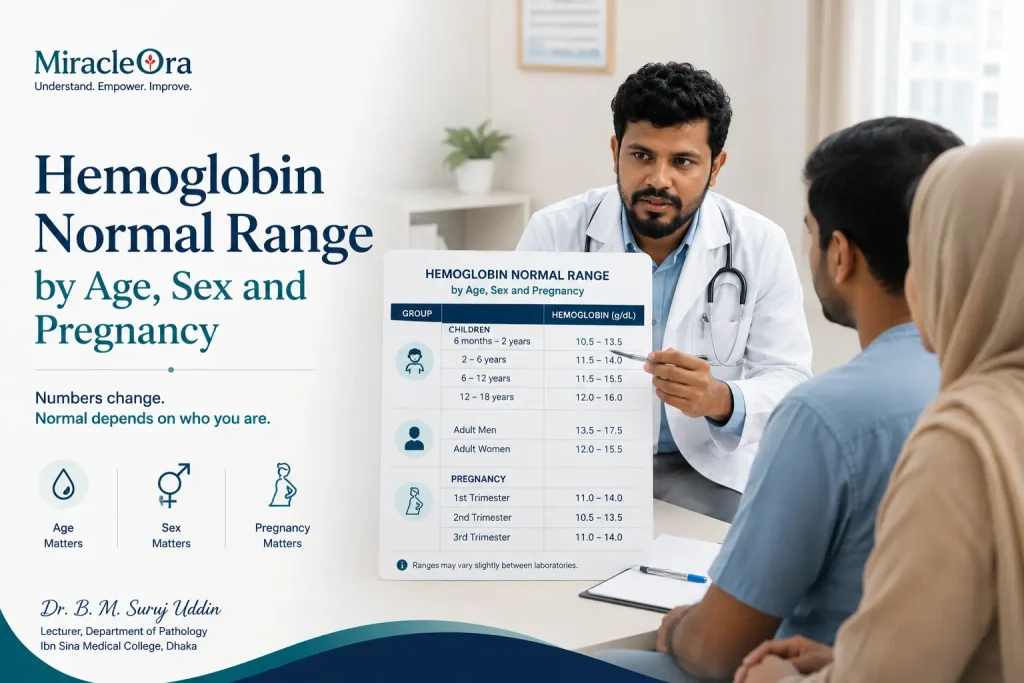
WHO 2024 Hemoglobin Cutoffs, by Age and Sex
These are the individual-level cutoffs below which the World Health Organization defines anemia. WHO publishes them in grams per liter; the g/dL column is the same value divided by ten, because many reports use those units.
| Group | Anemia cutoff (g/L) | Same value in g/dL |
|---|---|---|
| Children 6 to 23 months | below 105 g/L | below 10.5 g/dL |
| Children 24 to 59 months | below 110 g/L | below 11.0 g/dL |
| Children 5 to 11 years | below 115 g/L | below 11.5 g/dL |
| Children 12 to 14 years | below 120 g/L | below 12.0 g/dL |
| Non-pregnant women, 15 years and older | below 120 g/L | below 12.0 g/dL |
| Men, 15 years and older | below 130 g/L | below 13.0 g/dL |
| Pregnant, first trimester | below 110 g/L | below 11.0 g/dL |
| Pregnant, second trimester | below 105 g/L | below 10.5 g/dL |
| Pregnant, third trimester | below 110 g/L | below 11.0 g/dL |
Source: World Health Organization, Guideline on haemoglobin cutoffs to define anaemia in individuals and populations (2024).
Note what this table does not contain. WHO’s cutoffs begin at 6 months of age, so there is no authoritative WHO figure here for newborns or younger infants, and we have not filled that gap with numbers we cannot attribute. A result for a baby under 6 months belongs with the pediatric team that ordered it.
What the 2024 Revision Changed
The 2024 guideline was WHO’s first significant update to these thresholds since 1968. Most values were reaffirmed rather than moved, which is worth knowing if you are comparing an older chart with a newer one and expecting a large difference.
The changes were targeted. The youngest children were split into two bands, 6 to 23 months at 105 g/L and 24 to 59 months at 110 g/L, where older charts often carried a single “under 5” figure. The second trimester of pregnancy is set at 105 g/L, distinct from the 110 g/L used in the first and third. WHO also revised its approach to elevation.
This is a good example of why a printed chart carries a date and a source, or should. A number without a source cannot be checked, and a number without a year cannot be known to be current. If you want the full report on one page, our CBC normal range chart sets hemoglobin next to the other values on the same report.
Pregnancy: Different Numbers for a Physiological Reason
Hemoglobin is a concentration, and pregnancy changes the volume it is measured in. StatPearls, on the NCBI Bookshelf, states that pregnant patients may have a lower hematocrit due to hemodilution. The same dilution applies to hemoglobin, which is why pregnancy has its own thresholds rather than being read against the non-pregnant range.
The American College of Obstetricians and Gynecologists, in Practice Bulletin 233 (2021), defines anemia in pregnancy as hemoglobin below 11 g/dL or hematocrit below 33% in the first trimester, below 10.5 g/dL or 32% in the second, and below 11 g/dL or 33% in the third. WHO’s 2024 cutoffs use the same hemoglobin values.
A hemoglobin result in pregnancy is read by the obstetric team alongside the rest of antenatal care, and it is not a number to act on alone. What else shifts on a blood count during pregnancy is covered in CBC values in pregnancy.
Children and Teenagers: Never an Adult Range
Applying an adult range to a child’s report is one of the more common ways a number gets misread at home. As the WHO table shows, a hemoglobin of 11.2 g/dL sits above the cutoff for a three year old and below it for a fourteen year old. The age band decides the comparison.
Screening ages are set separately from cutoffs. The American Academy of Pediatrics, on its HealthyChildren site, says babies and toddlers should be screened for iron deficiency “starting at about 9 to 12 months for babies that mostly consume breast milk and 15 to 18 months for babies who mostly consume infant formula,” and that adolescents who have monthly periods should be screened “within a year of getting their period, but no later than 14 years old.”
A flagged value on a child’s report is a conversation with the pediatrician, who has the growth history and the reason the test was done. Our page on CBC ranges for children covers the rest of the report.
Altitude and Smoking Change the Comparison
Two adjustments in the 2024 WHO guideline rarely appear on consumer charts, and both can move a result across a line.
WHO recommends adjusting hemoglobin concentrations to account for the elevation of a person’s place of residence, in increments of 500 meters, because living higher raises hemoglobin. It also recommends adjusting for smoking, and reports that mean hemoglobin was 3.3 g/L higher in smokers than in non-smokers.
WHO recommends no adjustment for inflammation or infection, including malaria, and no adjustment for race, ethnicity or genetic ancestry, citing insufficient evidence and the complexity of applying it.
Whether your laboratory or clinician applies an altitude or smoking adjustment to your result is something only they can tell you, and it is a reasonable question to ask if either applies to you.
Why Two Trusted Charts Still Disagree
Published adult figures differ from each other, and none of them is your range:
- Cleveland Clinic, on low hemoglobin, gives about 14.0 to 17.5 g/dL for men and 12.3 to 15.3 g/dL for women.
- Clinical Methods (NCBI Bookshelf) gives 14 to 18 g/dL for men and 12 to 16 g/dL for women.
- WHO 2024 gives a single anemia cutoff of 13.0 g/dL for men and 12.0 g/dL for non-pregnant women.
Different reference populations, different methods, different purposes. This is the honest limitation of every chart on this subject, including the ones on this page, and it is why the interval printed beside your own result is the one that counts. If your number is close to a line, reading your own hemoglobin number works through what “close to the line” does and does not settle.
Frequently Asked Questions
What is a normal hemoglobin level for a woman?
It depends on which source and which purpose. WHO’s 2024 cutoff defines anemia in non-pregnant women aged 15 and over as hemoglobin below 12.0 g/dL. Cleveland Clinic gives an adult female range of about 12.3 to 15.3 g/dL, and Clinical Methods gives 12 to 16 g/dL. Your laboratory prints its own interval, and MedlinePlus notes that it varies by laboratory, age, race and sex.
Does hemoglobin decrease with age in adults?
WHO’s 2024 cutoffs do not set separate thresholds for older adults; the adult bands are 15 years and over, by sex. Some published reference ranges differ by age group because the populations used to build them differ. What your own result should be compared with is the interval your laboratory prints.
Why is the pregnancy range lower?
Because plasma volume expands in pregnancy and hemoglobin is a concentration. StatPearls describes the lower hematocrit in pregnancy as a consequence of hemodilution. ACOG and WHO both set trimester-specific thresholds for that reason.
Can I use an adult chart for my child?
No. WHO sets separate cutoffs for children at 6 to 23 months, 24 to 59 months, 5 to 11 years and 12 to 14 years, and they are all below the adult values. A child’s result belongs with a pediatrician, who reads it against the right band and the child’s history.
Which range does my laboratory use?
The one printed on your report, next to your result. Laboratories build reference intervals from their own instruments and the population they serve, and a 2024 review notes those intervals are not always transferable between laboratories. If the interval is not on your copy, the laboratory or the clinician who ordered the test can tell you.
Medical disclaimer: This content is for general education only and is not a substitute for professional medical advice, diagnosis, or treatment. It cannot interpret your individual results. Talk to a qualified healthcare provider about your own hemoglobin level and your symptoms. See our full Medical Disclaimer.