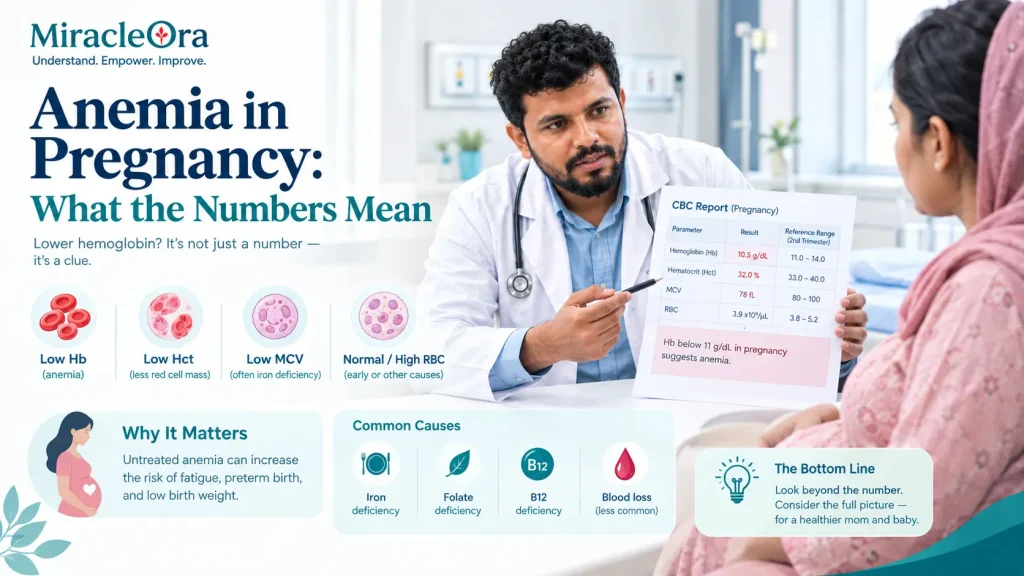
Most people do not go looking for a B12 test. It arrives because something else was found first, and the something is usually on the CBC.
MedlinePlus, in its Medical Encyclopedia entry "Vitamin B12 level" (review/update date 10 January 2026), states this directly: "This test is most often done when other blood tests suggest a condition called megaloblastic anemia."
So the sequence is normally backwards from what people expect. The blood count raises the question; the B12 level is one of the answers tested for. That is why this page sits in the anemia cluster rather than in a nutrition one.
What B12 has to do with red cells
The connection is not obvious from the outside, because B12 is filed mentally under diet and energy rather than under blood.
The link is production. Red cells are made in the bone marrow, and that production depends on the machinery for building new cells. When that machinery is short of what it needs, the cells that emerge are affected, and one of the visible consequences on a blood count is cell size.
That is why the finding that triggers the test is often a raised MCV rather than a low hemoglobin on its own. MedlinePlus's "RBC indices" page (review/update 27 February 2026) defines MCV as "Average red blood cell size" and gives the normal range as 79 to 95 femtoliters, with the standard caveat that "Normal value ranges may vary slightly among different labs."
A large average cell size alongside anemia is the pattern that raises the question. Low hemoglobin with a normal MCV covers the opposite finding and why it points elsewhere, and the types of anemia sets out the classification that cell size feeds into.
The nervous system half, which people miss
B12 is not only a blood question, and MedlinePlus is explicit about the second reason a clinician orders it.
The page states that the test may also be recommended for certain nervous system symptoms, and that a low level of B12 "can cause numbness or tingling in the arms and legs, weakness, and loss of balance." It also names severe confusion, cognitive decline and nerve abnormalities among the indications for testing.
This is the part that makes B12 different from iron. An iron problem shows up as an anemia and its consequences. A B12 problem can have effects that are not about oxygen carriage at all, and those effects can be present without the blood count being dramatic.
The practical consequence for a reader is only this: if you have been tested for B12 and also asked about numbness, balance or memory, those questions were not idle. They belong to the same investigation.
The numbers, and what they are worth
MedlinePlus gives the reference figures directly: "Normal values are 299 to 1054 picograms per milliliter (pg/mL), or 219 to 773 picomoles per liter (pmol/L)," followed by the caveat that "Normal value ranges may vary slightly among different laboratories."
On the low side, it states: "Values of less than 299 pg/mL (219 pmol/L) are a possible sign of a vitamin B12 deficiency."
Read that phrasing carefully, because the wording is doing precise work. A possible sign. Not a diagnosis, not a confirmation. The document is describing a result that raises a question, and the question is then answered by everything else a clinician has.
The lab-variation caveat matters more here than on most tests, because the units and the intervals differ between laboratories enough that comparing your figure to one you read elsewhere is unreliable. Why your lab's reference range is different explains where those intervals come from and why two of them can both be correct.
Why the level does not settle it
There is a reason a clinician who suspects B12 deficiency may order further tests even after a level comes back.
The serum level measures what is in the blood at that moment. It is a useful measurement and it is not a complete one, which is why results near a boundary are commonly followed up with additional testing rather than acted on directly. If you have been sent for more tests after a borderline B12, that is an ordinary next step rather than a sign that something alarming was found.
The same logic applies across this site's whole subject. A single number is a point, not a picture, and an iron studies panel is a good example of how several measurements are needed to answer what one apparently would.
What MedlinePlus lists as causes
The page names several routes to a low level, and the range of them is the point.
It lists insufficient dietary intake, malabsorption diseases, lack of intrinsic factor, elevated metabolism, and pregnancy. It describes pernicious anemia as a form of megaloblastic anemia caused by B12 deficiency due to poor absorption, and explains that this can occur when the stomach makes less of the substance called intrinsic factor that the body needs to absorb B12 efficiently.
The reason to notice that list rather than skim it: most of it is not about diet. Absorption problems and the intrinsic factor mechanism are about the body's ability to take up B12 rather than about how much arrives. That distinction is the whole reason the cause has to be established rather than assumed.
MedlinePlus also notes that elevated B12 levels are uncommon but can occur with liver disease or myeloproliferative disorders, so a high result is not automatically a good result.
What this page will not tell you
No supplement, no dose, no diet and no regimen appears anywhere on this page, and that is a deliberate editorial line rather than an oversight.
The reason is the causes list above. If a low level is caused by an absorption problem rather than by intake, then addressing intake is aimed at the wrong mechanism, and a reader who acts on a general recommendation may feel they have handled something they have not. Which route applies to a given person is precisely what the further testing establishes, and it is not knowable from a number on a page.
This site's page on iron studies already set the same line for iron, quoting MedlinePlus that taking more iron than the body needs can cause serious medical problems. The principle is identical here.
The short version
- MedlinePlus (10 January 2026) states the test is most often done when other blood tests suggest megaloblastic anemia. The CBC usually comes first.
- The blood finding that raises it is often a large average cell size rather than a low hemoglobin alone.
- B12 also has a nervous system side. MedlinePlus lists numbness, tingling, weakness and loss of balance.
- Normal values per MedlinePlus are 299 to 1054 pg/mL, and ranges vary between laboratories.
- Below that, MedlinePlus calls it a possible sign, not a diagnosis.
- Most of the listed causes are about absorption, not intake, which is why the cause has to be found rather than assumed.
- Bring the whole report to whoever ordered it. How to read a CBC report helps you find the relevant lines first, and why your hemoglobin might be low covers the wider set of explanations.