High lymphocytes, called lymphocytosis, means the blood holds more lymphocytes than expected. StatPearls (last updated 17 July 2023) defines it in adults as an absolute lymphocyte count above 4,000 per microliter. Five of the seven causes MedlinePlus lists for a raised lymphocyte count are infections. A high lymphocyte percentage on its own is a different finding, and can simply reflect fewer neutrophils.
That last distinction is the most useful thing to check on your own report, and the section below shows how. What your result means for you is decided by the doctor who ordered the test, who can see the whole report and your history.
First, check which line is flagged: percentage or count
Lymphocytes appear on a differential report in two forms: as a share of all white cells, and as an absolute count. The two can tell different stories.
StatPearls' lymphocytosis chapter by Hussein Hamad and Ankit Mangla (last updated 17 July 2023, read 11 September 2026) draws exactly this line. It defines lymphocytosis by an increase in the absolute lymphocyte count to more than 4,000 per microliter in adults. It describes relative lymphocytosis as a lymphocyte share above 40% of white cells while the absolute count stays normal.
MedlinePlus's blood differential page (review date 3 February 2025, read 11 September 2026) gives the usual lymphocyte share as 20% to 40%, and MedlinePlus notes that ranges vary between labs.
Two illustrative reports, with invented numbers, show how the percentage and the count can part ways:
| Report | Total WBC (per µL) | Lymphocyte % | Absolute lymphocytes (per µL) |
|---|---|---|---|
| A | 4,000 | 50% | 2,000 |
| B | 9,000 | 50% | 4,500 |
Both reports print the same 50% share, which is above MedlinePlus's 20% to 40%. But report A's absolute count of 2,000 sits within the adult range of 1,000 to 4,800 per microliter that the NHLBI gives, while report B's 4,500 is above StatPearls's 4,000 line. In StatPearls's terms, A is a relative lymphocytosis and B is an absolute one.
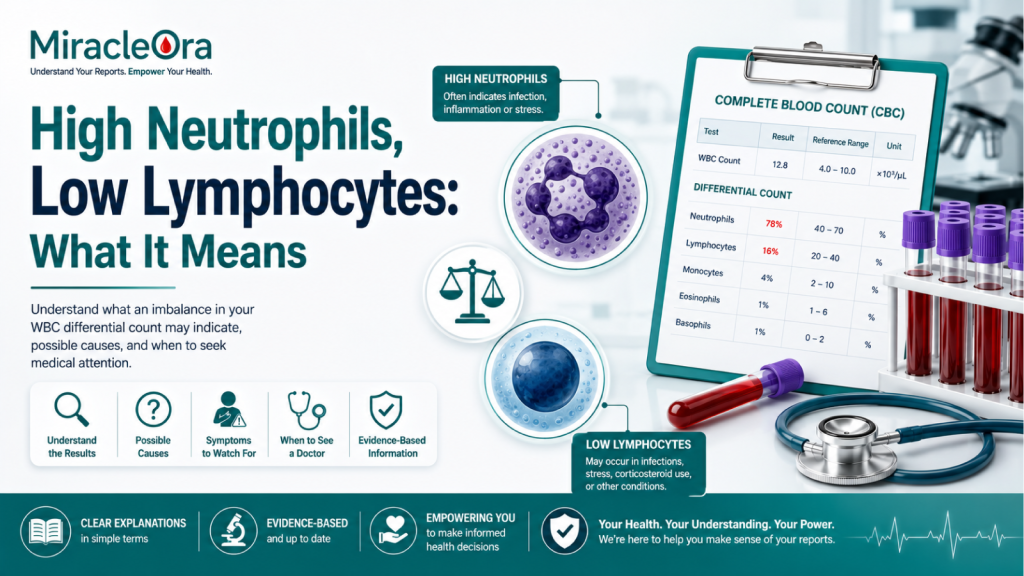
A relative rise can have a simple mechanism: the white cells are shares of one total, so if neutrophils fall, lymphocytes make up a bigger slice without increasing in number. The high neutrophils, low lymphocytes pattern explains how the two lines trade places, in the opposite direction.
What high lymphocytes can mean: the cause lists
MedlinePlus lists the following as causes of an increased lymphocyte count: chronic bacterial infection, hepatitis, infectious mononucleosis, tuberculosis, lymphocytic leukemia, multiple myeloma, and viral infections such as mumps or measles.
Five of those seven are infections. That is the base rate this page is built on.
StatPearls's list of reactive causes, meaning causes where the lymphocytes are responding to something rather than being abnormal themselves, is longer:
- Viral infections: Epstein-Barr virus (infectious mononucleosis), cytomegalovirus, HIV, influenza and hepatitis.
- Bacterial infections: whooping cough (Bordetella pertussis) and cat-scratch disease (Bartonella henselae).
- Mycobacterial infection: tuberculosis.
- Parasitic infection: toxoplasmosis.
- Non-infectious reactive causes: drug reactions, stress-induced lymphocytosis, and a raised count after removal of the spleen.
What these have in common is that the count rises because the immune system is responding to something. That is why timing and trend matter so much in the sections below.
Children run higher than adults
A child's lymphocyte count is not read against an adult's range. Cleveland Clinic's lymphopenia page (last reviewed 15 March 2023, read 11 September 2026) gives the normal range in children as 3,000 to 9,500 lymphocytes per microliter, against 1,000 to 4,800 in adults.
So a count that would be above StatPearls's adult line of 4,000 can sit inside a child's range. StatPearls's threshold is explicitly an adult one. CBC normal ranges for children versus adults covers how the whole report shifts with age, and why the child's own laboratory interval is the one to use.
When doctors look further
Many raised counts have an explanation that the history supplies, such as a recent viral illness or a known infection, and the doctor is the one who puts the history and the result together. StatPearls lists the situations in which further testing is considered:
- an absolute lymphocyte count above 30,000 per microliter;
- lymphocytosis that persists for more than one month without an explanation;
- abnormal lymphocyte appearance (morphology) on the blood smear;
- other low blood counts (cytopenias) at the same time.
Read that list for what it requires. Two of the four need time or a trend. One needs someone to look at your cells under a microscope. And one needs the rest of your report. None of them can be judged from a single flagged line, which is the honest reason this page cannot tell you which category your result falls into.
The smear is the step that looks at what the cells look like rather than how many there are, and what a peripheral blood smear is and why it was ordered explains it.
The leukemia question, answered honestly
For many readers, the fear behind this search is leukemia, so it deserves a direct answer.
StatPearls names chronic lymphocytic leukemia (CLL) as the most common leukemia in adults in the USA, and lists non-Hodgkin lymphomas and other lymphoproliferative disorders among the conditions that can cause lymphocytosis. MedlinePlus's cause list includes lymphocytic leukemia and multiple myeloma.
Those possibilities are real, and they are why clinicians use the evaluation triggers above. But they sit on lists dominated by infections, and the features that prompt a closer look are specific: persistence, a very high count, abnormal cells on the smear, other counts falling. A single mildly raised lymphocyte count after a recent cold does not match those triggers on its own.
Can a blood test detect cancer? covers what a routine blood count can and cannot show, in more depth.
When to see a doctor
Every flagged result goes back to the doctor who ordered the test, even when you feel well. That review is where the history, the trend and the rest of the report come together.
If the total white count is also high, what a high white blood cell count means covers the wider question of what raises it.
If you feel too unwell to wait for an appointment, go to the nearest hospital emergency department rather than reading further.
What to bring to the appointment
- Your whole report, not only the flagged line. Whether the percentage or the absolute count is high, and what the neutrophils are doing, both matter.
- Any recent illness, with dates. Infections dominate the cause lists, and the report cannot know you were ill.
- Every medicine you use. StatPearls lists drug reactions among the reactive causes. No medicine should be stopped or changed on the strength of a blood result; that is the prescriber's decision.
- Previous results. StatPearls's one-month persistence trigger shows how much the trend matters.
Frequently Asked Questions
What does it mean if lymphocytes are high?
It means the blood holds more lymphocytes than expected. StatPearls (last updated 17 July 2023) defines lymphocytosis in adults as an absolute lymphocyte count above 4,000 per microliter. Five of the seven causes MedlinePlus lists for a raised count are infections, and the doctor who ordered the test reads the result with your history.
What is relative lymphocytosis?
StatPearls describes it as a lymphocyte share above 40% of white cells while the absolute lymphocyte count remains normal. It can reflect a change in another cell type, such as fewer neutrophils, rather than more lymphocytes.
Can a viral infection cause high lymphocytes?
Yes. MedlinePlus lists viral infections such as mumps or measles, infectious mononucleosis and hepatitis among the causes of an increased lymphocyte count, and StatPearls adds cytomegalovirus, HIV and influenza among its reactive viral causes.
Is a high lymphocyte count a sign of cancer?
It can be one of the findings in some blood cancers, and StatPearls names chronic lymphocytic leukemia as the most common adult leukemia in the USA. But most causes on the MedlinePlus list are infections. StatPearls lists a count above 30,000, persistence beyond a month, abnormal cells on the smear, or other low counts as reasons for further testing, and that assessment is the doctor's.
The short version
- StatPearls defines adult lymphocytosis as an absolute lymphocyte count above 4,000 per microliter.
- Check whether the percentage or the absolute count is flagged; a high share with a normal count is relative lymphocytosis.
- Five of the seven causes on MedlinePlus's list are infections.
- Children have a higher range: 3,000 to 9,500 per microliter per Cleveland Clinic.
- StatPearls's triggers for further tests are a count above 30,000, persistence beyond a month, abnormal cells on the smear and other low counts. The doctor makes that call.