No. Infection is the first cause on the list, and it is often the answer, but it is one entry among several that named sources publish, and some of the others are not illnesses at all. MedlinePlus, the patient service of the US National Library of Medicine, lists the conditions that may cause a high white blood count, also called leukocytosis, as: “An infection, An inflammatory disease such as rheumatoid arthritis, An allergy, Leukemia or Hodgkin disease, Tissue damage from a burn injury or surgery.”
That list is worth reading slowly, because it contains an infection, an autoimmune disease, an allergy, a cancer and a burn. Five different kinds of thing, one number.
This page is general health education, not medical advice. It cannot tell you what your own result means, and it is not a reason to start or stop doing anything. The clinician who ordered the test is the person who reads it.
What the white blood count actually measures
MedlinePlus puts it in one sentence: “A white blood count measures the number of white blood cells (WBCs) in your blood.”
That is a count of cells in a volume of blood at the moment the sample was drawn. It is not a measure of how ill you are, how infectious you are, or how your immune system is performing. It is a population count, and the reason it is useful is that several different processes change that population in ways a clinician can put alongside everything else they know about you.
The count usually arrives as part of a complete blood count. If the whole report is unfamiliar, our plain-language walkthrough of how to read a CBC report covers the rest of the lines on the page.
The number that defines “high” is not the number on your report
This is the distinction that matters most on this page, and almost every competing article collapses it.
There is a clinical threshold, a single figure set by a source for a stated purpose. StatPearls, in its Leukocytosis chapter, last updated 15 June 2026, states that “In adults, a WBC count exceeding 11,000 cells/µL is generally considered leukocytosis, whereas a count greater than 100,000 cells/µL is termed hyperleukocytosis.”
There is also a reference interval, which is the two-ended range printed on your own report next to your own result. That interval was built by one laboratory, from its own instruments and its own population, and it is why two labs can flag the same sample differently. We covered why that happens in why your lab’s reference range differs from charts online.
They are two different objects. The threshold answers “at what point does a clinician call this leukocytosis.” The interval answers “was this result inside the middle of what this laboratory sees.” A result can sit just outside the interval on your report and be nowhere near the clinical threshold above. If your report simply carries a flag beside the number, what the H and L flags mean is a separate and smaller question than what the number means.
Why infection is the first thought, and why it is not the only one
An infection recruits white cells, so the count rises. That mechanism is real and it is common, which is why “high WBC equals infection” became the folk rule. The problem with folk rules is what they do to the other entries on the list.
MedlinePlus’s own causes list puts an inflammatory disease such as rheumatoid arthritis, an allergy, tissue damage from a burn injury or surgery, and leukemia or Hodgkin disease alongside infection. Inflammation without infection raises the count. So does physical damage to tissue. So, on that list, do two blood cancers.
There is also a category of causes that is not disease at all. StatPearls names, among physiologic contributors to a raised white cell count, pregnancy, smoking, emotional and physical stress, vigorous exercise, and medications including corticosteroids. Its explanation of the mechanism is demargination, which it describes as “the mobilization of cells, which is mediated by the effects of external factors on adhesion molecules.” In plain terms, some white cells normally sit along the walls of blood vessels rather than circulating freely, and certain signals push them back into circulation. Nothing new has been made. The count in the tube goes up anyway.
That is why a clinician does not read this number on its own, and why a repeat sample is such a common next step for a single out-of-range value.
Which white cells went up is a different question from how many
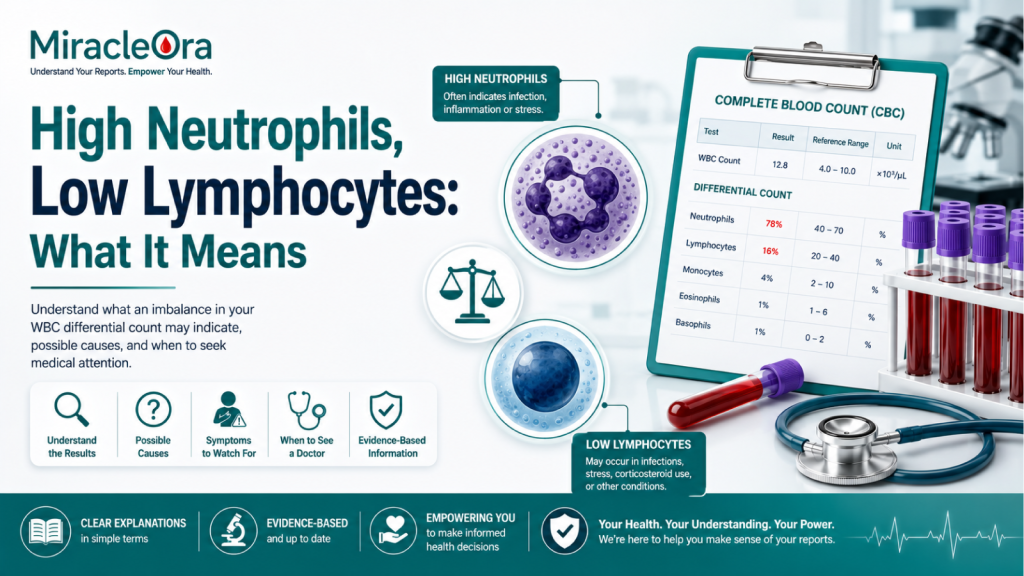
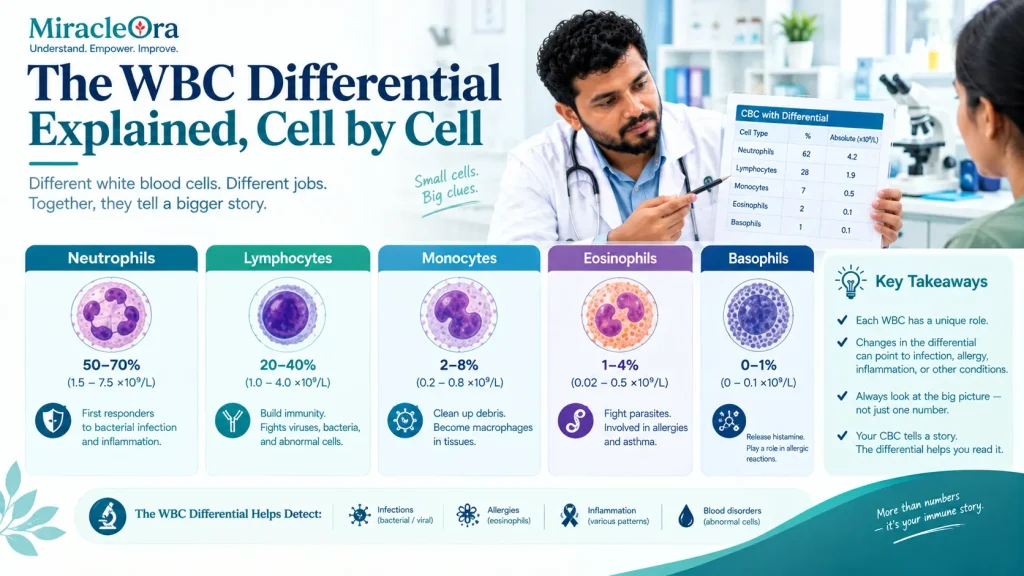
A white blood count is a single total. A differential breaks that total into its parts: neutrophils, lymphocytes, monocytes, eosinophils and basophils, each as a percentage and usually as an absolute count.
The total tells you something moved. The differential is what tells a clinician which population moved, and that is the line that carries most of the diagnostic information. StatPearls notes that interpretation requires consideration of age, physiologic states such as pregnancy, differential cell counts, clinical history, symptom duration, laboratory trends and associated abnormalities in the complete blood count. That is a list of things a reader cannot supply to a webpage and a clinician already has.
If your report shows one and not the other, the difference between a CBC and a CBC with differential explains what the extra lines add and why a clinician may order it.
Can this number tell me whether I have an infection?
Not by itself, in either direction. A raised count is consistent with infection and consistent with several other things on the list above. A normal count does not rule an infection out. We wrote that argument out in full, with the sources, in can a CBC detect infection, and it is the honest answer to the question most people arrive at this page with.
The very high numbers, and what a source actually says about them
Two terms turn up in searches about extreme results, and both are worth defining from a source rather than from a forum.
Hyperleukocytosis is StatPearls’ term for a WBC count of 100,000 cells/µL or higher.
A leukemoid reaction is described by the same chapter as “a transient and marked increase in WBC count, and is typically characterized by a neutrophil count greater than 50,000 cells/µL without a myeloproliferative neoplasm.” The chapter states that it must be distinguished from leukemia by careful evaluation and peripheral smear review.
The reason that second definition exists is instructive. A very large number is not self-explaining, and telling the two apart is done by a specialist looking at the cells, not by the size of the number.
What happens next, and the limit of this page
MedlinePlus’s own guidance on results is short and it is the right note to end on: “If you have questions about your results, talk to your provider. Your provider will consider your symptoms, medical history, and the results of other blood tests to understand your white blood count results.”
No page can triage you, and this one is not trying to. We have not composed a list of warning signs, because we could not attribute one to a named source in a form worth publishing, and an unsourced urgency list on a page like this is wrong in both directions: it can frighten a reader who is fine and reassure a reader who is not. If you feel unwell, that is a reason to be seen, whatever any number says. If you feel fine and a number is flagged, that is a question for the clinician who ordered the test, and it is a normal question to ask.
Frequently asked questions
Does a high white blood cell count always mean infection?
No. MedlinePlus lists infection, an inflammatory disease such as rheumatoid arthritis, an allergy, leukemia or Hodgkin disease, and tissue damage from a burn injury or surgery among the conditions that may cause one. StatPearls separately names pregnancy, smoking, emotional and physical stress, vigorous exercise and medications including corticosteroids as physiologic contributors. Which of those, if any, applies to you is a clinical judgment.
What WBC count is considered high?
StatPearls states that in adults a WBC count exceeding 11,000 cells/µL is generally considered leukocytosis. That is a clinical threshold, not the same thing as the reference interval printed on your own report, which your laboratory built from its own instruments and population. Both can appear on the same page and mean different things.
Can stress or exercise raise my white blood cell count?
StatPearls names emotional and physical stress and vigorous exercise among physiologic contributors, and describes demargination as the mechanism: cells that normally sit along vessel walls are mobilized into circulation. Whether that explains a particular result is not something a page can settle, because it depends on the circumstances of the draw, which your clinician knows and we do not.
Does a high white blood cell count mean leukemia?
Leukemia and Hodgkin disease are on MedlinePlus’s list of conditions that may cause a high white blood count, alongside infection, inflammatory disease, allergy and tissue damage. A single value cannot establish any of them. StatPearls describes the leukemoid reaction, a transient marked rise typically with a neutrophil count above 50,000 cells/µL and no myeloproliferative neoplasm, precisely because a large number needs to be distinguished from leukemia by evaluation and smear review rather than by its size.
What does a low white blood cell count mean?
That is the opposite direction and has its own causes. MedlinePlus lists, for a low white blood count or leukopenia: bone marrow damage, cancers that affect the bone marrow, an autoimmune disorder such as lupus, and HIV. It is covered as its own topic on this site.
Sources, read on 2026-09-02
- MedlinePlus (US National Library of Medicine), White Blood Count (WBC), page last updated 6 August 2024: what the test measures, the causes listed for a high and a low count, and the guidance on results.
- StatPearls, Leukocytosis, NCBI Bookshelf, last update 15 June 2026: the 11,000 cells/µL threshold, hyperleukocytosis at 100,000 cells/µL, the physiologic contributors, demargination, and the leukemoid reaction.
Medical disclaimer: This content is for general education only and is not a substitute for professional medical advice, diagnosis, or treatment. It cannot interpret your individual results. Talk to a qualified healthcare provider about your own white blood cell count and your symptoms.