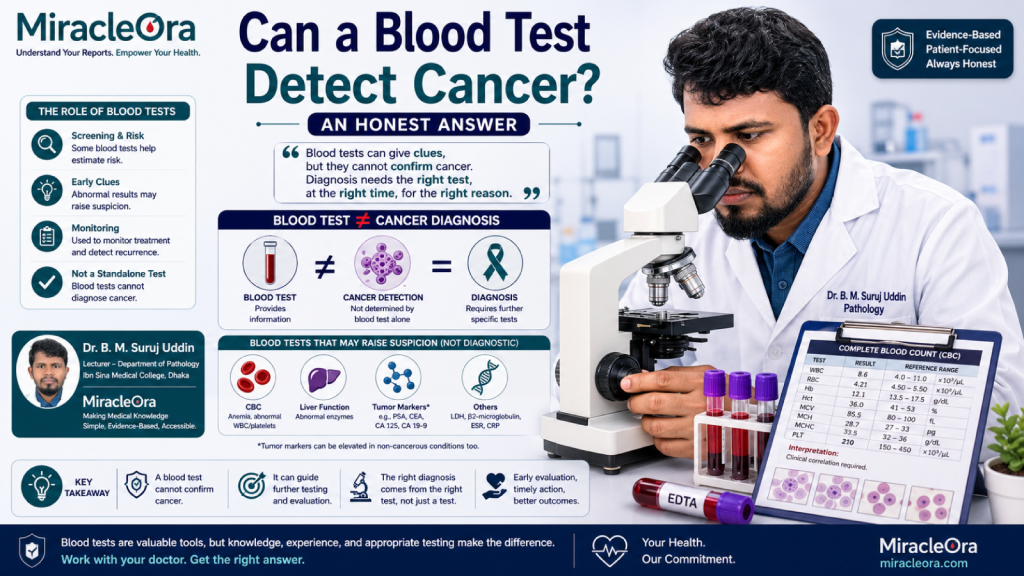
Most cancers cannot be diagnosed from a blood test. A complete blood count (CBC) can point toward some cancers of the blood and immune system, such as leukemia and lymphoma, but as reported by Cleveland Clinic it cannot detect solid organ cancers such as lung, breast or colon cancer. Blood tests are used to raise a question, to monitor a known cancer, and to check how the rest of the body is coping. What confirms a cancer diagnosis is an examination of cells or tissue, usually a biopsy. A normal blood count is not a cancer clearance, and an abnormal one is usually caused by something far more ordinary.
This is general health education, not medical advice. It cannot tell you what your result means. If you are worried about cancer, that conversation belongs with a doctor who can see your history, your examination and your full results.
What a CBC can genuinely point toward
A CBC counts red blood cells, hemoglobin, white blood cells and platelets. Cancers that arise in the blood and bone marrow can change those counts directly, because they arise in the very cells being counted.
Patterns that can prompt a doctor to look harder include a markedly high or markedly low white cell count, a low count in more than one cell line at once, unexplained anemia, or a low platelet count without an obvious cause. As reported by Cleveland Clinic, a CBC can help detect blood and immune-system cancers such as leukemia and lymphoma. None of those patterns is a diagnosis on its own. Each one has common non-cancer explanations, which is why the next step is investigation rather than conclusion.
A related test often follows: the peripheral blood smear, in which a person examines the cells under a microscope rather than relying on the analyzer alone. Our explainer on what a peripheral blood smear is and why one is ordered covers what that step adds.
What a CBC cannot see at all
The large majority of cancers are solid tumors in organs, and they do not announce themselves in a blood count. A tumor in the lung, breast, bowel, prostate, or elsewhere can be present while every line of a CBC sits inside its reference range.
Sometimes an advanced cancer produces indirect effects that show up, such as anemia from slow blood loss in the digestive tract, or changes when a cancer involves the bone marrow. Those are downstream consequences, and they appear late and unreliably. They are not a detection mechanism you can count on.
This is exactly why organized screening programs exist and use other methods. Colonoscopy and stool tests, mammography, cervical screening and lung screening in eligible people exist because a routine blood panel does not find those cancers. A CBC is not a substitute for the screening you are otherwise due, and our page on what a CBC test is actually used for sets out the screening role it does have.
Tumor markers: mostly monitoring, rarely diagnosis
Tumor markers are substances measurable in blood that can be produced by cancer cells or by the body in response to cancer. Names people encounter include PSA, CA-125, CEA, AFP and CA 19-9.
As reported by Mayo Clinic, blood tests used in cancer care are generally not used on their own to diagnose cancer. Tumor markers have two well-established problems for diagnosis. They rise in benign conditions, and they can be normal in people who do have the cancer in question. Their most reliable roles are following a known cancer over time, watching a response to treatment, and checking for recurrence. PSA is used in prostate screening discussions, but that is a discussion with a clinician about benefits and harms, not a yes-or-no test.
| Blood test | What it is genuinely used for | What it cannot do |
|---|---|---|
| Complete blood count (CBC) | Screen broadly; can flag patterns seen in blood and immune-system cancers | Detect solid organ cancers; confirm any diagnosis |
| Peripheral blood smear | Look at cell appearance directly, adding detail the analyzer misses | Replace a bone marrow examination or biopsy |
| Tumor markers (PSA, CA-125, CEA and others) | Monitor a known cancer, track treatment response, watch for recurrence | Serve as a general cancer screen; rule cancer in or out |
| Liquid biopsy on a known cancer | Identify genetic features of a diagnosed cancer to guide treatment | Diagnose cancer in someone without one |
| Multi-cancer early detection (MCED) tests | Under active research as a possible future screening tool | Replace current screening programs today |
| Biopsy (not a blood test) | Confirm the diagnosis by examining cells or tissue | Nothing else does this job |
Source for the CBC and tumor marker rows: Cleveland Clinic, "Blood Tests for Cancer: Diagnosis and Screening", and Mayo Clinic, "Cancer blood tests: Lab tests used in cancer diagnosis".
Liquid biopsy and multi-cancer tests: where the science actually stands
Coverage of "one blood test that finds 50 cancers" has been enthusiastic, so it is worth stating the current position carefully.
Multi-cancer early detection tests look for fragments of tumor DNA or other signals circulating in blood. The concept is genuinely promising. As reported by the National Cancer Institute's Division of Cancer Prevention, no clinical trials have yet determined whether using these tests to screen for cancer will lower the burden of cancer in populations, and key questions remain unanswered. NCI's Cancer Screening Research Network launched the Vanguard Study, enrolling up to 24,000 people, to inform the design of a much larger randomized trial that would test whether the benefits outweigh the harms.
What that means for a reader today: these tests are a research frontier, not a replacement for the screening your health system already recommends. The harms being studied are real ones, including false alarms that lead to unnecessary investigation, and false reassurance that leads someone to skip a screening test that works.
The two mistakes people make with a blood count and cancer
Most articles answer half of this question. Both halves matter, and they pull in opposite directions.
Mistake one: reading an abnormal value as a cancer signal. Almost every out-of-range CBC value has common, benign explanations that are far more likely than cancer. A raised white count is usually a response to infection, stress, exercise, smoking or a steroid medicine. Low hemoglobin is most often iron deficiency. A low platelet count can follow a viral illness or reflect the sample clumping in the tube. Doctors work outward from the common causes, and so should your expectations. Our page on an abnormal blood test when you feel fine explains why an isolated flag so often turns out to be unremarkable.
Mistake two: treating a normal count as an all-clear. This is the more dangerous error. A normal CBC says nothing about a tumor in an organ. If you have a persistent symptom, a normal blood panel is not the answer to it. Symptoms that persist deserve investigation regardless of what the blood work says, and so does a screening invitation you have not yet acted on.
Holding both ideas at once is the honest position: a blood count is neither a cancer detector nor a cancer exclusion. It is one page of evidence in a larger file. If you also want to know what a count can say about infection, our companion piece on whether a CBC can detect infection applies the same logic.
What actually confirms a diagnosis
A cancer diagnosis is made by examining cells or tissue. That means a biopsy, or for blood cancers, a bone marrow examination alongside specialized blood testing such as flow cytometry and genetic studies. Imaging, including ultrasound, CT, MRI and PET, shows where something is and how far it extends, and guides where to take the sample from.
Blood tests sit around that process. They can prompt it, they can help stage and monitor, and they check that organs are coping with treatment. They do not replace the step where a person looks at the cells.
When to see a doctor
Symptoms drive investigation, and no blood result should be used to talk yourself out of one. Make an appointment for symptoms that persist or are unexplained: a lump anywhere, unexplained weight loss, a cough or hoarseness lasting more than about three weeks, a change in bowel or bladder habit that does not settle, difficulty swallowing, a sore that will not heal, or a mole that is changing.
Seek urgent medical care for coughing up blood, vomiting blood or black tarry stools, blood in the urine, unexplained bruising or bleeding, severe unexplained breathlessness, drenching night sweats with fevers and weight loss, or new severe pain. As reported by Cleveland Clinic and Mayo Clinic patient resources, these features are investigated promptly, and they do not wait on a routine blood count.
Also act on the screening invitations you are eligible for. They are the tests designed to find the cancers a blood count cannot.
Frequently asked questions
Would leukemia show up on a routine CBC?
Often it produces changes a doctor would notice, such as a markedly abnormal white cell count or low counts across several cell lines, and as reported by Cleveland Clinic a CBC can help detect blood and immune-system cancers. It is still not a diagnosis. Confirmation requires further specialized testing, usually including a bone marrow examination.
Can a normal blood test rule out cancer?
No. Most solid organ cancers do not change a blood count, especially early on. A normal result is not a clearance, and persistent symptoms should be investigated regardless of it.
Does a high white blood cell count mean cancer?
Usually not. Infection, physical stress, corticosteroid medicines, smoking, strenuous exercise and pregnancy are all common reasons the white count rises. Doctors consider the pattern, how extreme the value is, whether it persists, and everything else in your history.
Are the new multi-cancer blood tests available to me?
They exist commercially in some settings, but as reported by the National Cancer Institute's Division of Cancer Prevention, no clinical trials have yet shown that screening with them reduces the burden of cancer, and large studies are still underway. They are not a substitute for established screening, and any decision about one belongs in a conversation with your doctor.
My doctor ordered more blood tests after my CBC. Does that mean they suspect cancer?
Not by itself. Follow-up testing is routine after an unexplained result, and the great majority of these investigations end in a common, benign explanation. Ask your doctor directly what they are checking for. A clear answer is easier to live with than a guess.
Medical disclaimer: This content is for general education only and is not a substitute for professional medical advice, diagnosis, or treatment. It cannot assess your risk of cancer or interpret your results. Always talk to a qualified healthcare provider about your own symptoms and results, keep up with the screening you are eligible for, and seek urgent care for the features described above. See our full Medical Disclaimer.