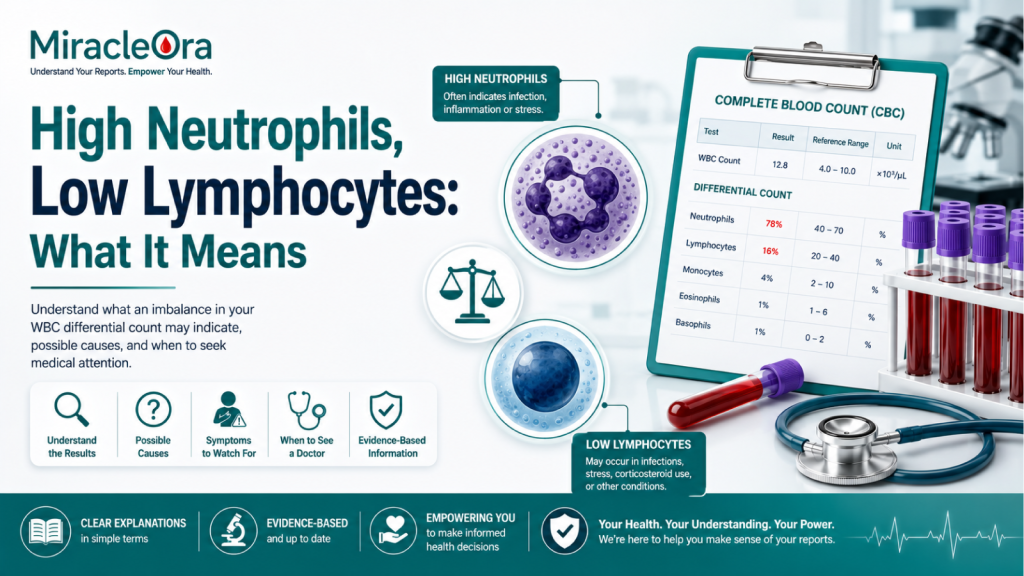
Low lymphocytes, called lymphopenia or lymphocytopenia, means the blood has fewer lymphocytes than expected. The NHLBI (updated 31 May 2022) gives a usual adult range of 1,000 to 4,800 per microliter, and Cleveland Clinic defines adult lymphopenia as a count below 1,000. Causes run from a recent viral infection or steroid medicine to conditions that need investigating, and the NHLBI notes that many people have no symptoms at first.
This line can be flagged next to a high neutrophil count and left unexplained. This page explains what it measures, what the sources list as causes, and what a doctor does next. It cannot tell you what your own result means; that is the job of the doctor who ordered the test. For the wider picture of the white cell count, this cluster's pillar, what a high white blood cell count means, covers the total.
First, check whether the percentage or the count is low
Lymphocytes are printed on a differential in two forms: as a percentage of all white cells and as an absolute count. MedlinePlus's blood differential page (review date 3 February 2025, read 11 September 2026) gives the usual lymphocyte share as 20% to 40%.
A low percentage does not always mean a low count, because the white cells are shares of one total. Two illustrative reports, with invented numbers:
| Report | Total WBC (per µL) | Lymphocyte % | Absolute lymphocytes (per µL) |
|---|---|---|---|
| A | 12,000 | 15% | 1,800 |
| B | 4,000 | 20% | 800 |
Report A has the lower percentage, below MedlinePlus's 20% to 40% share, yet its absolute count of 1,800 sits within the NHLBI's adult range of 1,000 to 4,800. Report B's percentage sits at the bottom edge of MedlinePlus's share, but its absolute count of 800 is below the 1,000 line Cleveland Clinic uses for adults.
Report A shows the pattern where neutrophils have risen and squeezed the lymphocyte share. The high neutrophils, low lymphocytes pattern covers that pairing, which is a frequent reason this line is flagged at all.
The absolute count is the one that defines lymphopenia, and it is the number the ranges below refer to.
The numbers the sources publish
The NHLBI's lymphopenia diagnosis page (updated 31 May 2022, read 11 September 2026) states that a normal lymphocyte count in adults is usually between 1,000 and 4,800 per microliter, and that in children aged 6 and younger, fewer than 2,000 per microliter indicates lymphopenia.
Cleveland Clinic's lymphopenia page (last reviewed 15 March 2023, read 11 September 2026) gives the same adult range and defines adult lymphopenia as fewer than 1,000 per microliter. For children it gives a normal range of 3,000 to 9,500, and defines lymphopenia in children under 2 as fewer than 3,000.
| Group | NHLBI | Cleveland Clinic |
|---|---|---|
| Adults, usual range | 1,000 to 4,800 | 1,000 to 4,800 |
| Adults, lymphopenia | (range given only) | below 1,000 |
| Children | below 2,000 at age 6 and younger | below 3,000 under age 2 |
Notice that the two sources draw the children's line differently. That is not an error by either one. It is a clear example of why the interval printed by your own laboratory is the one that applies, and why a child's result is never read against an adult's range. CBC normal ranges for children versus adults explains how the whole report changes with age.
What low lymphocytes can mean: the causes
The NHLBI's page on lymphopenia causes (updated 31 May 2022, read 11 September 2026) groups them like this:
- Infections: HIV, viral hepatitis, influenza, SARS-CoV-2 (the virus that causes COVID-19), tuberculosis, pneumonia, sepsis and malaria.
- Medical treatments: blood and bone marrow transplant, cancer treatment, steroid therapy and major surgery.
- Autoimmune disorders: such as Sjögren's syndrome, lupus and rheumatoid arthritis.
- Blood diseases: including blood cancers such as Hodgkin's disease, and aplastic anemia.
- Alcohol and nutrition: drinking too much alcohol, or poor nutrition, meaning a diet without enough protein or other nutrients.
- Inherited conditions: such as ataxia telangiectasia, DiGeorge syndrome, common variable immunodeficiency, severe combined immunodeficiency (SCID) and Wiskott-Aldrich syndrome.
The NHLBI's overview page (updated 31 May 2022, read 11 September 2026) adds two points of scale: it calls poor nutrition the main risk factor for lymphopenia worldwide and HIV the most common infection behind it. It also says plainly that sometimes the cause is not known.
MedlinePlus's list of causes of decreased lymphocytes is shorter: chemotherapy, HIV/AIDS, leukemia, radiation, sepsis, steroid use and aging. Cleveland Clinic names nutritional deficiencies of protein, vitamin B12, folic acid and zinc.
On medicines: steroid therapy appears on the NHLBI's list and steroid use on MedlinePlus's. That is an association to discuss with the prescriber, not a reason to change anything. No medicine should be stopped or changed because of a blood result and a web page.
Symptoms: often none at all
The NHLBI's lymphopenia symptoms page (updated 31 May 2022, read 11 September 2026) says that many people have no symptoms at first, and that the condition is often found on routine blood tests or while investigating something else.
When symptoms do occur, the NHLBI lists frequent infections such as colds or pneumonia; unusual infections caused by organisms that do not usually affect people with a working immune system; long-lasting infections such as tuberculosis; missing or abnormal tonsils; enlarged lymph nodes; skin problems including hair loss, eczema and mouth sores; failure to thrive; and an enlarged spleen.
Cleveland Clinic makes a clarifying point: lymphopenia alone does not cause symptoms, but the conditions associated with it may. Its advice is direct: "See a healthcare provider if you have an infection."
If you feel too unwell to wait for an appointment, go to the nearest hospital emergency department.
How doctors investigate a low count
The NHLBI's diagnosis page describes the tests that may follow:
- A complete blood count with differential, which gives the lymphocyte count itself alongside the other cells. The difference between a CBC and a CBC with differential explains how to tell which one your report is.
- Flow cytometry, which measures the different types of lymphocyte: T cells, B cells and natural killer cells.
- Immunoglobulin level tests, which check the antibodies made by B lymphocytes.
- Tests for causes, including HIV, COVID-19 and other viruses, tuberculosis, and other blood or immune conditions.
Not everyone with a low result needs all of these. Which tests follow is the doctor's decision, based on the count, the history and whether the result persists.
Why many low results settle
The NHLBI's overview says treatment depends on the cause and how serious it is, that lymphopenia usually improves when the underlying condition improves, and that no treatment may be needed if it causes no health problems.
That is relevant to a situation many readers are in: a mildly low count after a recent illness, or in someone who feels completely well. Reference intervals are built so that some healthy people fall outside them, and an abnormal blood test when you feel fine explains why. A repeat result, with the history attached, is what tells a passing dip from a persistent one.
None of that means a low count should be ignored. It means the result is a question for the doctor, not a verdict.
What to bring to the appointment
- Your whole report, including whether the percentage, the absolute count or both are flagged, and what the neutrophils show.
- Any recent illness, with dates. Infections lead the NHLBI's list.
- Every medicine you use, especially steroids.
- Previous results, if you have them. A trend shows whether a low count is passing or persistent.
- How often you get ill, and whether infections have been unusual or slow to clear. The NHLBI's symptom list is built around exactly that.
Frequently Asked Questions
What does low lymphocytes mean?
It means the blood has fewer lymphocytes than expected, a finding called lymphopenia or lymphocytopenia. The NHLBI (updated 31 May 2022) gives a usual adult range of 1,000 to 4,800 per microliter, and Cleveland Clinic defines adult lymphopenia as below 1,000. The doctor who ordered the test reads your result against your own lab's interval.
Is a low lymphocyte percentage the same as lymphopenia?
No. A percentage is a share of the total white count, so it falls when neutrophils rise even if the number of lymphocytes has not changed. Lymphopenia is defined by the absolute lymphocyte count.
Can a viral infection cause low lymphocytes?
Yes. The NHLBI lists viral infections including HIV, viral hepatitis, influenza and SARS-CoV-2 among the causes, alongside tuberculosis, pneumonia, sepsis and malaria. It also notes that lymphopenia usually improves when the underlying condition improves.
Should I worry about low lymphocytes?
The sources describe a wide range, from a count that settles after an illness to conditions that need investigating. The NHLBI says many people have no symptoms at first, and Cleveland Clinic advises seeing a healthcare provider if you have an infection. Whether your result needs further tests is the ordering doctor's decision.
The short version
- Lymphopenia is defined by the absolute lymphocyte count, not the percentage.
- NHLBI: usual adult range 1,000 to 4,800 per microliter. Cleveland Clinic: adult lymphopenia below 1,000.
- Children's lines differ between sources, which is why your lab's own interval applies.
- The NHLBI lists infections, treatments including steroids, autoimmune and blood diseases, poor nutrition, alcohol and inherited conditions.
- Many people have no symptoms at first. See a doctor if you have an infection, and go to hospital if you are too unwell to wait.