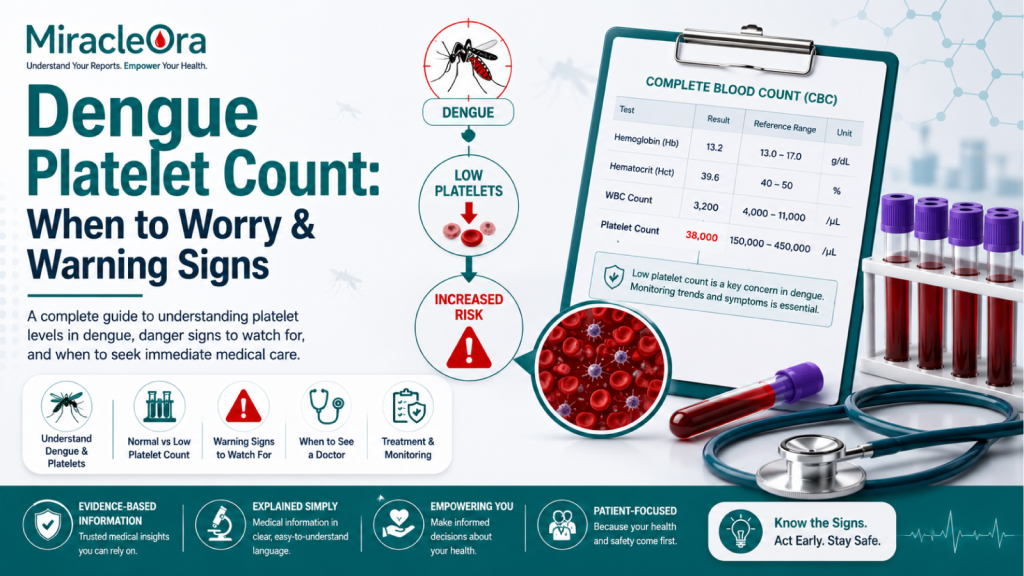
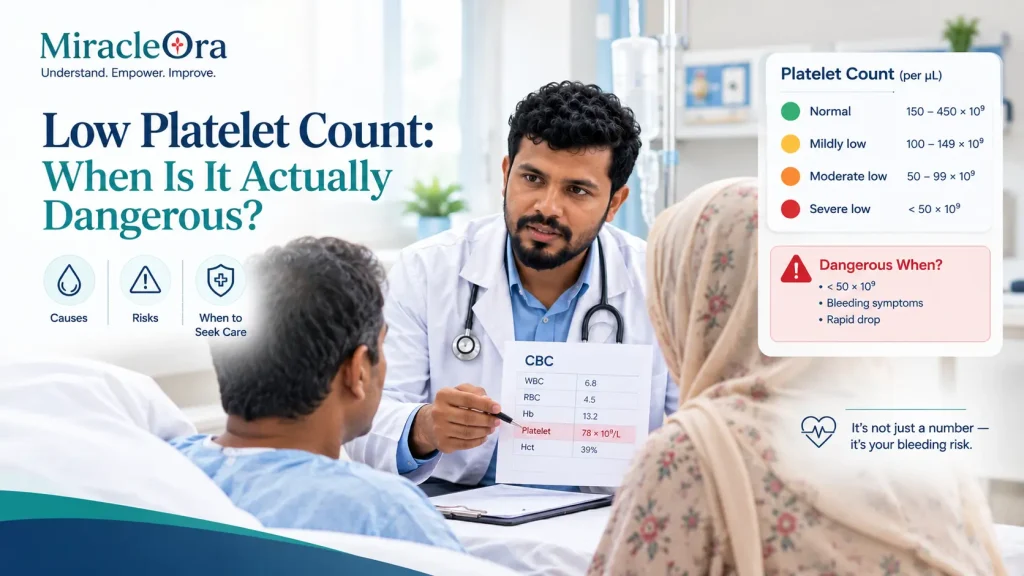
The short answer: frequent nosebleeds can be one sign of a low platelet count, but most nosebleeds have ordinary causes such as dry air, colds or irritation. The link between nosebleeds, low platelets and a clotting problem becomes more likely when the nosebleeds come with other bleeding signs: bleeding gums, easy bruising, tiny red spots on the skin, heavy periods, or blood in urine or stool. Only a blood test, read by the clinician who ordered it, can say what your count is and why.
Before anything else on this page, the signs that should not wait for an appointment.
When a nosebleed needs care now
The escalation rule comes first, because a person reading this during a nosebleed needs it more than the explanation.
The National Heart, Lung, and Blood Institute (NHLBI), in its thrombocytopenia health topic page (last updated February 18, 2025, read on September 23, 2026), states: "Call 9-1-1 to seek immediate medical care if you have bleeding that does not stop when you apply pressure."
The MedlinePlus Medical Encyclopedia entry Nosebleed (review date July 28, 2025, read on September 23, 2026) lists these as reasons to get emergency care:
- Bleeding that does not stop after 20 minutes
- A nosebleed after a head injury, which the page notes may suggest a skull fracture
- A nose that may be broken
- Taking medicines that prevent blood from clotting (blood thinners)
- Earlier nosebleeds that needed care from a specialist
The same MedlinePlus page lists reasons to contact a health care provider, rather than emergency care: frequent nosebleeds, nosebleeds not related to a cold or other minor irritation, and bleeding after sinus or other surgery.
NHLBI also lists blood in urine or stool, "which can appear as red blood or as a dark, tarry color," among the bleeding signs of thrombocytopenia. Its page on living with platelet disorders (last updated March 24, 2022, read on September 23, 2026) advises people to "Tell your provider right away" about bleeding symptoms, and to "call 9-1-1 immediately" for symptoms of serious bleeding.
If you already know your platelet count is low and a nosebleed will not stop, that is exactly the situation the NHLBI sentence above describes. No article, including this one, can triage you. The people who can are on the other end of an emergency number or at your care team's after-hours line.
Why platelets and nosebleeds are connected
Platelets are the part of the blood involved in clotting. When a small blood vessel breaks, platelets help seal it. When the platelet count falls, there are fewer of them available for that job, and bleeding can show up in places where small vessels break easily, such as the nose and gums.
The medical name for a low platelet count is thrombocytopenia. The MedlinePlus Medical Encyclopedia entry Thrombocytopenia (review date January 29, 2026, read on September 23, 2026) lists its symptoms as: "Bleeding in the mouth and gums, Bruising, Nosebleeds, Petechiae (rash-red spots typically on the extremities due to low platelets)."
So nosebleeds are on the list. They are also only one item on it, and that is the point this article keeps returning to.
Nosebleeds, low platelets and the signs that travel together
A single nosebleed during a dry winter tells very little. A pattern tells more. The table below sets the two MedlinePlus pages and the NHLBI page side by side. It is not a diagnostic tool. It shows what each source lists, so you can see why a clinician asks the questions they ask.
| What you notice | What the sources say about it |
|---|---|
| Nosebleeds with a cold, allergies, dry or cold air, or after blowing the nose hard | MedlinePlus lists these among the causes of nosebleeds. None of them is a platelet problem. |
| Nosebleeds that keep coming back | MedlinePlus: "Repeated nosebleeds may be a symptom of another disease such as high blood pressure, a bleeding disorder, or a tumor." A low platelet count is one kind of bleeding problem, not the only one. |
| Nosebleeds plus bleeding gums | Both appear on the MedlinePlus thrombocytopenia symptom list and in NHLBI's list of bleeding signs. |
| Nosebleeds plus tiny flat red spots on the skin | NHLBI calls these petechiae: "small, flat red spots under the skin caused by blood leaking from blood vessels." MedlinePlus says they typically appear on the extremities. |
| Nosebleeds plus bruising or larger discolored patches | NHLBI describes purpura as "bleeding under your skin that can cause red, purple, or brownish-yellow spots." |
| Nosebleeds plus heavy menstrual bleeding | Listed by NHLBI as a bleeding sign of thrombocytopenia. |
| Nosebleeds while taking a blood thinner | MedlinePlus: "Blood thinners, such as warfarin, clopidogrel (Plavix), or aspirin, may cause or worsen nosebleeds." It also lists being on a blood thinner as a reason for emergency care when a nosebleed occurs. |
The reframing in that table is simple. The nosebleed alone is the weakest clue. The company it keeps is the stronger one. A person with occasional nosebleeds in dry weather and no other bleeding signs is in a different position from a person with nosebleeds, gum bleeding and a new crop of red spots on the shins, even before any blood is drawn.
On the medicine row: that MedlinePlus sentence describes a known effect. It is not an instruction to stop or change anything. Any change to a prescribed medicine is a decision for the prescriber, who knows why it was started.
What your platelet count can and cannot tell you
The platelet count is part of the complete blood count (CBC), the same panel that reports red cells and white cells. If you have been handed a CBC and want to understand the other lines on it, the WBC differential explained cell by cell walks through the white cell section.
What the count can tell you is how many platelets were in that sample, compared with the reference interval your lab printed beside it. Reference intervals are set by each laboratory and are not identical everywhere, so the interval on your own report is the one that applies to you. The broader question of how low is concerning, and why the number alone does not decide it, is covered in low platelet count: when is it actually dangerous.
What the count cannot tell you on its own:
- Why it is low. MedlinePlus divides thrombocytopenia into three major causes: "Not enough platelets are made in the bone marrow; Increased removal of platelets in the bloodstream; Increased trapping of platelets in the spleen or liver." The count looks the same on paper whichever mechanism is behind it.
- How clotting is working overall. A count is a number of platelets. MedlinePlus lists blood clotting tests, partial thromboplastin time (PTT) and prothrombin time (PT), as separate tests a provider may order.
- Whether bleeding will happen. NHLBI states: "You may not have serious bleeding until your platelet count is very low." That sentence cuts both ways. A mildly low count does not automatically explain a set of nosebleeds, and a count within range does not rule out the other causes of repeated nosebleeds that MedlinePlus names, such as high blood pressure or a bleeding disorder.
This is the part that most pages on this topic skip. People often assume that a normal platelet count settles the question, or that a low one fully explains the nosebleeds. Neither assumption is safe to make without the clinician who has the whole picture.
What can lower platelets
MedlinePlus lists conditions that affect platelet production, including aplastic anemia, leukemia, vitamin deficiencies and myelodysplastic syndrome, and names chemotherapy as a frequent medicine-related cause. It also lists immune causes such as immune thrombocytopenia (ITP), clotting disorders such as disseminated intravascular coagulation (DIC) and thrombotic thrombocytopenic purpura (TTP), and liver disease affecting the spleen.
That list can read as frightening, and it is worth being calm about what it is. It is a list of possibilities a clinician works through, not a list of what you have. Some of the bone marrow conditions on it can also affect the white or red cell lines of the same CBC, which is one reason clinicians read the whole report rather than one line. What a low white count adds to that picture is covered in low WBC count: should you worry.
What we do not do on this site is match a reader's symptoms to a cause. The same nosebleed and the same count can belong to very different stories.
What a doctor may check
MedlinePlus describes the usual starting point as "a physical exam and ask about your medical history and symptoms," followed by tests that can include:
- A complete blood count (CBC)
- Blood clotting tests, PTT and PT
- A review of the peripheral blood under the microscope (a blood smear)
- In some cases, a bone marrow aspiration or biopsy
Which of these, if any, are needed is the ordering clinician's call. A test on that list is not a sign that anything serious is suspected; it is how the picture gets filled in.
Making the appointment more useful
Clinicians work from history, and nosebleeds are easy to describe vaguely. A short written note before the visit can make the conversation faster and more precise. Useful things to record:
- How often the nosebleeds happen, and roughly how long each one lasts
- One side or both, and whether they start on their own or after blowing, picking or a knock
- Other bleeding signs: gums when brushing, bruises you cannot explain, red pinpoint spots, heavier periods than usual, any change in urine or stool color
- Every medicine and supplement, including over-the-counter pain relievers, since MedlinePlus names aspirin among the medicines that may cause or worsen nosebleeds
- Recent illness, including fever, and any family history of bleeding problems
- A copy of the CBC report with the lab's own reference intervals printed on it
This list is about describing what is happening. It is not about changing anything. The interpretation, and any decision about treatment, belongs to the clinician who ordered the test.
The honest limits of this page
A lab report should not create fear. It should create understanding, and part of understanding is knowing what a web page cannot do.
This page cannot tell you whether your nosebleeds are caused by your platelet count. It cannot tell you what your count means for you, because that depends on your history, your medicines, your other results and how the count has moved over time. It cannot tell you that a nosebleed is safe to wait out if it matches the emergency signs above. And it does not publish a platelet number at which nosebleeds become dangerous, because NHLBI's own wording ("very low") is deliberately not a line to measure yourself against.
What it can do is help you walk into the appointment knowing which questions matter, and recognize the signs that mean the appointment should be today, or an emergency call now.
Frequently asked questions
Can low platelets cause nosebleeds?
Yes. MedlinePlus lists nosebleeds among the symptoms of thrombocytopenia, the medical term for a low platelet count, alongside bleeding gums, bruising and petechiae. MedlinePlus also lists many everyday causes of nosebleeds, such as dry air, colds and irritation.
Are frequent nosebleeds a sign of a blood disorder?
They can be, but not always. MedlinePlus states that repeated nosebleeds may be a symptom of high blood pressure, a bleeding disorder or a tumor, and lists frequent nosebleeds as a reason to contact a health care provider. The provider decides what, if anything, needs testing.
When is a nosebleed an emergency?
MedlinePlus lists bleeding that does not stop after 20 minutes, a nosebleed after a head injury, a possibly broken nose, and taking blood thinners among reasons for emergency care. NHLBI advises calling 9-1-1 for bleeding that does not stop when pressure is applied.
If my platelet count is normal, can nosebleeds still point to a bleeding problem?
A count measures how many platelets there are, and MedlinePlus lists clotting tests (PT and PTT) as separate tests. It also names causes of repeated nosebleeds unrelated to platelet numbers, such as high blood pressure. Your clinician can say whether further testing makes sense.
What platelet count causes nosebleeds?
No single number applies to everyone. NHLBI states that serious bleeding may not happen until the count is very low, and reference intervals differ between labs. The clinician who ordered your test is the right person to interpret your result.