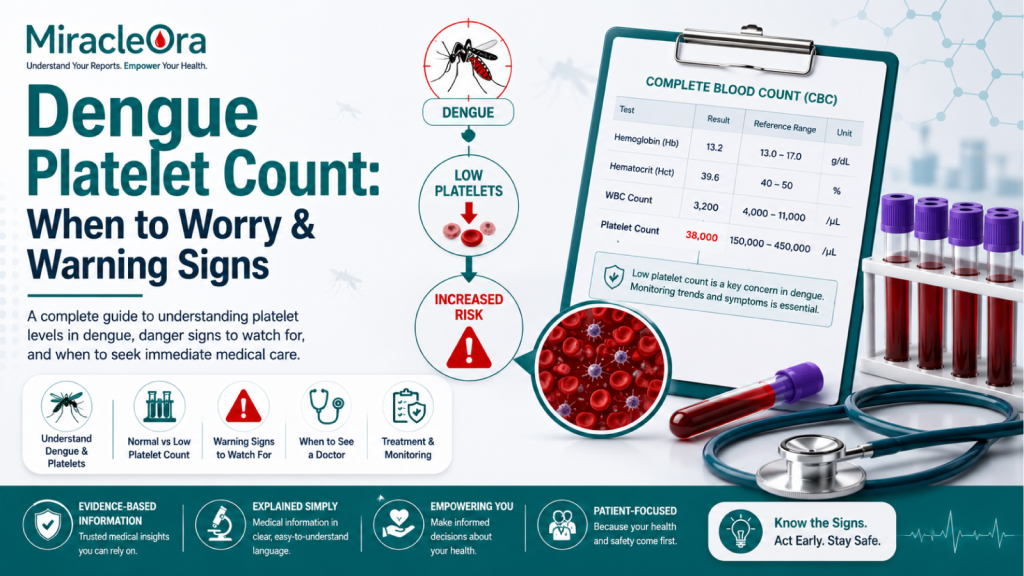
Short answer: A viral fever low platelet count is common and, in most cases, temporary. Viruses can lower platelets in several ways at once: the bone marrow makes fewer for a while, the immune system clears more of them, and inflammation switches on clotting that uses them up. A 2021 review in the Journal of Clinical Medicine found that, outside viral hemorrhagic fevers and rare severe infections, this drop rarely causes significant bleeding. The key exception is dengue, where the dangerous phase can begin just as the fever goes away. Warning signs, not the number alone, decide urgency, and the clinician who ordered the test is the right person to interpret it.
A laboratory report should not create fear. It should create understanding. So this page starts with the signs that change what happens next, and then explains the biology behind the number.
When fever with a low platelet count needs care right away
Most people reading this are looking at a flagged result during or after an ordinary viral illness. Some are not, and for them the symptoms matter far more than the lab value.
If dengue is possible
Dengue is a concern for anyone who lives in, or has recently traveled to, a place where it spreads. The CDC's page on dengue signs and symptoms (read September 23, 2026) lists these warning signs of severe dengue:
- Bleeding from the nose or gums
- Belly pain or tenderness
- Vomiting at least 3 times in 24 hours
- Vomiting blood
- Blood in the stool
- Feeling tired, restless or irritable
The CDC says these signs usually begin in the 24 to 48 hours after the fever has gone away, and it advises going immediately to a local clinic or emergency room if any of them appear. It describes severe dengue as a medical emergency. A normal-looking temperature does not cancel these signs.
Any fever with a low platelet count
Not every fever with low platelets is dengue, and the urgent signs are broader than one disease. The National Heart, Lung, and Blood Institute's thrombocytopenia overview (read September 23, 2026) advises calling 9-1-1 for bleeding that does not stop when pressure is applied.
For fever in general, MedlinePlus, the NIH's consumer health library (read September 23, 2026), lists these as reasons to call 911: a person who cannot be woken easily, seems confused, has difficulty breathing, has a very bad headache, has a stiff neck, or has a seizure. MedlinePlus also lists a new rash or new bruises, and an adult fever lasting longer than 48 to 72 hours, as reasons to contact a provider right away. For infants 3 months or younger, it lists any rectal temperature of 100.4°F (38°C) or higher.
If any of these apply, the exact platelet number stops being the main question. Being assessed in person is.
What platelets do, and what "low" means on your report
Platelets are small cell fragments that help blood clot. When their number falls, bruising and bleeding can come more easily, although many mild drops cause no symptoms at all and are found only on routine blood work, according to NHLBI.
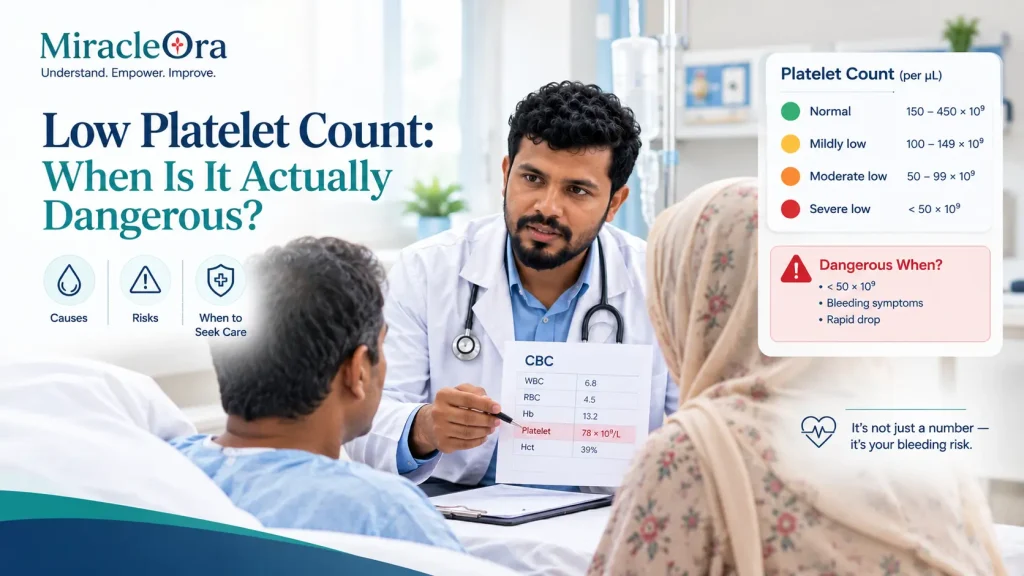
NHLBI gives a normal adult platelet count of 150,000 to 450,000 platelets per microliter of blood. That is one authority's range, not a universal one. Each laboratory prints its own reference range beside your result, and that printed range is the one your clinician reads the number against. Reports also use different units: 150 x10^9/L, 150 x10^3/µL and 150,000/µL describe the same count written three ways.
A result just below the printed range means something very different from a result far below it, and neither means much without the person attached to it. Our guide on when a low platelet count is actually dangerous walks through how clinicians think about severity.
Viral fever low platelet count: the four mechanisms
The 2021 review Thrombocytopenia in Virus Infections by Raadsen and colleagues in the Journal of Clinical Medicine (read September 23, 2026) describes four main ways a viral infection lowers the platelet count. In a single infection, more than one can be happening at the same time.
| Mechanism | What the review describes | In plain language |
|---|---|---|
| Lower production | Viruses can affect the bone marrow and megakaryocytes (the cells that make platelets), or shift cytokines in ways that reduce thrombopoietin, the hormone that drives platelet production | The factory slows down for a while |
| Faster destruction | Activated platelets are cleared by immune cells; antibodies and complement can tag platelets for removal | The immune system removes more of them than usual |
| Consumption | Infection can trigger clotting pathways that activate and use up platelets | Platelets get spent faster than they are replaced |
| Sequestration | The spleen and liver can hold on to more platelets than normal | Some platelets are parked out of circulation |
This is why the drop is so common. An infection does not need to damage the marrow to lower the count. Simply switching on the immune response and inflammation can tip the balance between how many platelets are made and how many are used or removed.
It also explains why the count can keep drifting down for a short time after someone starts to feel better. The immune clearance described in the review does not stop the moment the fever does.
Which infections are linked with low platelets
The same review names a long list of viruses associated with low platelet counts, including dengue, Zika, yellow fever, chikungunya, hepatitis B and C, HIV, hantavirus, influenza, SARS-CoV-2 (the virus that causes COVID-19), measles, parvovirus B19, RSV, cytomegalovirus, Epstein-Barr virus and varicella-zoster virus.
NHLBI notes that bacterial infections can also lower the platelet count temporarily, so "fever plus low platelets" does not by itself identify a virus, let alone a specific one. Which infection is likely depends on symptoms, exposures, travel, season and other test results. That is a clinical judgment, and it is the reason a low count during a fever is worth discussing with the clinician who ordered the test rather than matching it to a list.
The rest of the blood count gives the platelet number context
A platelet count rarely arrives alone. It sits inside a complete blood count, and the other lines often explain it.
The CDC's clinical guidance for health professionals on dengue's clinical features (read September 23, 2026) lists a low white blood cell count and a low platelet count as common laboratory findings in dengue. It also names a pattern clinicians watch for: a rising hematocrit at the same time as a rapid fall in platelets. The hematocrit is the share of blood made up of red cells, and a rise can reflect fluid leaving the blood vessels.
A low white count during a viral illness has its own set of explanations, covered in our article on low WBC count causes. The differential, which breaks the white count into its cell types, adds more detail; our walkthrough of the WBC differential, cell by cell explains each line. If your report also flags lymphocytes, our guide to what high lymphocytes can point to covers that pattern.
None of these lines is a diagnosis on its own. Together, they help a clinician decide whether a low platelet count fits an ordinary viral picture or needs a closer look.
Why the fever going away is not the all-clear in dengue
This is the part most explanations of viral fever and platelets leave out, and it runs against instinct. With most infections, a falling temperature is a good sign. In dengue, it can mark the start of the riskiest window.
The CDC's clinical guidance describes three phases:
- Febrile phase. Fever typically lasts 2 to 7 days and can come in two waves.
- Critical phase. This begins around the time the fever breaks and typically lasts 24 to 48 hours. Plasma leakage during this phase may lead to shock.
- Recovery phase. Fluid is reabsorbed, vital signs stabilize and platelet counts recover.
The CDC estimates that about 1 in 20 people with dengue go on to develop severe dengue. That also means most do not, which is a genuine reason for calm. But it explains why a clinician may want repeat blood counts during the days around the fever breaking, even when the person feels better, and why the CDC's warning signs list is framed around that timing.
One result is a snapshot; the trend tells the story
A single platelet count captures one moment. During an infection, clinicians usually care more about the direction of travel: is the count falling, holding steady or starting to climb, and how fast? They read it alongside the hematocrit, the white count, blood pressure, hydration and how the person looks and feels.
That is why two people with the same platelet number can be handled very differently. It is also why a lab flag on its own is not a verdict. Useful questions to bring to the ordering clinician include:
- Does this count fit the infection you think I have, or does anything here need a closer look?
- Would a repeat blood count help, and when?
- Which symptoms should prompt me to come back before then?
- Could any medicine or supplement I use affect platelets or bleeding?
Medicines, papaya leaf and other remedies
Questions about medicine during a fever with low platelets belong with a clinician or pharmacist, because the answer depends on the person and the likely cause. For suspected dengue specifically, the CDC's dengue treatment guidance (read September 23, 2026) advises against aspirin and ibuprofen and recommends seeing a healthcare provider and mentioning any recent travel.
Papaya leaf extract comes up constantly in conversations about dengue and platelets. The most thorough review we found, a 2019 systematic review and meta-analysis by Rajapakse and colleagues in BMC Complementary Medicine and Therapies, Carica papaya extract in dengue (read September 23, 2026), described the extract as an unlicensed herbal remedy. It found some studies reporting higher platelet counts, but rated the evidence as low quality and concluded that current evidence is insufficient to comment on its role in dengue. The authors noted that the clinical value of a platelet rise is unclear without better outcome measures, such as effects on plasma leakage, severe complications or death.
Put simply, papaya leaf has not been shown to make dengue safer, and a higher number on a report is not the same thing as a better outcome. No home remedy replaces the warning-sign checks above or an in-person assessment. Anyone considering an herbal product during an illness can raise it with the treating clinician first.
What recovery usually looks like
For most viral infections, the outlook is reassuring. The Raadsen review describes virus-related low platelets as a finding that, outside viral hemorrhagic fevers and rare severe infections, does not usually lead to significant bleeding and rarely needs a platelet transfusion. In dengue, the CDC describes platelet counts recovering during the recovery phase, after the critical window has passed.
How fast a count returns to its usual range varies with the infection and the person, so the timing of any follow-up test is something to agree with your clinician. A count that stays low after the illness has clearly ended, or keeps falling, is a reason to go back rather than to wait.
Frequently asked questions
Is a low platelet count during a viral fever dangerous?
Usually it is temporary and does not cause significant bleeding, according to a 2021 review in the Journal of Clinical Medicine. The exceptions are viral hemorrhagic fevers such as severe dengue, and rare severe infections. Warning signs such as bleeding, severe belly pain, repeated vomiting, confusion or trouble breathing mean in-person care right away, whatever the number says.
Does a low platelet count with fever mean I have dengue?
No. Many viruses and some bacterial infections can lower platelets, according to NHLBI and published reviews. Dengue is a consideration mainly for people who live in or have recently traveled to areas where it spreads, and the CDC advises telling your healthcare provider about any recent travel.
How low is too low?
There is no single cutoff that applies to everyone, and reference ranges vary by lab. Clinicians weigh the number together with bleeding signs, the trend and the rest of the blood count, which is why the ordering clinician is the right person to judge a specific result.
Can papaya leaf raise my platelet count?
A 2019 systematic review in BMC Complementary Medicine and Therapies found some studies reporting higher counts, but rated the evidence as low quality and called it insufficient to judge the extract's role in dengue. It has not been shown to prevent severe dengue or its complications.
Why did my platelets keep dropping after the fever stopped?
Immune clearance of platelets can continue for a short time after symptoms ease, as described in the 2021 Journal of Clinical Medicine review. In dengue, the CDC places the critical phase around the time the fever breaks, which is why warning signs in that window need prompt care.
The bottom line
A viral fever low platelet count is usually the body's immune response doing its job, with platelets caught in the process, and it usually settles as the infection clears. The number alone does not decide how worried to be. The warning signs do, and in dengue the days just after the fever breaks deserve the closest attention. If any urgent sign listed above is present, in-person care comes first. For everything else, the clinician who ordered the test is the right person to read your result in context.