The short answer: a malaria typhoid low platelet count question usually comes from someone with a fever, a CBC report and a platelet line flagged low. Both infections can lower platelets, but published studies find a low count far more often in malaria than in typhoid. The platelet number cannot tell you which infection is present, or whether it is dengue or something else. Specific tests do that: a malaria blood smear or rapid test, and a blood culture for typhoid. Interpretation belongs to the clinician who ordered your tests.
This page explains what the sources say, calmly and in order. It starts with the signs that should not wait.
When fever with low platelets needs care now
The urgency in this situation usually comes from the illness, not from the platelet number itself. That distinction matters, and it cuts both ways.
For malaria, the US Centers for Disease Control and Prevention (CDC) describes the disease on its malaria diagnosis and testing page (reviewed March 20, 2024, read on September 25, 2026) as "a potential medical emergency," and states that "Delay in diagnosis and treatment is a leading cause of death in malaria patients in the United States." CDC's malaria clinical features page (reviewed March 20, 2024, read on September 25, 2026) lists signs of severe malaria, including:
- Impaired consciousness
- Seizures
- Circulatory collapse or shock
- Fluid on the lungs or acute breathing distress
- Acute kidney injury
- Abnormal bleeding
For typhoid, the CDC Yellow Book 2026 chapter on typhoid and paratyphoid fever (published April 23, 2025, read on September 25, 2026) states that complications occur in 10 to 15 percent of hospitalized patients, generally after two to three weeks of illness, and names gastrointestinal hemorrhage, intestinal perforation and encephalopathy among them.
In plain terms: confusion, fits, fainting, struggling to breathe, very little urine, bleeding that will not stop, blood in vomit or stool, or sudden severe belly pain during a fever are reasons for emergency care, whatever the platelet count says. So is any fever after time in a malaria area, which CDC's wording treats as urgent in itself. This article cannot triage anyone. An emergency department or your care team can.
Why fevers in South Asia and Africa bring the platelet question
In much of South Asia and sub-Saharan Africa, a person with a few days of fever may have dengue, malaria, typhoid, a viral fever or another infection, and the early symptoms overlap. A CBC is often one of the first tests done, and the platelet line is often the one that gets flagged.
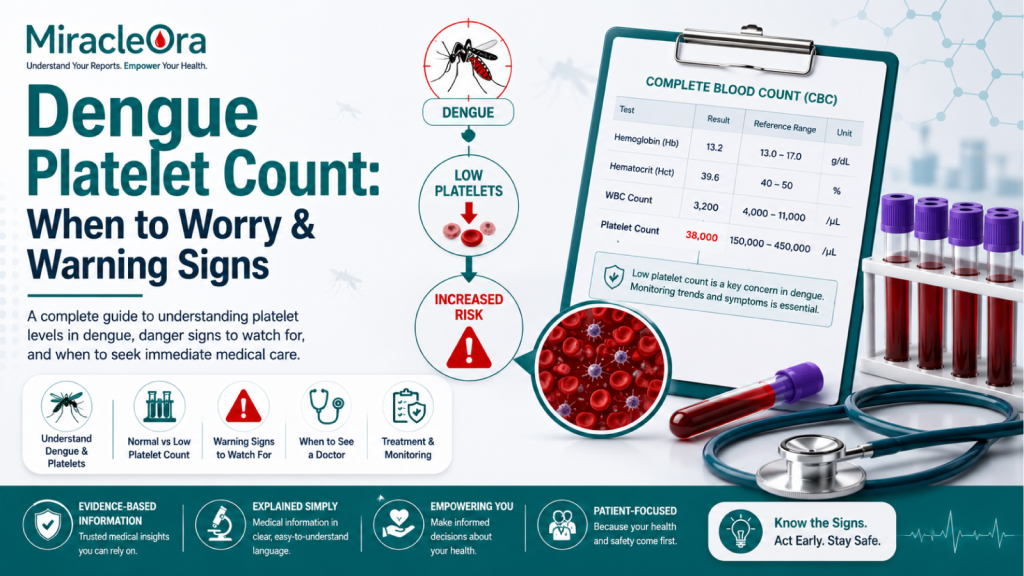
Most people searching this topic in Bangladesh or India have dengue in mind, because dengue is the infection best known for dropping platelets. That is reasonable, and it is covered separately in dengue platelet count: when to worry and the warning signs. The point of this page is narrower: a low count during a fever is not, by itself, a dengue result. Malaria and typhoid can produce it too, and they are managed differently, which is why the clinician looks for the infection rather than reading the number alone.
Malaria and a low platelet count
Low platelets are very common in malaria. A 2011 review by Lacerda and colleagues in Memórias do Instituto Oswaldo Cruz, titled "Thrombocytopenia in malaria: who cares?" (read on September 25, 2026), reports that across published studies, platelet counts under 150,000/mm³ were found in "24-94% in patients with acute malaria," in both Plasmodium vivax and Plasmodium falciparum infections. CDC's clinical features page also lists a "mild decrease in blood platelets (thrombocytopenia)" among the laboratory findings of malaria, alongside mild anemia and raised liver tests.
The same review makes three points worth knowing:
- The low count is not itself a severity criterion. The authors note that thrombocytopenia is not one of the World Health Organization criteria for severe malaria, even though it is often present in severe cases.
- Serious bleeding is uncommon. The review states that "there is no report of a single patient in the literature who has died only because of malaria-associated thrombocytopenia." Minor bleeding is described in case reports.
- The count usually recovers. "Platelet counts usually revert to normal ranges a few days after efficacious antimalarial treatment."
This is the calm part of the picture, and it is real. It is also not a reason to relax about malaria itself. The same CDC list of severe malaria signs includes abnormal bleeding, and malaria can become dangerous for reasons that have nothing to do with platelets. The number is reassuring more often than the illness is safe to wait out.
Typhoid and a low platelet count
Typhoid can lower platelets too, but in the one direct comparison we found, it did so less often than malaria.
A 2018 hospital-based study by Anabire, Aryee and Helegbe in BMC Research Notes, hematological abnormalities in patients with malaria and typhoid in Tamale, Ghana (read on September 25, 2026), compared 54 people in a malaria group with 25 in a typhoid group. Using a platelet cutoff of under 150 × 10⁹/L, it found thrombocytopenia in 38.9% of the malaria group and 12.0% of the typhoid group. The authors state that thrombocytopenia "was significantly associated" with the malaria group.
Two honest limits apply to that study, and the authors name one of them: "the sample size was small." The second is how typhoid was identified. The study used the Widal test, and the CDC Yellow Book describes the Widal test as "unreliable but widely used in low- and middle-income countries because of its low cost." So the typhoid figure is a signal from one small study, not a general rate.
Malaria typhoid low platelet count: the number cannot name the infection
This is the gap most pages on this topic leave open. They list causes of low platelets with fever, but they rarely say plainly that the count cannot choose between them.
| Question | What the platelet count can say | What actually answers it |
|---|---|---|
| Is the count below the lab's range? | Yes, compared with the reference interval printed on your report | The CBC itself |
| Is this malaria? | No | A blood smear under the microscope or a rapid antigen test, per CDC |
| Is this typhoid? | No | A blood culture, which the CDC Yellow Book calls the preferred method |
| Is this dengue? | No | Tests your clinician chooses for dengue, plus clinical warning signs |
| How sick is the person? | Only partly | The clinical picture: consciousness, breathing, bleeding, fluids, organ function |
CDC's diagnosis page describes malaria parasites being identified by examining "a drop of the patient's blood, spread out as a 'blood smear' on a microscope slide," and notes that rapid tests give results in minutes but "it is recommended that all RDTs are followed-up with microscopy." It also states that when the first smear is negative, smears should be repeated every 12 to 24 hours, for a total of three sets, before malaria can be ruled out. If a smear was mentioned on your report, what a peripheral blood smear is and why it was ordered explains the test in plain language.
For typhoid, the Yellow Book states that a single blood culture is "positive in only approximately 50% of cases," and that multiple cultures improve sensitivity. So one negative test does not always close the question, which is another reason the ordering clinician, not a single result, decides what happens next.
Other lines on the same report
A clinician rarely reads the platelet line alone. The Ghana study also looked at anemia and low white cell counts in both groups, and the Lacerda review and CDC both describe anemia in malaria. A low white count, a low hemoglobin and a low platelet count can appear together in several fevers, and the pattern is information for the clinician rather than an answer for the reader. If your white cell line is also flagged, low WBC count: should you worry walks through what that line measures.
Reference intervals are set by each laboratory. The 150,000/mm³ figure above is the cutoff the cited studies used, not a universal line, and the interval printed on your own report is the one that applies to you.
How low is too low?
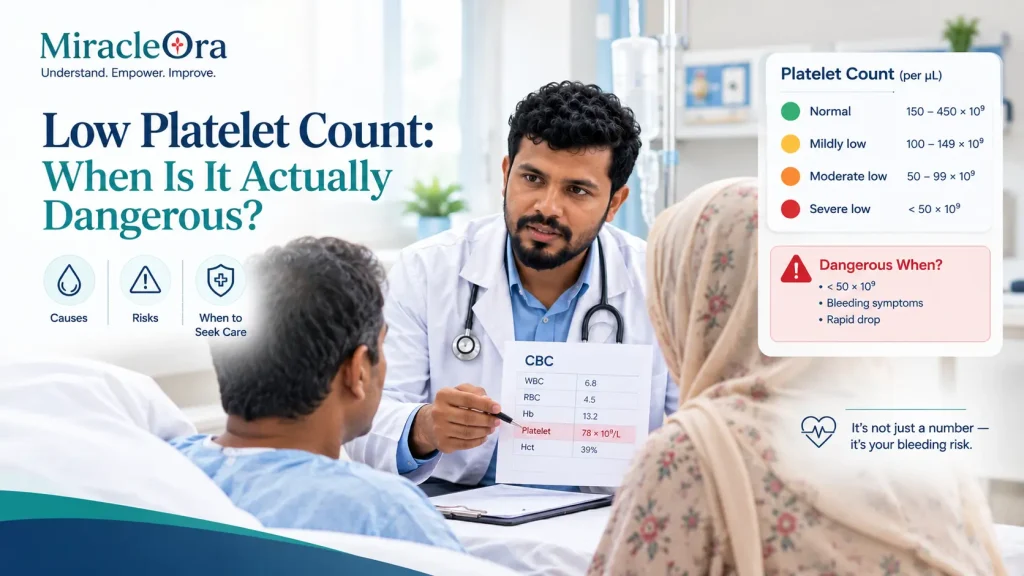
There is no single number in these sources that separates safe from dangerous in malaria or typhoid. The Lacerda review is explicit that the low count is not what defines severe malaria, and CDC's severe malaria criteria are about the whole person. For low platelets in general, including how clinicians think about very low counts, low platelet count: when is it actually dangerous covers the question without pretending one threshold fits everyone.
What this means in practice is simple. A person with a moderately low count who is confused or breathless is in more danger than a person with a lower count who is alert and drinking. The number is one input. The clinician weighs it with everything else.
What to bring to the appointment
A short written note can make a fever visit faster and more precise:
- The day the fever started and how it has changed
- Any recent travel or stay in a malaria area
- Other symptoms: vomiting, belly pain, diarrhea, rash, bleeding gums, bruising or dark stool
- Every medicine and supplement, including over-the-counter pain relievers
- Copies of all CBC reports, with the lab's reference intervals, so the trend is visible
This list is for describing what is happening. Decisions about testing and treatment belong to the clinician.
The honest limits of this page
A laboratory report should not create fear. It should create understanding, and part of understanding is knowing what a web page cannot do. This page cannot tell you which infection you have, whether your count is safe for you, or how quickly it will recover. It can explain why your clinician is asking for a smear, a rapid test or a blood culture instead of reading the platelet line alone, and it can make the emergency signs clear.
Frequently asked questions
Does malaria cause a low platelet count?
Often, yes. A 2011 review in Memórias do Instituto Oswaldo Cruz reports counts under 150,000/mm³ in 24 to 94 percent of acute malaria cases across studies, and CDC lists a mild platelet decrease among malaria's laboratory findings. The review adds that counts usually recover a few days after effective treatment.
Does typhoid lower platelets?
It can. A 2018 study from Tamale, Ghana, found low platelets in 12.0% of its typhoid group compared with 38.9% of its malaria group. The study was small and identified typhoid with the Widal test, which the CDC Yellow Book calls unreliable, so the figure is a signal rather than a rate.
Can a platelet count tell dengue, malaria and typhoid apart?
No. A low count can occur in all three. CDC describes a blood smear or rapid antigen test for malaria and a blood culture for typhoid. Your clinician decides which tests fit your situation.
Is a low platelet count in malaria dangerous?
The Lacerda review states that no patient in the literature is reported to have died from malaria-associated low platelets alone. Malaria itself is different: CDC calls it a potential medical emergency, and abnormal bleeding is one of its severe malaria signs.
When should someone with fever and low platelets get urgent care?
The CDC severe malaria signs include impaired consciousness, seizures, shock, breathing distress, kidney injury and abnormal bleeding. The CDC Yellow Book lists gut bleeding and perforation among typhoid complications. Any of these, or any fever after time in a malaria area, warrants urgent care.