The short answer: a target cells blood smear comment means the lab saw red blood cells that look like a bullseye, with a dark spot in the middle, a pale ring and a dark rim. The MedlinePlus Medical Encyclopedia says these cells are "seen in association with some forms of anemia, and following the removal of the spleen." Teaching references also link them to liver disease, thalassemia, iron deficiency and hemoglobin C or E. A target cell is a clue, not a diagnosis. What it means for you depends on the rest of your report, and the clinician who ordered the test is the right person to interpret it.
First: when to seek care sooner
A shape comment on a smear is rarely the reason for urgency on its own. Symptoms and the rest of the report decide how quickly anything needs to happen.
One smear finding does sit next to a genuine emergency. Cleveland Clinic's page on thrombotic thrombocytopenic purpura (TTP) (last reviewed May 5, 2025, read on September 27, 2026) states that in TTP, red blood cells "will be broken and torn (schistocytes)," and that "TTP is a medical emergency. But prompt care can save your life." The symptoms it lists include confusion or altered mental status, headaches, pale or yellowing skin, shortness of breath, tiny red or purple dots beneath the skin, blood in the urine and vision changes.
Chest pain, fainting, severe breathlessness, confusion, a racing heart, black or bloody stools, or very heavy bleeding call for emergency care rather than more reading. If you feel well and your clinician has already reviewed the report, the finding is usually something to understand and discuss, not something to panic over. This page cannot triage anyone.
What the smear actually looks at
A blood smear is a drop of blood spread thinly on a glass slide, stained and examined under a microscope. The MedlinePlus guide to the blood smear test (last updated December 16, 2024, read on September 27, 2026) explains that it is often ordered after abnormal complete blood count results, and makes a point worth repeating: "The results of a blood smear alone usually can't diagnose a medical condition." Providers combine it with your history and other tests.
Normal red cells are round discs, thinner in the middle, so they show a small pale center on the slide. When the person reading the smear sees a different shape often enough to matter, they write it down by name. That is where words like target cells, spherocytes and schistocytes come from. For the background on why a smear gets ordered in the first place, our explainer on what a peripheral blood smear is and why it was ordered covers it.
Target cells blood smear findings, explained
What a target cell is
The Blood Project, a hematology teaching resource written by William Aird (August 23, 2021, read on September 27, 2026), describes a target cell as a "centrally located disk of hemoglobin surrounded by an area of pallor with an outer rim of hemoglobin adjacent to the cell membrane." The formal name is codocyte. Cleveland Clinic's poikilocytosis page describes codocytes as "cells with a dark center in the middle, resembling a bullseye."
Why the bullseye forms
The Blood Project gives the mechanism in one line: an "excess of cell membrane relative to cell volume." Put simply, the cell has more outer skin than contents. That can happen because the cell is too small for its membrane, or because the membrane itself has grown. When the loose membrane settles on the slide, it bunches toward the middle and creates the dark central spot.
What target cells are linked to
According to the same Blood Project entry, target cells are "seen in liver disease (macrocytic targets), iron deficiency anemia, thalassemia (microcytic target cells)," and "may also be seen in hemoglobin C and E disease, and following splenectomy." MedlinePlus names some forms of anemia and spleen removal.
Notice the words in brackets. The size of the cells on the same report often points in a direction. Small target cells tend to sit with the thalassemia and iron deficiency group. Large ones tend to sit with liver disease. That is a pattern for a clinician to weigh, not a verdict. Our guide to thalassemia trait vs iron deficiency explains how a CBC helps separate those two common look-alikes.
Spherocytes: small, round and without a pale center
The MedlinePlus image entry on spherocytosis (review date February 27, 2026, read on September 27, 2026) describes spherocytes as red cells that are "small, spherically shaped, and lack the light centers seen in normal, round RBCs." It ties them to hereditary spherocytosis, "a hereditary disorder of the red blood cells (RBCs), which may be associated with a mild anemia."
Cleveland Clinic's hereditary spherocytosis page (last reviewed January 26, 2026, read on September 27, 2026) calls it an inherited disorder that causes hemolytic anemia, meaning red cells break down faster than usual. It lists fatigue, a fast heartbeat, pale skin and shortness of breath as common signs, and names the tests used to look further: the CBC, the peripheral blood smear, a Coombs test, hemolysis tests, red cell osmotic fragility, Band 3 protein testing and genetic testing, along with family history.
Because several of those tests exist precisely to sort out why spherocytes are present, the word "spherocytes" on a report is where a clinician's questions start, not where they end.
The other shapes you may see named
Cleveland Clinic's poikilocytosis page (last updated March 2, 2023, read on September 27, 2026) defines poikilocytosis as a state in which "more than 10% of red blood cells in a blood sample aren't shaped like normal red blood cells." It lists eight shape types. Here they are side by side:
| Report word | Other name | What it looks like (Cleveland Clinic) |
|---|---|---|
| Codocytes | Target cells | Dark center resembling a bullseye |
| Spherocytes | None | Spherical, like a ball or globe |
| Schistocytes | Red cell fragments | Fragments, usually jagged |
| Drepanocytes | Sickle cells | Curved and thin, like a sickle or crescent |
| Dacrocytes | Teardrop cells | Narrow to a point on one side |
| Elliptocytes | Ovalocytes, cigar cells | Oval, from egg shaped to cigar shaped |
| Echinocytes | None | Evenly spaced thorny projections |
| Acanthocytes | Spur cells | Spikes of different lengths and widths |
The same page groups causes of abnormal shapes into inherited conditions, such as hereditary elliptocytosis, sickle cell disease and thalassemia, and acquired ones, such as iron deficiency anemia, liver disease, kidney disease and leukemia. That breadth is exactly why one shape word cannot tell you which of them, if any, applies.
Reading the shape together with the numbers
This is the part most explanations skip. A smear comment rarely arrives alone. It sits beside a CBC, and the analyzer's numbers describe the same cells in a different language.
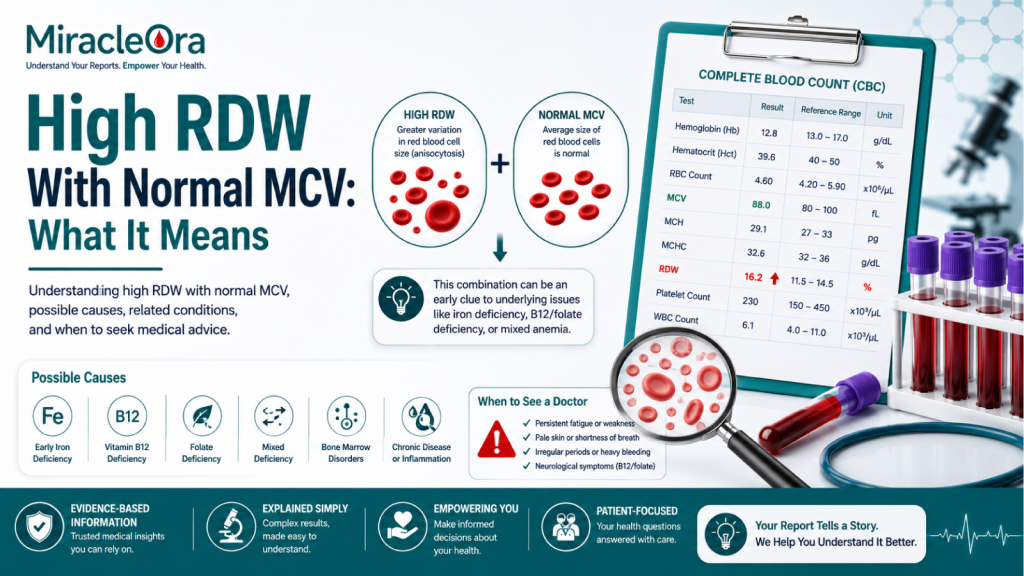
| If the smear says | CBC lines to look at with your clinician | Why they matter |
|---|---|---|
| Target cells | MCV, hemoglobin, RDW | Small cells lean toward the thalassemia and iron deficiency group; large cells toward liver disease, per The Blood Project |
| Spherocytes | Hemoglobin, MCHC | Shows whether anemia is present alongside the shape change |
| Schistocytes | Platelet count, hemoglobin | TTP, the condition Cleveland Clinic links to fragments, is by name a low platelet (thrombocytopenic) disorder |
| Teardrop or sickle cells | Hemoglobin, full blood count | Shows whether the shape change comes with anemia |
The numbers do not replace the smear, and the smear does not replace the numbers. A clinician reads them together. If a line in that table is new to you, our plain-language guide to reading a CBC report walks through each one.
What usually happens next
It depends on the finding and on everything else, and the choice of follow-up belongs to your clinician. The sources cited on this page point to the kinds of questions that tend to follow each shape:
- Target cells with small red cells: whether the picture is iron deficiency or an inherited hemoglobin difference such as thalassemia, the two groups The Blood Project names for microcytic target cells.
- Spherocytes: whether hereditary spherocytosis or another cause of red cell breakdown is involved, using tests such as those Cleveland Clinic lists.
- Schistocytes: how the platelet count and symptoms look, given the TTP link Cleveland Clinic describes.
- Target cells with large red cells: questions about liver health, since The Blood Project links macrocytic target cells to liver disease.
This page does not suggest starting, stopping or changing any medicine or supplement based on a smear comment.
Questions worth bringing to the appointment
- Which shapes were seen, and roughly how many?
- Does my MCV suggest small or large cells alongside them?
- Is this finding new, or was it on earlier reports?
- Are further tests planned, and what would each one tell us?
- Does anything in my family history matter here?
It also helps to mention past spleen surgery, any liver condition, known anemia in relatives, and every medicine and supplement you take.
The honest limits of this page
A laboratory report should not create fear. It should create understanding. Target cells, spherocytes and the other shapes are descriptions of how cells looked on a slide. Named sources link each shape to a range of possibilities, from inherited conditions to ones that need prompt care. No page can tell you which one applies to you. The ordering clinician, with your full report and history, can.
Frequently asked questions
What do target cells on a blood smear mean?
They are bullseye shaped red cells. MedlinePlus links them to some forms of anemia and to spleen removal, and The Blood Project adds liver disease, thalassemia, iron deficiency and hemoglobin C or E disease. The rest of the report guides interpretation.
Are target cells dangerous?
Target cells themselves are a description, not an illness. What matters is the cause, which ranges widely. Your clinician weighs the finding against your CBC numbers, symptoms and history.
What is the difference between target cells and spherocytes?
Target cells have a bullseye pattern because they carry extra membrane for their volume. Spherocytes are small and round and lack the normal pale center, according to MedlinePlus.
Should I worry about schistocytes on my report?
Schistocytes are red cell fragments. Cleveland Clinic links them to TTP, which it calls a medical emergency, so they are read promptly alongside the platelet count and symptoms. Symptoms such as confusion, tiny red or purple dots on the skin or blood in the urine call for prompt care.
Can a blood smear diagnose a condition on its own?
Usually not. MedlinePlus states that smear results alone usually cannot diagnose a medical condition, and are combined with your history and other tests.