The most important CBC emergency signs are symptoms, not numbers on their own. US health authorities describe bleeding that does not stop with pressure, chest pain, signs of stroke, and a fever of 100.4°F (38°C) or higher during chemotherapy as reasons to get care immediately. On the report itself, laboratories keep a short list of "critical values", results extreme enough that the lab contacts the clinician directly. Most results marked high or low are neither. They are ordinary out-of-range findings that belong in a conversation with the clinician who ordered the test, not a trip to the emergency room.
This page is the calm version of the question "should I go now?" It starts with the signs that mean yes, then explains how laboratories themselves separate an urgent result from an ordinary flag.
Call 9-1-1 or go to emergency care now
These are the situations where the published guidance is clear. If any of them apply, the blood count can wait; getting help cannot.
- Bleeding that does not stop. The National Heart, Lung, and Blood Institute (NHLBI) advises, on its thrombocytopenia page (updated February 18, 2025; read September 28, 2026), calling 9-1-1 "if you have bleeding that does not stop when you apply pressure."
- Chest pain or signs of stroke. NHLBI's platelet disorders symptoms page (updated February 18, 2025) states that chest pain or signs of stroke, "including changes in your vision or speech or trouble walking, are medical emergencies," and advises calling 9-1-1 right away.
- Fever during chemotherapy. The CDC's guidance for people having cancer treatment (updated November 14, 2024; read September 28, 2026) is to call the doctor immediately for a temperature of 100.4°F (38°C) or higher, and to tell emergency staff about the chemotherapy on arrival.
If you have a low result on your report and you feel very unwell, for example fainting, struggling to breathe, confusion or a severe new headache, that combination is a reason to seek emergency care rather than to wait for an appointment. None of this requires you to interpret your own numbers first.
What labs mean by a "critical value"
Laboratories have a formal category for results that cannot wait. Cleveland Clinic Laboratories defines critical values, on its critical and urgent values page (read September 28, 2026), as values that "indicate the patient is in danger of death unless treatment is initiated immediately." Its policy requires these results to be reported to the responsible caregiver "within 30 minutes of the result being known."
For blood counts, that laboratory lists, as examples:
| Test | Cleveland Clinic Laboratories critical threshold |
|---|---|
| Hemoglobin | below 6 g/dL |
| Platelets | below 10 K/µL (10,000 per microliter) |
It also keeps a separate, less severe "urgent" category. For outpatients, its urgent white blood cell limits are below 1.01 K/µL or above 74.99 K/µL.
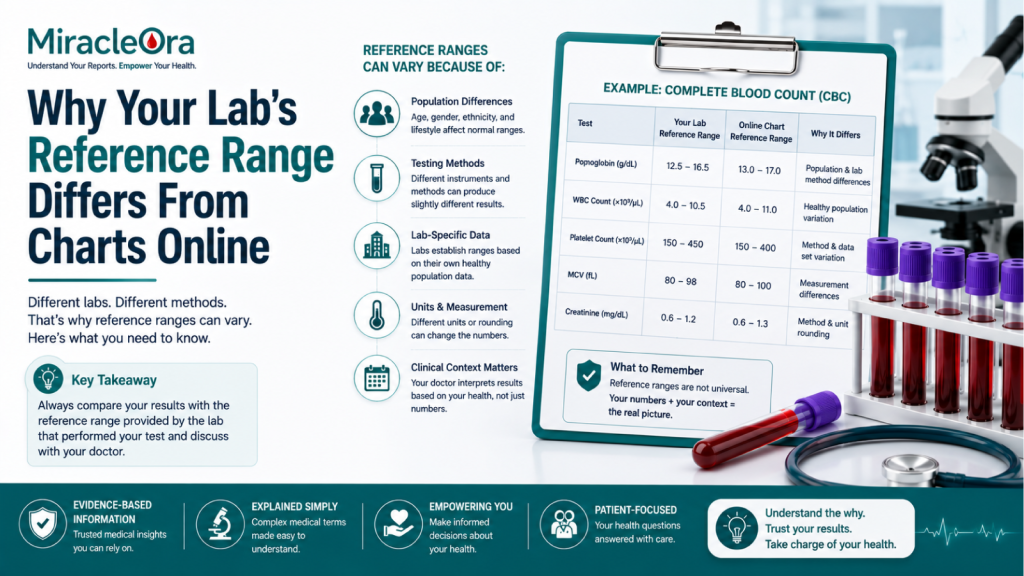
Two points keep this in proportion. First, these are one laboratory's thresholds. Each laboratory sets its own critical list, so no single number here is a universal rule, and your own laboratory's list may differ. Second, these values sit far outside the usual reference range. A result marked "L" or "H" is not the same thing, which our guide on what H and L flags mean on a blood test explains.
Why an ordinary flag is not a critical value
Every CBC is printed against a reference range, and a result just outside it gets a flag. That flag is automatic. A critical value belongs to a different, much smaller list that the laboratory handles as a direct call to the clinician, not just a line on a printout.
In practice, this means the system is designed so that a dangerous result is passed to your clinician quickly, rather than left for you to discover alone on a patient portal at midnight. If you have been contacted and told to go to hospital or to have the test repeated urgently, that instruction outranks anything you read online, including this page.
Red flags by cell line
Each part of the blood count has its own warning pattern. Here is what published sources connect with each one.
Red cells and hemoglobin
A low hemoglobin is common and usually explained through follow-up tests rather than emergency care. NHLBI's anemia symptoms page (updated March 24, 2022; read September 28, 2026) notes that mild anemia may produce no symptoms, and lists weakness, tiredness, shortness of breath, headache, dizziness and fainting, and yellowing of the skin among the symptoms that can develop. The red flag is the combination: a low result together with chest pain, fainting or severe breathlessness is a reason for urgent care. If your number is low but you feel well, our explainer on whether your hemoglobin is low covers what the reading can mean.
White cells and neutrophils
The most time-sensitive white cell concern is infection when neutrophils, the cells that fight bacteria first, are very low. That is the situation the CDC's 100.4°F guidance for people on chemotherapy is built around, and it describes a fever at that level as a reason to call the doctor immediately. People who have been told they have a low absolute neutrophil count for any reason can ask their clinician which fever plan applies to them. Our page on the absolute neutrophil count, with the math explains how that number is calculated.
A very high white count is the other direction. Cleveland Clinic Laboratories places extreme white counts in its urgent category, meaning the clinician is contacted promptly. A high white count has many possible explanations, and working out which one applies is the ordering clinician's job, using your symptoms and the rest of the report.
Platelets
Platelets are where bleeding symptoms matter most. NHLBI lists these symptoms of a low platelet count: bleeding from the gums, nosebleeds, bleeding for a long time after a small injury, blood in stool, urine or vomit, easy bruising, petechiae (small, flat red spots under the skin) and purpura (bleeding under the skin). Bleeding that will not stop with pressure is the 9-1-1 sign. Our guide to when a low platelet count is actually dangerous goes through the levels and symptoms in more depth.
High platelet counts carry a different risk, which is clotting. NHLBI lists chest pain and heart palpitations, difficulty breathing, dizziness, vision changes, weakness, numbness, slurred speech, headaches, and pain and swelling of the legs among symptoms linked to high platelets.
The pattern clinicians watch: the result plus the person
Across all three cell lines, the same principle applies. Urgency is not judged from one number in isolation. The clinician weighs:
- How far the value is from the reference range, and whether it reaches the laboratory's critical list.
- Symptoms, especially bleeding, fever, chest pain, breathlessness, fainting and changes in vision, speech or movement.
- Speed of change, meaning whether the result is new or has been stable on earlier tests.
- Context, such as pregnancy, chemotherapy, a known blood condition, recent illness or recent surgery.
This is also why a result that looks similar on two reports can mean different things for two people. A stable low value that a clinician already knows about is a very different picture from a sudden new drop with symptoms.
What is usually not an emergency
Most CBC flags fall into this group. Results just outside the range with no symptoms, a single borderline value, or a value that has been stable on earlier tests are normally handled with routine follow-up. Waiting for the clinician's review in these cases is not negligence; it is the ordinary pace at which laboratory medicine works. If you are unsure which group your result falls into, calling the ordering clinician's office or a nurse advice line is a reasonable middle step between ignoring a result and going to the emergency department.
Frequently asked questions
What CBC result is considered critical?
Each laboratory sets its own list. As one published example, Cleveland Clinic Laboratories lists hemoglobin below 6 g/dL and platelets below 10 K/µL as critical values. Your own laboratory's thresholds may differ, and critical results are called through to the clinician rather than simply flagged.
Will someone call me if my blood count is dangerous?
Laboratories run critical-result policies for this reason. Cleveland Clinic Laboratories, for example, requires critical results to be reported to the responsible caregiver within 30 minutes. The clinician then decides how to contact you. If you have not heard back and you have concerning symptoms, seeking care is reasonable rather than waiting.
Should I go to the emergency room for a flagged CBC result?
A flag on its own is not the usual reason. The published emergency signs are symptoms: bleeding that does not stop with pressure, chest pain, signs of stroke, and fever during chemotherapy. For a flagged result without those symptoms, the ordering clinician is the usual first contact.
Can a normal CBC rule out an emergency?
No. A blood count does not measure everything, and it cannot rule out problems such as a heart attack or stroke. Emergency symptoms deserve urgent care whatever an earlier blood test showed.
Are critical values the same for children and adults?
Not necessarily. Laboratories set their own lists and may use different thresholds for different age groups, so an adult list should not be applied to a child. The child's clinician is the right person to interpret the result.
The bottom line
Emergencies around blood counts are defined mostly by symptoms and by a short list of extreme values that laboratories report straight to the clinician. Knowing those signs lets you act fast when it matters and stay calm when a routine flag appears. Any interpretation of your own numbers belongs with the clinician who ordered the test.