Questions to ask doctor about blood test results work best when they are short and specific: which results matter for me, compared with what range, is this new or a change from before, could anything have affected it, what is the likely explanation, and what happens next. Those six questions turn a list of flags into a plan. Appointments are often brief, so it helps to write the questions down, bring earlier reports, and ask the most important one first. Your doctor, who knows your history, is the person who can say what a result means for you. This guide gives you the wording.
Before the questions: when not to wait for an appointment
Some situations should not sit in a queue for a routine visit. The National Heart, Lung, and Blood Institute (NHLBI) advises calling 9-1-1 for bleeding that does not stop when pressure is applied, and describes chest pain or signs of stroke as medical emergencies. The CDC advises people receiving chemotherapy to call their doctor immediately for a temperature of 100.4°F (38°C) or higher. If the lab or your doctor's office has contacted you and asked you to act quickly on a result, follow that instruction first. The questions below are for the ordinary, far more common situation: a report with a few flags and a scheduled conversation.
Why a short list works better than a long one
Kaiser Permanente's Health Encyclopedia publishes a checklist titled Medical Tests: Questions to Ask the Doctor (current as of May 1, 2026; read September 28, 2026). It covers the whole journey, from "Why do I need this test?" to "After the test, what will be the next step?" Many of those questions belong before the blood draw. Once the results are back, the time in the room is better spent on a smaller set, ranked by what changes your plan.
The questions below are grouped in the order they tend to be most useful. If you only get to ask three, ask the first three.
Six core questions to ask doctor about blood test results
1. "Which of these results matter for me, and which can I set aside?"
This is the single most useful question. A report can carry several high and low flags, and not all of them carry the same weight. MedlinePlus, in its guide How to Understand Your Lab Results (updated September 4, 2025; read September 28, 2026), notes that "it's common for healthy people to sometimes have results outside the reference range." Asking your doctor to sort the flags into "matters here" and "not a concern here" gives you a map for the rest of the conversation.
2. "What range are you comparing it with?"
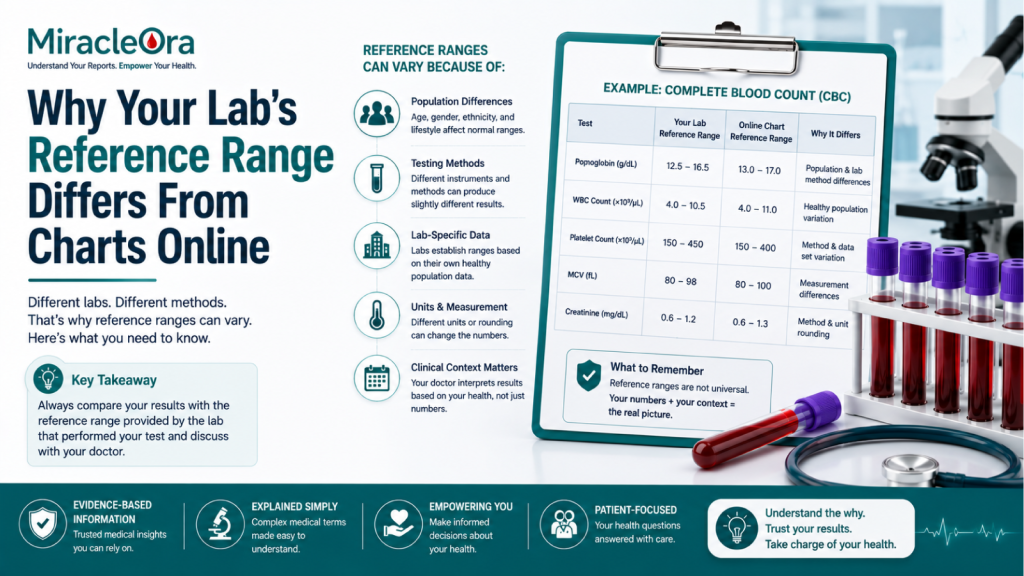
Testing.com, the patient education site marked as board-approved, explains that reference ranges for most tests are specific to the laboratory that performs them, because laboratories use different equipment and methods. A chart found online may therefore not match your report. Asking which range applies, and whether it is adjusted for age, sex or pregnancy, avoids a lot of confusion. Our explainer on why your lab's reference range differs from charts online goes into the reasons.
3. "Is this new, or has it been like this before?"
A single result is a snapshot. Bringing earlier reports, or asking the doctor to pull them up, lets you both see whether a value is stable, improving or moving. A low value that has been steady for years is a different conversation from one that has changed since last time.
4. "Could anything about the test itself have affected this?"
MedlinePlus lists factors that can change results, including certain foods and drinks, certain medicines or supplements, hard exercise before the test, and having a menstrual period at the time of testing. Mentioning anything unusual about the day of the draw gives the doctor useful context. Our guide on dehydration and blood test results shows how one everyday factor can move several numbers at once.
5. "What do you think is the most likely explanation, and what else are you considering?"
This asks for the doctor's reasoning in plain words. It is fine to follow up with "What would make you think it is something else?" The answer shows you what any next tests are designed to check.
6. "What happens next, and when?"
Kaiser Permanente's list includes this almost word for word: "After the test, what will be the next step?" and "Will other tests be needed?" The answer might be nothing, a repeat test, more specific tests, a review of medicines or a referral. Asking for the timing (weeks, months, or at the next check-up) gives you something concrete to hold on to.
Questions for specific situations
Not every question fits every report. These are useful when they apply.
When a result is borderline or only slightly out of range
- "Is this far enough outside the range to act on, or is it one to watch?"
- "Would you expect it to come back into range on a repeat?"
When you are told the test will be repeated
- "What are you hoping the repeat will show?"
- "Is there anything to do differently before the repeat, such as fasting or timing?"
Preparation questions like this come straight from Kaiser Permanente's checklist ("What should be done to prepare for the test?"). Timing can matter for some tests, which our guide on whether the time of day affects blood test results explains.
When more tests are ordered
- "What will this test tell you that the first one did not?"
- "How will the result change what we do?"
The second question appears in Kaiser Permanente's list as "Will the results change the treatment?" It is a respectful way to understand why a test is worth doing.
When a referral is suggested
- "What question are you hoping the specialist will answer?"
- "Is this routine, or do you want me seen soon?"
When you take medicines or supplements
- "Could any of my current medicines or supplements affect these numbers?"
Bring a complete, current list. Any decision about a medicine belongs to the prescribing clinician, so this question is for information, not a cue to change anything on your own.
Questions about symptoms and safety
These are easy to forget and matter a great deal.
- "Which symptoms should make me call you before the next appointment?"
- "Which symptoms mean I should go to emergency care?"
- "Who do I call outside office hours?"
The CDC's guidance for people on chemotherapy includes making sure you know which number to call when the office is open and when it is closed. That habit is useful for anyone waiting on follow-up.
Questions about the report itself
- "Can I have a copy of the full report, including the reference ranges?"
- "Will the results be sent to my other doctors?"
- "How will I hear about the next result, and when should I follow up if I have not heard?"
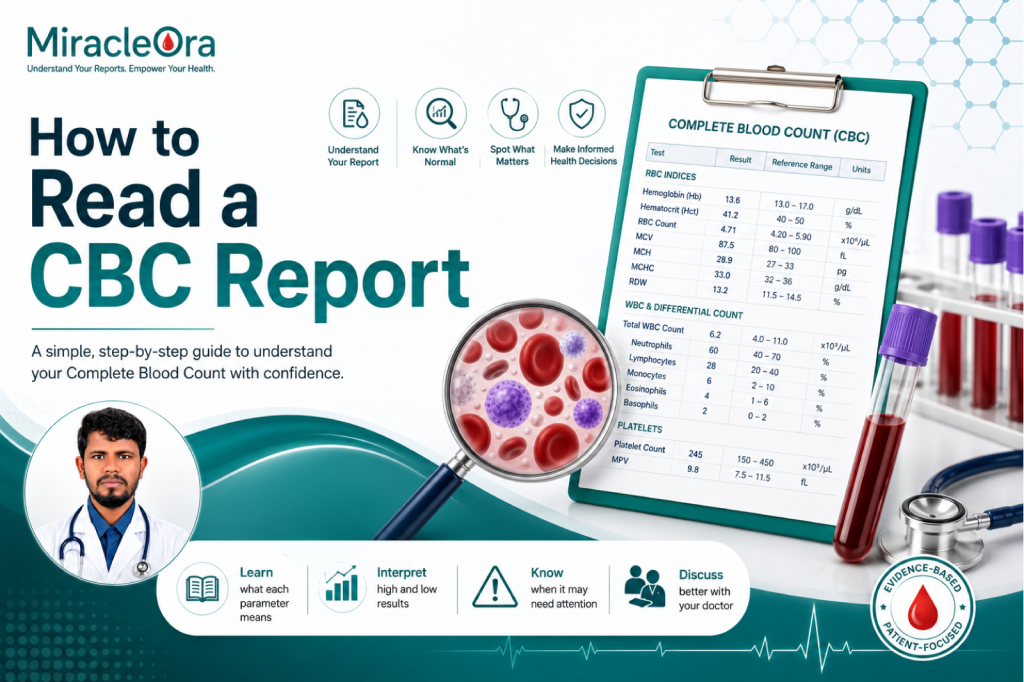
If the abbreviations are the main obstacle, our plain-language walk-through on how to read a CBC report covers each line.
How to make the most of a short appointment
A little preparation keeps the conversation focused.
- Write the questions down, most important first, and bring a printed or on-screen copy of the report.
- Bring earlier results, especially if they came from a different lab or clinic.
- Note anything unusual about the test day, such as a recent illness, hard exercise, a missed meal, or a new medicine or supplement.
- Write down the answers, or ask whether a family member or friend can come with you to take notes.
- Repeat back the plan in your own words at the end: "So the next step is X, in about Y weeks, and I should call if Z." It is a simple way to check that you and your doctor have understood each other.
What a good answer sounds like
A helpful answer usually includes three parts: what the result is, what the doctor thinks it most likely means in your case, and what the plan is. If one of those parts is missing, it is reasonable to ask for it. Phrases such as "Could you say that another way?" or "What would you want to know if this were your result?" are ordinary parts of a medical conversation.
It also helps to remember what the result is not. MedlinePlus explains that tests can produce false positives and false negatives, and that abnormal findings often lead to more testing to find out what is really going on. An out-of-range number is the start of a conversation, not its conclusion.
Frequently asked questions
What is the most important question to ask about blood test results?
"Which of these results matter for me, and what happens next?" It turns a list of flags into priorities and a plan. MedlinePlus notes that healthy people sometimes have results outside the reference range, so knowing which flags carry weight is the key step.
Is it rude to ask my doctor to explain my blood results again?
No. Asking for a result to be explained in plain words, or asking the doctor to repeat the plan, is a normal part of a medical conversation. Writing the answer down helps you remember it later.
Should I bring previous blood test results to my appointment?
Earlier results help the doctor see whether a value is new, stable or changing, especially if they came from another laboratory. If they are on a patient portal, having them ready on your phone saves time.
What should I ask if my doctor wants to repeat a blood test?
Ask what the repeat is meant to show, whether any preparation is needed, and when it should happen. Kaiser Permanente's checklist includes preparation among its recommended questions.
Can I ask for a copy of my blood test report?
Asking is always reasonable. Having your own copy, with the laboratory's reference ranges printed beside each result, makes follow-up conversations and second opinions easier.