What happens if blood test is abnormal? Most often, a calm sequence rather than a sudden one. The flag is generated automatically when a number falls outside the laboratory's reference range. A clinician then reviews it alongside your symptoms, history and earlier results, and chooses one of a few paths: no action, watching it, repeating the test, ordering more specific tests, or referring you on. Many out-of-range results need nothing more than a repeat or a note in your record. Your ordering clinician decides which path fits you, and that is the person to ask.
This page walks through that sequence step by step, so the wait between "abnormal" and "answer" feels less like a blank.
First: the situations that skip the queue
A few situations do not follow the usual timeline. The National Heart, Lung, and Blood Institute (NHLBI) advises calling 9-1-1 for bleeding that does not stop when pressure is applied, and describes chest pain or signs of stroke, such as changes in vision or speech or trouble walking, as medical emergencies. The CDC advises people receiving chemotherapy to call their doctor immediately for a temperature of 100.4°F (38°C) or higher. If a laboratory or clinician contacts you directly and asks you to act on a result, that instruction comes first. Everything below describes the far more common case: a flagged result and no emergency symptoms.
Step 1: The flag is automatic
The word "abnormal" on a report is produced by software, not by a person deciding something is wrong. The British Heart Foundation explains, in an expert answer on abnormal blood test results by cardiac nurse Ruth Goss (updated June 12, 2026; read September 28, 2026), that results are compared against reference ranges and that "these flags are generated automatically and do not always mean something is wrong."
Our guide to what H and L flags mean on a blood test covers how to read the markers themselves.
Step 2: Why healthy people get flags too
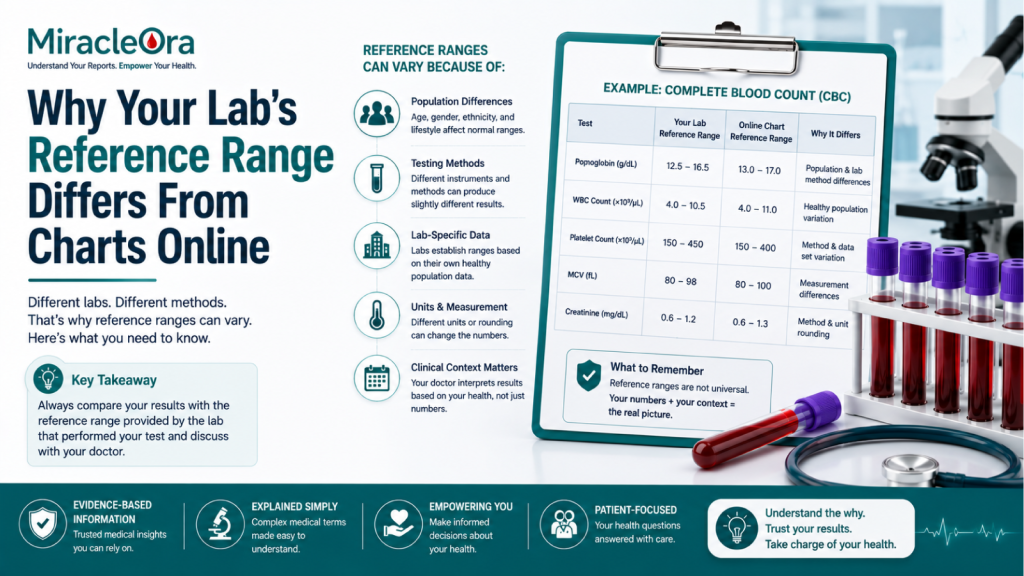
Reference ranges are built from healthy people, and by design they leave some healthy people outside. Testing.com, in its article Reference Ranges and What They Mean (updated July 9, 2021; read September 28, 2026), explains that ranges for many tests cover the middle 95% of a healthy reference population. "Statistically speaking," it notes, "that means 5% of people in that same population will have results that fall outside the limits."
A complete blood count reports many separate values at once, so a report with one or two results just outside their ranges is common in people who feel well. MedlinePlus makes the same point in plainer words: "It's common for healthy people to sometimes have results outside the reference range." Testing.com adds that ranges are specific to the laboratory that performs the test, which is why two labs can give you different numbers for the same blood.
Step 3: A clinician reviews the result in context
This is the step that turns a number into a meaning. The clinician who ordered the test looks at:
- How far outside the range the value sits, and in which direction.
- Which values moved together. A single isolated flag reads differently from a group of related ones.
- Your symptoms, or the absence of them.
- Earlier results, to see whether this is new, stable or changing.
- Things that affect results. MedlinePlus lists certain foods and drinks, certain medicines or supplements, hard exercise before the test, and a menstrual period at the time of testing.
- Your wider history, including known conditions, pregnancy and recent illness.
A value that has sat just outside the range for years, and that your clinician already knows about, is a different picture from one that is new. If you feel completely well and are puzzled by the flag, our article on a blood test that is abnormal when you feel fine explores that situation.
What happens if blood test is abnormal: five common paths
After review, the next step usually falls into one of these paths. They are listed from lightest to most involved; the order is not a measure of how worried to be.
| Path | What it usually looks like | Often chosen when |
|---|---|---|
| No action | Result noted in your record | Slightly out of range, no symptoms, fits your history |
| Watch | Checked again at a future routine visit | Mild change worth tracking over time |
| Repeat | Same test again after a set interval | Unexpected result that may be a one-off |
| Further tests | More specific tests on blood or other samples | A pattern that needs explaining |
| Referral | Appointment with a specialist | A question beyond the ordering clinician's scope |
The BHF notes that a clinician "may also ask you to have a repeat blood test to check that the results are accurate." MedlinePlus explains that abnormal findings can lead providers to order additional tests to find out what a result means. A referral, for example to a hematologist for a blood count question, is a way to get a specialist's answer, not a verdict in itself.
Step 5: You hear back
How you hear depends on the practice. The BHF explains that "if further action is needed on your results, your doctor or nurse will be in touch," and that they may ask you to come in or book an appointment over the phone. Some clinics release results to a patient portal before anyone has discussed them with you, which can explain why a flag is sometimes seen before an explanation arrives.
If you have not heard back within the time your clinic gave you, calling to ask is reasonable. It is also reasonable to ask how you will be contacted about the next result.
What you can do while you wait
- Write down what you noticed on the test day: a recent illness, hard exercise, a missed meal, poor fluid intake, or a new medicine or supplement.
- Gather earlier reports, especially if they came from a different lab or clinic.
- Prepare a few questions, starting with "Which of these results matter for me?" and "What happens next, and when?"
- Bring a current list of medicines and supplements. Any decision about a medicine belongs to the clinician who prescribed it.
- Know the red flags listed at the top of this page, and who to call outside office hours.
It can also help to remember what a result is not. MedlinePlus explains that tests can produce false positives, meaning a result suggests a condition that is not actually present, as well as false negatives. An out-of-range value is a reason for a conversation, not a conclusion.
Why "watch and repeat" is not the same as "ignore"
A plan to repeat a test or check it again later can feel like nothing is happening. In practice it is one of the most common responsible choices in laboratory medicine. A single result is a snapshot. A second result shows whether the first was a passing fluctuation, a stable baseline or a real change. The repeat is only useful if it actually happens, so noting the date and booking it early is worth the effort.
When the next step is more tests
If further tests are ordered, it helps to ask what question each one is meant to answer. For blood count results, that might be tests of iron, vitamin B12 or folate, a look at the cells under a microscope, or a repeat count with a differential. Each is chosen to narrow down possible explanations. Our overview of what a CBC test is actually for explains why a blood count often starts a search rather than ending one.
Frequently asked questions
Does an abnormal blood test mean something is wrong?
Not necessarily. The British Heart Foundation explains that abnormal flags are generated automatically and do not always mean something is wrong, and Testing.com notes that, by the way ranges are built, 5% of a healthy reference population falls outside a typical range. Your clinician interprets the result in context.
How long does it take to hear about an abnormal result?
It varies by clinic and by how urgent the result is. The BHF explains that your doctor or nurse will be in touch if further action is needed. If you have not heard within the time your clinic gave you, calling to ask is reasonable.
Why would a doctor repeat an abnormal blood test?
The BHF notes that a repeat can check that results are accurate. A second result also shows whether the first was a temporary change or something that persists, which guides what happens next.
Will I be referred to a specialist?
Sometimes, but many abnormal results are handled by the clinician who ordered the test. A referral is usually made when a specialist can answer a specific question, and it does not by itself mean something serious has been found.
Should I change my diet or medicines after an abnormal result?
That is a conversation to have with your clinician first. Decisions about medicines belong to the prescribing clinician, and the right step depends on why the value is out of range.