A lot of blood test anxiety results from one thing: seeing numbers and red flags before anyone has explained them. The calm way through is a method, not a reassurance. First, check for anything urgent. Then read each flag against the range printed beside it, ask how far out it is, whether it fits the rest of the picture and whether it has changed from before, and take your questions to the clinician who ordered the test. MedlinePlus notes that "it's common for healthy people to sometimes have results outside the reference range," so a flag on its own is a question, not a verdict.
This guide sets out that method step by step, explains why a flag is not the same as a diagnosis, and shows where your own judgment ends and your clinician's begins.
First: a quick check for anything urgent
Before reading any number, look at how you feel. A calm method starts with the one thing that should never wait. MedlinePlus lists warning signs of a medical emergency in adults (reviewed January 8, 2025, read on October 2, 2026), including:
- Bleeding that will not stop
- Coughing up or vomiting blood
- Breathing problems, such as difficulty breathing or shortness of breath
- Chest pain or discomfort lasting two minutes or more
- Fainting or loss of consciousness
- Sudden dizziness, weakness or change in vision
- A change in mental status, such as confusion or unusual behavior
If any of these are happening, the report can wait and emergency care cannot. Likewise, if the lab or your clinician has contacted you and asked you to act quickly, follow their instructions; they have seen your result in context.
If none of that applies, you have time, and you can read the report slowly.
Why a flag is not a diagnosis
Lab reports flag a result when it falls outside a reference range. MedlinePlus's guide to understanding your lab results (last updated September 4, 2025, read on October 2, 2026) defines a reference range as "a set of numbers that form the high and low ends of the range of results that's considered to be normal."
The way those ranges are built explains much of the worry. The laboratory education site Testing.com explains in its article on laboratory test reference ranges (updated July 9, 2021, read on October 2, 2026) that for many tests, reference ranges cover "the middle 95% of the reference population." It adds: "Statistically speaking, that means 5% of people in that same population will have results that fall outside the limits."
A complete blood count reports many separate values. The more lines on a report, the more likely it is that at least one falls just outside its range in a healthy person. That is arithmetic, not a finding about you, and it is why a single mild flag is so often the start of a conversation rather than the start of a problem. Our guide to what the H and L flags mean explains how those markers are applied.
The calm method: five steps for reading your report
Most guides on this topic offer either coping tips for the wait or a general explanation of ranges. This method joins the two. Read your report with a pen and a sheet of paper.
Step 1: Read each flag against your own lab's range
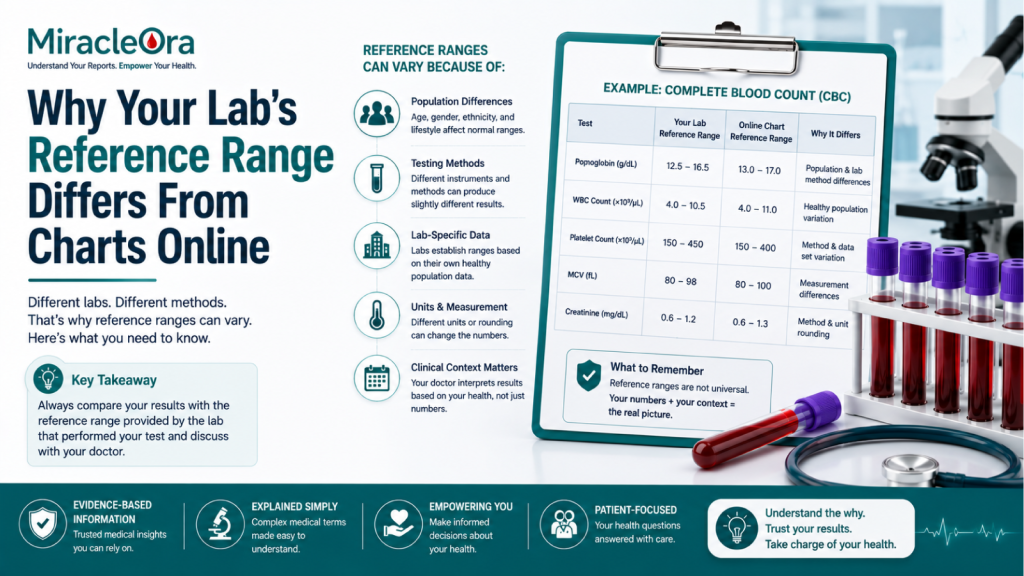
Use the range printed beside your result, not a chart from a website. MedlinePlus notes on its WBC count page (reviewed February 3, 2025) that "normal value ranges may vary slightly among different labs." Our article on why your lab's range differs from charts online explains why the same number can be flagged in one lab and not another.
Step 2: Ask how far out of range it is
Testing.com lists this as the first question to ask about an out-of-range result: "How far out of range are your results?" A value just past the limit is read very differently from one far beyond it. Write the number, the limit and the gap.
Step 3: Ask how it fits the rest of the picture
Testing.com's second question is "How do the results fit with the rest of your clinical picture?" Note anything relevant: symptoms or none, recent illness, exercise, medicines, supplements, and whether you followed preparation instructions. MedlinePlus lists food and drink, medicines or supplements, strenuous exercise and the menstrual cycle among the things that can affect results.
Step 4: Compare with earlier results
The third question is "Are the present results different from those you have had in the past?" A value that has sat slightly outside the range for years reads differently from one that has recently moved. Gather earlier reports if you have them.
Step 5: Turn the page into questions
End with three or four written questions for the clinician who ordered the test. Testing.com notes that a provider may repeat a test to rule out technical or circumstantial factors, and that "the best source of this information is your health care provider."
A worked example of the method
Here is how the method reads on paper, using a made-up report line rather than a real patient. Suppose a CBC shows a value marked L, a little below the lower limit printed beside it, in someone who feels well.
- Step 1: the flag is judged against that lab's own range, not an online chart.
- Step 2: the gap between the value and the limit is small, and that is written down.
- Step 3: there are no symptoms, and the person had a cold two weeks earlier.
- Step 4: a report from last year showed a similar value.
- Step 5: the questions become "Is this similar to my past results? Does the recent cold matter? Do you want to repeat it?"
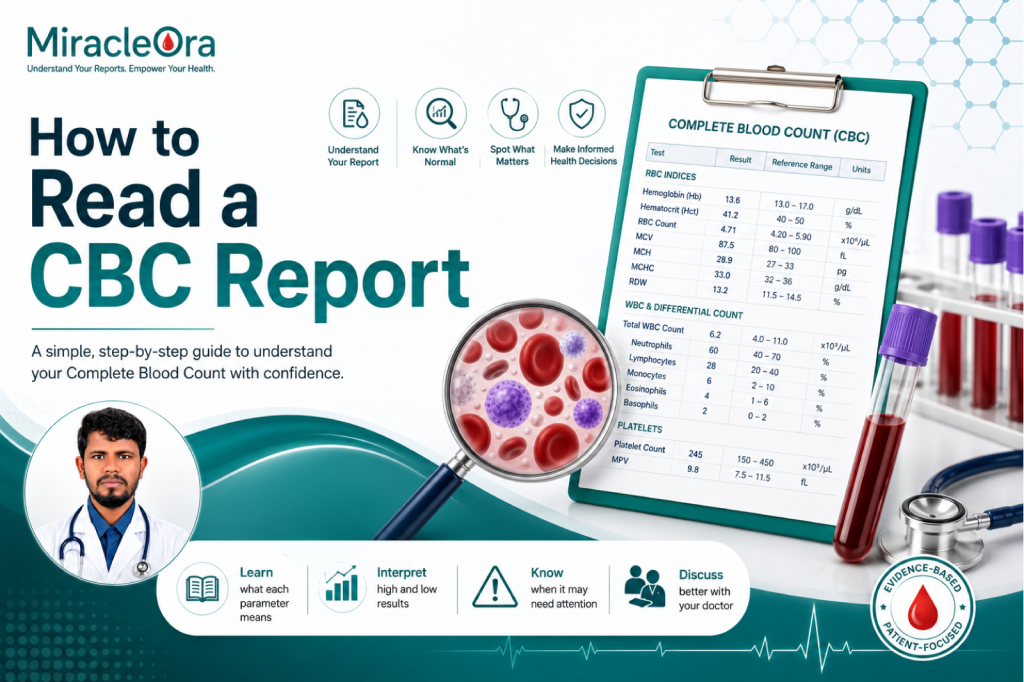
The method does not answer those questions. It turns a frightening red letter into a short, specific conversation, which is the part a reader can do. For a fuller tour of each line, our guide on how to read a CBC report walks through the report section by section.
What the method cannot do
Being honest about limits is part of staying calm. MedlinePlus is clear that a normal result is not a guarantee: "A test result that is within a reference range isn't always a guarantee of good health. Some people with health problems can have results that are considered 'normal.'" It also notes that you "may need additional testing, especially if you have symptoms of a health condition."
So the method works in both directions. It should stop a mild flag from becoming a crisis, and it should also stop a normal report from overriding symptoms that are worrying you. Neither the flag nor the absence of one replaces the clinician's reading. If you feel well but one line is flagged, our article on an abnormal result when you feel fine covers what that combination can mean.
Looking after the worry itself
The worry deserves attention in its own right. The National Institute of Mental Health (page last reviewed December 2024, read on October 2, 2026) begins its anxiety overview with a steadying line: "Feeling anxious is a normal part of life. Many people worry about things such as health, money, school, work, or family."
Harvard Health Publishing's tips for medical test anxiety (Heidi Godman, March 1, 2023, read on October 2, 2026) include bringing a buddy for support, trying relaxation exercises such as deep breathing, and using trusted sources such as the National Library of Medicine rather than random searches. Those ideas carry over well to reading results: open the report with someone you trust nearby, or wait until you can discuss it with your clinician.
The NIMH also notes that anxiety disorder symptoms "can interfere with daily life and routine activities, such as job performance, schoolwork, and relationships." If worry about your health is lasting, affecting sleep, work or relationships, or returning with every test, that is worth raising with your doctor or a mental health professional. Asking for help with it is a reasonable step, not an overreaction.
The clinician is the last step, not the first fear
A laboratory report should not create fear; it should create understanding. The method in this article is a way to arrive at your appointment with clear questions instead of a night of searching. The interpretation itself belongs with the clinician who ordered the test, who can see your history, examination and earlier results together.
This article is general information. It cannot interpret your individual result or tell you whether a flag matters for you.
Frequently asked questions
Is it normal to have one result outside the range?
It can be. MedlinePlus states that "it's common for healthy people to sometimes have results outside the reference range," and Testing.com explains that many ranges are built around the middle 95% of a reference population. Your clinician can tell you whether a flag matters for you.
Should I look at my results before my doctor calls?
That is a personal choice. Some people prefer to wait until they can discuss them, and others read them with someone they trust nearby. If you read them first, check for urgent symptoms, then write down questions rather than searching late at night.
What questions should I ask about an abnormal result?
Testing.com suggests three: how far out of range the result is, how it fits with the rest of your clinical picture, and whether it differs from your past results. Asking whether a repeat test is planned is also reasonable.
When should I seek help for health anxiety?
If worry about your health is lasting or interfering with daily life, it is worth raising with your doctor or a mental health professional. The NIMH notes that anxiety disorder symptoms can affect work, school and relationships.