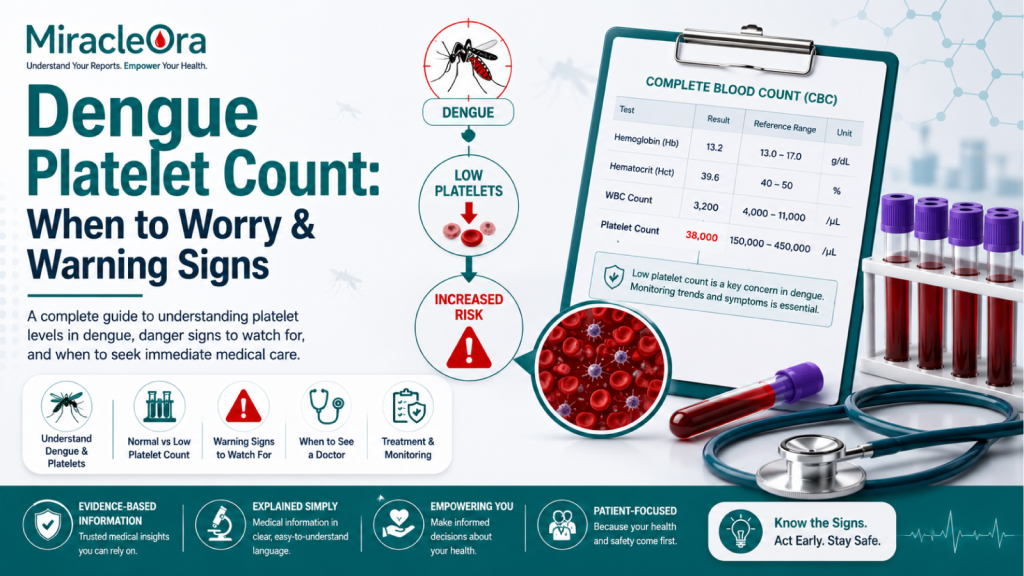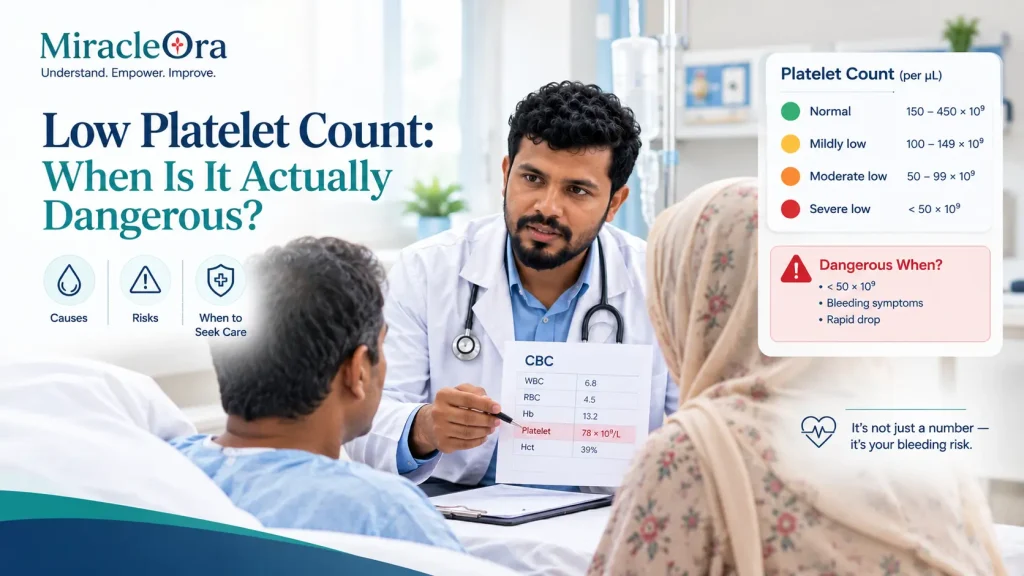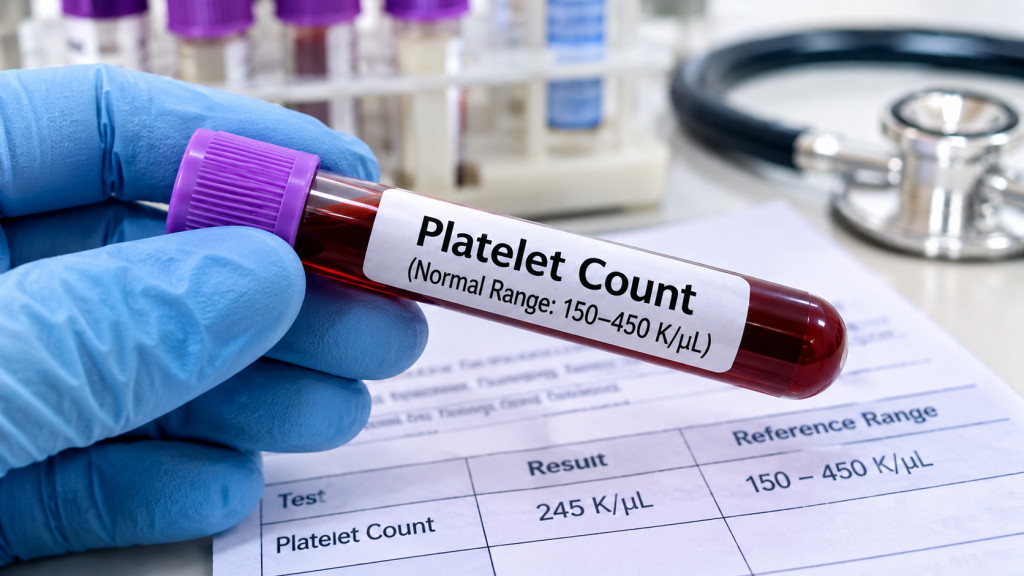
Most US references put a normal adult platelet count at 150,000 to 400,000 or 150,000 to 450,000 per microliter, but there is no single agreed range. Across ten adult intervals from five dated clinical sources, only 165,000 to 300,000 sat inside every one, though the band that applies to you depends on your sex and age. Outside it, whether a count is flagged depends on the lab's range.
That is the short answer. The rest of this page shows where the ranges come from, which numbers move between "normal" and "flagged" depending on whose range is used, and what to look at on your own report.
What does the platelet count actually count?
It counts how many platelets are in a set volume of your blood sample. Platelets are the cell fragments involved in clotting, and the result is a concentration, not a total for your whole body.
The same number can be written three ways. MedlinePlus states that "The normal number of platelets in the blood is 150,000 to 400,000 platelets per microliter (mcL) or 150 to 400 × 10⁹/L." Many reports print a shorter form. Using MedlinePlus's conversion, 250 × 10⁹/L means 250,000 per microliter. Some reports write the same count as 250 × 10³/µL; by our arithmetic that is identical, because a liter holds a million microliters, so 10³ per microliter equals 10⁹ per liter. Our CBC normal range chart has a unit conversion table if your report uses a different style.
Throughout this page, numbers are given in thousands per microliter (the "× 10⁹/L" form), so 150 means 150,000.
Why do trusted sources print different normal ranges?
Because each one describes a different reference group or uses a different definition. A reference range is built from results in healthy people, and MedlinePlus notes that "It's common for healthy people to sometimes have results outside the reference range."
Here are the adult intervals we compared, each read from the source on November 10, 2026:
| Source | Who it applies to | Range (× 10⁹/L) | Source date |
|---|---|---|---|
| MedlinePlus Medical Encyclopedia, "Platelet count" | Adults, no sex split | 150 to 400 | Reviewed February 3, 2025 |
| NHLBI, "Thrombocytopenia" | Adults | 150 to 450 | Updated February 18, 2025 |
| Cleveland Clinic, "Platelet Count (PLT)" | Adults, "regardless of age" | 150 to 400 normal; above 450 high | Updated October 21, 2024 |
| Mayo Clinic Laboratories, CBC test catalog | Adult men | 135 to 317 | Archived copy of December 4, 2025 |
| Mayo Clinic Laboratories, CBC test catalog | Adult women | 157 to 371 | Archived copy of December 4, 2025 |
| SENIORLAB study, Journal of Clinical Medicine | Age- and sex-independent limits the authors called commonly employed | 150 to 350 | Published September 3, 2020 |
| SENIORLAB study | Men 60 to 69 / 70 to 79 / 80 and over | 150 to 300 / 130 to 300 / 120 to 300 | Published September 3, 2020 |
| SENIORLAB study | Women 60 and over | 165 to 355 | Published September 3, 2020 |
Mayo Clinic Laboratories states that its "Intervals are Mayo-derived, unless otherwise designated," which means they come from that laboratory's own reference work. The SENIORLAB figures come from Swiss adults aged 60 and over who described themselves as healthy and were followed for illness and death, so they describe that group, not everyone.
None of these is the "real" range. MedlinePlus puts the practical consequence plainly: "You can't compare test results from different labs." The range printed beside your result is the one your laboratory used to flag it.
Which counts are normal everywhere, and which depend on the lab?
Across all ten intervals, a count from 165 to 300 is inside every range. A count from 120 to 164, or from 301 to 450, is inside at least one range and outside at least one other. Below 120 or above 450, every interval we compared would place it outside.
The picture is tighter once you apply only the intervals that fit a particular reader. This table applies the general adult ranges to everyone, and adds the sex- and age-specific ranges only where they apply:
| Reader | Inside every applicable range | Low flag depends on whose range | High flag depends on whose range |
|---|---|---|---|
| Woman under 60 | 157 to 350 | 150 to 156 | 351 to 450 |
| Man under 60 | 150 to 317 | 135 to 149 | 318 to 450 |
| Woman 60 or over | 165 to 350 | 150 to 164 | 351 to 450 |
| Man 60 to 69 | 150 to 300 | 135 to 149 | 301 to 450 |
| Man 70 to 79 | 150 to 300 | 130 to 149 | 301 to 450 |
| Man 80 or over | 150 to 300 | 120 to 149 | 301 to 450 |
Two things stand out. First, the "depends" zone at the top is wide, especially for men: a count of 330 is unflagged against a 150 to 400 range but above Mayo Clinic Laboratories' adult male range. Second, the sex split pushes the lower limit in opposite directions. A man's count of 140 is below the common 150 cutoff but inside the Mayo male range, while a woman's count of 155 is above 150 but below the Mayo female range.
This table describes how labels move between published ranges. It does not say what any count means for your health, and it is not a substitute for the range on your own report.
Use the comparer below to see where your own number sits against each of the ten ranges, side by side, with the ranges that fit your sex and age marked.
Platelet range comparer: where does your count sit against ten published adult ranges?
Type the platelet count from your report and pick the unit printed beside it. The comparer shows where that number sits against each of the ten published adult ranges on this page, side by side. Sex and age are optional; they only decide which ranges match you. Nothing you type leaves your browser.
NHLBI says: “Call 9-1-1 to seek immediate medical care if you have bleeding that does not stop when you apply pressure.” 9-1-1 is the US number; outside the US, use your local emergency number.
Sources and limits
Ranges read on Nov 10, 2026 from: MedlinePlus Medical Encyclopedia, “Platelet count” (reviewed Feb 3, 2025); NHLBI, “Thrombocytopenia” (updated Feb 18, 2025); Cleveland Clinic, “Platelet Count (PLT)” (updated Oct 21, 2024); Mayo Clinic Laboratories CBC test catalog (archived copy of Dec 4, 2025); SENIORLAB study, Journal of Clinical Medicine (published Sep 3, 2020); MedlinePlus, “How to Understand Your Lab Results” (updated Sep 4, 2025).
If the comparer does not load, the same check works by hand. Take the ten adult ranges from the source table under "Why do trusted sources print different normal ranges?" above, convert your number to the × 10⁹/L form if needed (MedlinePlus equates 150,000 per microliter with 150 × 10⁹/L, so divide a per-microliter count by 1,000), and mark each range as inside, below or above. The reader table earlier in this section shows the result for six common readers. Either way, the range printed on your own report is the one your lab used, and the clinician who ordered the test is the person to ask what your number means for you.
What about the 400 to 450 band?
On some pages it carries no label at all. Cleveland Clinic's platelet count page gives "Normal platelet count range: Between 150,000 and 400,000 platelets per microliter" and, after its low-count line, "High platelet count (thrombocytosis): More than 450,000 platelets per microliter." A count of 420 is above that page's normal range but below its definition of high.
MedlinePlus closes the gap the other way, stating that "A high platelet count is 400,000 (400 × 10⁹/L) or above." So the same 420 is "high" on one authority page and in between on another. The difference is that a normal range describes healthy people, while a cutoff for calling something thrombocytosis is a definition, and the two are not always drawn at the same point. Our page on what a high platelet count can mean covers what usually follows when a count sits above the range.
Does your sex or age change what counts as normal?
In some laboratories, yes. Mayo Clinic Laboratories publishes separate adult ranges for men (135 to 317) and women (157 to 371). Other sources, including MedlinePlus, NHLBI and Cleveland Clinic, give one adult range for everyone.
Age is less settled. Cleveland Clinic keeps one range "regardless of age" while also noting that "it's normal for platelet counts to decrease with age, especially after age 60." The SENIORLAB researchers went further. In self-described healthy Swiss adults aged 60 and over, they found women's limits stayed steady with age, while men's lower limit fell from 150 in their sixties to 120 at 80 and over.
They also tested what a single range does in practice. Using routine results from people aged 60 and over in Liechtenstein, a one-size range of 150 to 350 flagged 12.6% of men's results as low, against 6.4% of women's. The authors concluded: "We propose to abandon the practice of employing sex- and age-independent RL for platelet counts in the elderly."
That is one study of one older European population, and a proposal rather than a guideline. It does show why an older man's report and an older woman's report can carry low flags at different rates without either being unusual for their group.
A worked example: one number, several labels
The report line below is a synthetic example made up for this page. It is not a real patient's result.
PLT 142 × 10³/µL L (reference 150 to 450)
On this report, 142 is flagged low. Against the ten intervals in our comparison, 142 is below seven of them and inside three: Mayo Clinic Laboratories' adult male range and the SENIORLAB ranges for men aged 70 to 79 and 80 and over. Change the reader's sex or age, or the lab's range, and the same number gains or loses its flag.
A second synthetic line, PLT 330 × 10³/µL with a printed range of 150 to 400, carries no flag. Against Mayo's adult male range or the SENIORLAB men's ranges, it would sit above the limit.
The point of the example is narrow. A flag tells you how your number compares with one specific range. It does not tell you why the number is where it is, and our article on what the H and L markers mean explains how laboratories apply them.
What is worth looking at on your own report?
Four things on the page itself answer most of the confusion before any interpretation starts:
- The unit. 150 × 10⁹/L, 150 × 10³/µL and 150,000/µL are the same value (MedlinePlus equates the first and last; the middle form is the same count by our arithmetic, explained above).
- The printed range, and whether it is labeled. Some reports show a male or female range, or an age band. If yours does not, the lab may be using one range for every adult.
- How far outside the range the number sits. A count a few points past one edge falls inside the "depends on whose range" zones above. Our page on borderline results explains why results just outside a range are common in healthy people.
- Whether there is an earlier result to compare. If two reports came from different laboratories, the ranges themselves may differ, as our article on different results from two labs explains.
None of these steps tells you what your count means. They tell you which questions to bring to the clinician who ordered the test, such as which range they are reading it against and whether your sex or age changes that. Our list of questions to ask about your blood results has more.
When does a platelet number need prompt medical attention?
That depends on the whole picture, not on the range edges discussed above. MedlinePlus states: "If your platelet count is below 50,000 (50 × 10⁹/L), your risk for bleeding is higher." That is far below any of the range disagreements on this page.
Our guide on when a low platelet count is actually dangerous covers what named sources say about low counts and warning signs. If you have unexplained bleeding or bruising, or your result worries you, the clinician who ordered the test is the right person to ask, because they can see your symptoms, history and the rest of your blood count. This page is general information, and our medical disclaimer explains its limits.
Frequently asked questions
Is a platelet count of 140 normal?
It is below the 150 lower limit used by MedlinePlus, NHLBI and Cleveland Clinic, but inside Mayo Clinic Laboratories' adult male range of 135 to 317. Whether 140 is flagged on your report depends on the range your laboratory prints.
Why does my report say 150 to 450 when a website says 150 to 400?
Both are published adult ranges: NHLBI uses 150 to 450, and MedlinePlus uses 150 to 400. Your laboratory chose or derived its own, and that is the range your result was compared with.
Is a normal platelet count different for women and men?
Some laboratories say yes. Mayo Clinic Laboratories gives 157 to 371 for adult women and 135 to 317 for adult men, while MedlinePlus, NHLBI and Cleveland Clinic each give a single adult range.