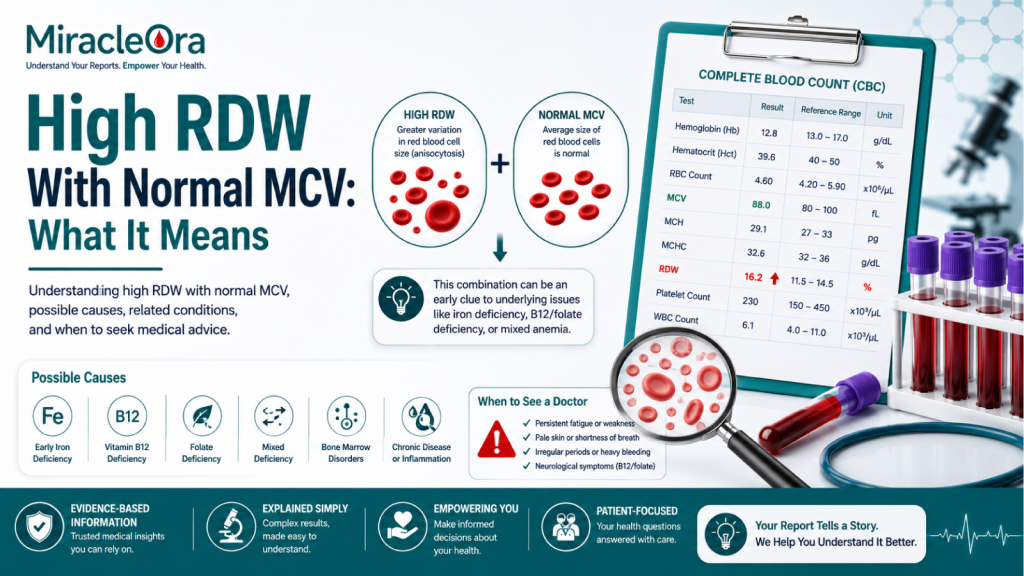
The short answer: anisocytosis means your red blood cells are not all the same size. Poikilocytosis means they are not all the same shape. Both are descriptions of what a trained reader saw under the microscope, not diagnoses. Cleveland Clinic puts it plainly: “these terms are just descriptive,” and anisocytosis “may or may not be a sign of an underlying health condition that requires treatment.” They are most often linked to anemia, and their meaning depends on the rest of your report, which the clinician who ordered the test interprets.
First: how you feel matters more than the word
A smear comment is not an emergency on its own. Symptoms are what decide urgency.
Cleveland Clinic, on its anisocytosis page (last reviewed May 15, 2023, read on September 27, 2026), advises seeing a healthcare provider “if you’re experiencing symptoms of anemia, including fatigue, shortness of breath or pale skin.” It lists symptoms that can accompany the underlying anemia, including weakness, irregular heartbeat, headache, dizziness and chest pain. The MedlinePlus Medical Encyclopedia entry on anemia (review date January 29, 2026, read on September 27, 2026) says to contact your provider for “any symptoms of anemia or unusual bleeding.”
Chest pain, fainting, severe breathlessness, a racing heart, heavy bleeding, or new yellowing of the skin or eyes call for prompt or emergency care rather than more reading. This page cannot triage anyone. A clinician or emergency service can.
Why these words appear on your report
A blood smear is a thin layer of blood spread on a glass slide, stained and looked at under a microscope. MedlinePlus, on its blood smear test page (last updated December 16, 2024, read on September 27, 2026), says a smear may be ordered when “You had a complete blood count (CBC) with abnormal results,” or because of symptoms such as fatigue, jaundice, easy bruising or fever.
Automated analyzers measure red cells well, but they describe them with numbers. A smear adds eyes. The reader writes down what they see in a standard vocabulary, and anisocytosis and poikilocytosis are two of the most common entries. If you want the background on why a smear is ordered at all, our guide to the peripheral blood smear covers it.
Anisocytosis meaning: variation in size
Cleveland Clinic’s anisocytosis page defines it simply: “Anisocytosis describes red blood cells that are of different sizes.” It describes two directions:
- Macrocytosis: “larger-than-normal red blood cells”
- Microcytosis: “smaller-than-normal red blood cells”
A sample can also contain a mix of both.
How anisocytosis connects to RDW
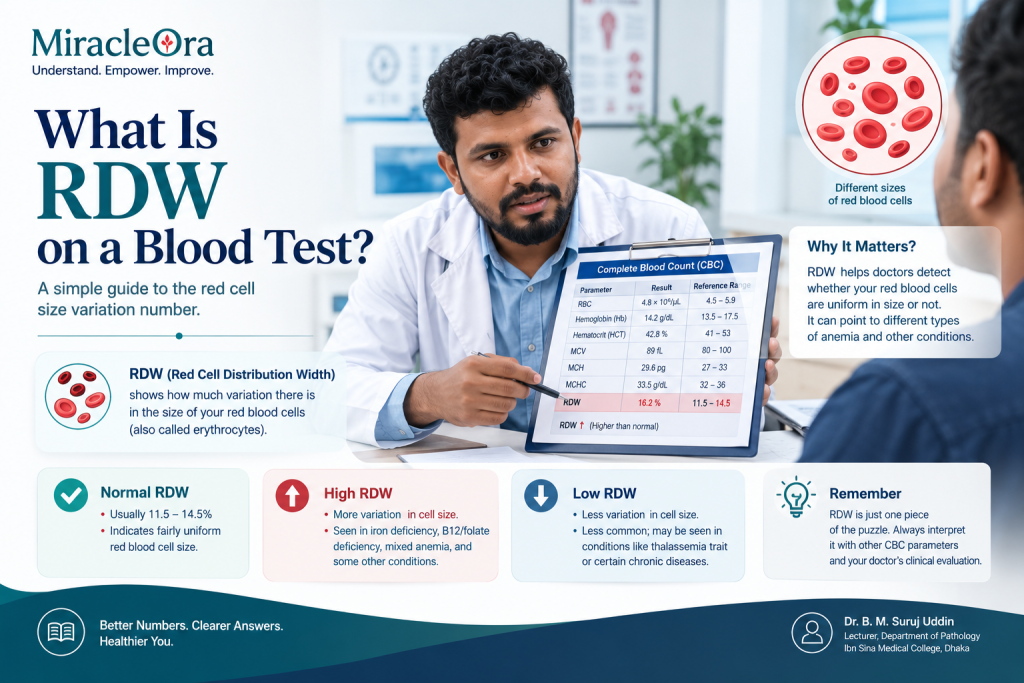
This is the link most smear glossaries leave out. The same variation in size that a reader calls anisocytosis is what the analyzer measures as RDW, the red cell distribution width. Cleveland Clinic names RDW as one of the two main ways anisocytosis is identified, alongside the smear, and gives a normal RDW of 12% to 15%, noting elsewhere that ranges vary by laboratory. Your own report’s range is the one that applies.
So if your CBC shows a raised RDW and your smear says “anisocytosis,” the two lines are usually describing the same thing twice: once as a number and once in words. They are not two separate problems. Our guide to what RDW is on a blood test explains the number side.
What anisocytosis is associated with
Cleveland Clinic lists a wide range of associated conditions. Among anemias: iron-deficiency anemia, megaloblastic anemia, pernicious anemia, autoimmune hemolytic anemia, sickle cell anemia and sideroblastic anemia. Among other conditions: thalassemia, hereditary spherocytosis, kidney disease, liver disease, thyroid disease, heart disease, myelodysplastic syndrome, myelofibrosis and colon cancer.
That list is long precisely because anisocytosis is a general finding. It narrows nothing down on its own. Common, manageable causes sit on the same list as rarer ones, and the word alone does not say which applies to you.
Poikilocytosis meaning: variation in shape
A healthy red cell is a round, flattened disc. Cleveland Clinic’s poikilocytosis page (last reviewed March 2, 2023, read on September 27, 2026) defines poikilocytosis as red cells with abnormal shapes, and says it occurs “when more than 10% of red blood cells in a blood sample aren’t shaped like normal red blood cells.”
The shape names you might see
Cleveland Clinic describes the main abnormal shapes. Here they are in one place, with the plain-language description from that page:
| Term on a report | What it looks like |
|---|---|
| Acanthocytes | “Cells with spikes of different lengths and widths” |
| Codocytes (target cells) | “Cells with a dark center in the middle, resembling a bullseye” |
| Dacrocytes (teardrop cells) | Cells that narrow to a point at one side, “like a teardrop” |
| Drepanocytes (sickle cells) | “Curved and thin cells that resemble a sickle or crescent” |
| Echinocytes | Cells covered in evenly spaced projections, “like a sea urchin” |
| Elliptocytes | “Oval and abnormally long cells” |
| Schistocytes | “Red cell fragments that are usually jagged but may be any shape” |
| Spherocytes | “Spherical cells that resemble a ball or a globe” |
When a report names a specific shape, it is giving the clinician more to work with than the general word “poikilocytosis.” Some shapes are more closely tied to particular conditions than others, which is why the clinician may focus on one line of the comment more than the rest.
What poikilocytosis is associated with
Cleveland Clinic groups the causes into inherited conditions, including sickle cell disease, thalassemia and hereditary spherocytosis, and acquired ones, including nutritional deficiencies, kidney disease, liver disease and various infections.
When both appear together
Reports sometimes combine the two words as “anisopoikilocytosis,” meaning variation in both size and shape. It carries no extra meaning beyond the two terms together. Many reports also add a descriptor such as slight, moderate or marked, or a plus-sign grade, to show how much variation was seen. How those grades are defined can differ between laboratories, so the grade is best read with the clinician.
How clinicians use these findings
Smear words are clues that help sort anemia into types. They are read with:
- Hemoglobin and hematocrit, to see whether anemia is present
- MCV, to see whether cells are small, normal or large on average
- RDW, the number that matches anisocytosis
- Other tests chosen by the clinician, depending on the pattern
For an overview of how anemias are grouped, see types of anemia, explained in plain language. One common question, whether small red cells point to iron deficiency or an inherited trait, has its own page: thalassemia trait vs iron deficiency.
This page does not suggest any treatment, supplement or medicine change based on a smear comment. Those decisions belong to the clinician.
Questions worth bringing to the appointment
- Which part of the smear comment matters most for me?
- Does the anisocytosis on the smear match the RDW on my CBC?
- Were any specific cell shapes named, and what do they mean in my case?
- Are further tests planned, and what are they looking for?
- Do my earlier blood counts show the same pattern?
The honest limits of this page
A laboratory report should not create fear. It should create understanding. Anisocytosis and poikilocytosis are words for what red cells looked like, in size and shape. They are real observations, and they are also general ones. This page can translate them. It cannot tell you what caused them in your blood, which depends on your full report, your history and your clinician’s judgment.
Frequently asked questions
√ What is the anisocytosis meaning on a blood test?
It means the red blood cells vary in size more than usual. Cleveland Clinic describes it as “red blood cells that are of different sizes,” and notes the term is descriptive rather than a diagnosis.
√ Is anisocytosis serious?
Not by itself. Cleveland Clinic says it “may or may not be a sign of an underlying health condition that requires treatment.” Its meaning depends on the rest of your results and your symptoms.
√ What is the difference between anisocytosis and poikilocytosis?
Anisocytosis refers to variation in red cell size. Poikilocytosis refers to variation in shape, which Cleveland Clinic describes as more than 10% of red cells not being normally shaped.
√ Is anisocytosis the same as a high RDW?
They describe the same property in two ways. RDW is the analyzer’s number for size variation, and anisocytosis is the word a smear reader uses for it. Cleveland Clinic names RDW as one of the ways anisocytosis is identified.
√ What is anisopoikilocytosis?
It is a combined term meaning red cells vary in both size and shape. It does not add a separate meaning beyond the two findings together.