This article is general health education, not medical advice, and it cannot diagnose you or interpret your specific numbers. A complete blood count, or CBC, measures three families of cells in a sample of your blood: red blood cells (which carry oxygen), white blood cells (which fight infection), and platelets (which help your blood clot). Your report lists each measurement next to a reference range, and any value outside that range is usually flagged with an "H" for high or an "L" for low. Below we explain what each line generally reflects. But a flag is not a diagnosis, and only your own doctor, who knows your history and your lab's ranges, can tell you what your result means for you.
Keep that last point in mind as you read. The goal here is to help you understand the vocabulary on the page so your conversation with your doctor is calmer and clearer, not to replace that conversation.
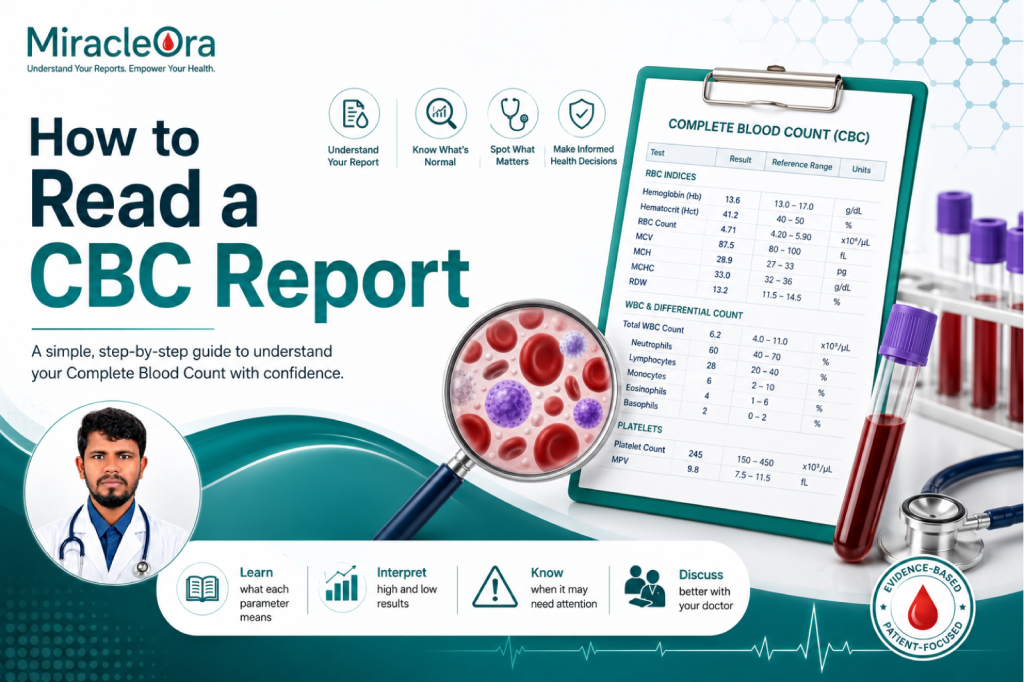
How the report is laid out
Almost every CBC printout uses the same four columns, and reading them in order is the whole skill:
- The test name or abbreviation on the left (for example, Hgb, WBC, PLT).
- Your result, the actual measured number.
- The unit the number is measured in (for example, g/dL for hemoglobin).
- The reference range, the band of values the lab considers typical for a general population.
When your result sits inside the reference range, most labs leave it unmarked. When it falls above or below, the lab prints a flag, usually H (high) or L (low), and sometimes WNL (within normal limits) for values that are fine. That flag column is the part that makes people anxious, so it is worth saying plainly: the flag only tells you the number is outside a statistical range. It does not tell you why, whether it matters, or what to do. That is your doctor's job.
What each part of a CBC generally measures
Red blood cells, hemoglobin, and hematocrit
These three lines are all about your oxygen-carrying capacity, and they tend to move together.
- Red blood cell (RBC) count is the number of red cells in a measured volume of blood. Red cells carry oxygen from your lungs to the rest of your body.
- Hemoglobin (Hgb or Hb) is the iron-rich protein inside red cells that actually holds the oxygen. It is often the single number people look at first when anemia is a question.
- Hematocrit (Hct) is the percentage of your blood made up of red cells by volume.
In general, when these values are low together, doctors think about anemia; when they are high, they consider dehydration or other causes. But "low hemoglobin" has many possible reasons, and a single low reading in someone who feels well is a very different situation from a low reading with symptoms. We cover the nuance separately in is my hemoglobin low, and what could it mean.
The red cell indices: MCV, MCH, and RDW
These are calculated numbers that describe the size and uniformity of your red cells, and they help characterize an anemia rather than just detect it.
- MCV (mean corpuscular volume) is the average size of a red cell. Doctors describe cells as small (microcytic), normal (normocytic), or large (macrocytic) based on it.
- MCH (mean corpuscular hemoglobin) is the average amount of hemoglobin per red cell.
- RDW (red cell distribution width) measures how much your red cells vary in size from one another. A higher RDW means a wider mix of sizes.
One pattern that confuses people is a high RDW with a normal MCV, because the "average" cell looks fine while the population underneath is actually mixed. That specific combination is worth understanding on its own, and we walk through it in what a high RDW with a normal MCV can mean.
White blood cells and the differential
Your white blood cell (WBC) count reflects how active your immune system is at the moment of the draw. Many CBCs come "with differential," meaning the lab breaks the total down into five cell types, each of which tends to rise in different situations:
- Neutrophils commonly rise with bacterial infection, inflammation, and physical stress.
- Lymphocytes commonly rise with viral infections and some immune conditions.
- Monocytes can rise with certain infections and inflammatory conditions.
- Eosinophils are often associated with allergies and parasitic infections.
- Basophils are the smallest fraction and rarely rise on their own.
According to the StatPearls reference on normal and abnormal CBC results, typical adult proportions are roughly 40 to 60 percent neutrophils and 20 to 40 percent lymphocytes, though the ranges printed on your own report are the ones that count. Because the neutrophil-to-lymphocyte balance is often what shifts during common infections, it is a frequent source of questions; we compare the two in neutrophils vs lymphocytes: what the balance can suggest.
Platelets
Platelets (PLT) are cell fragments that help your blood clot. A count that is low is called thrombocytopenia and a count that is high is thrombocytosis. Platelet numbers can move for many everyday and temporary reasons, and they get particular attention during illnesses like dengue, where tracking the trend over days matters more than any single reading. We cover that specific situation in understanding platelet count in dengue.
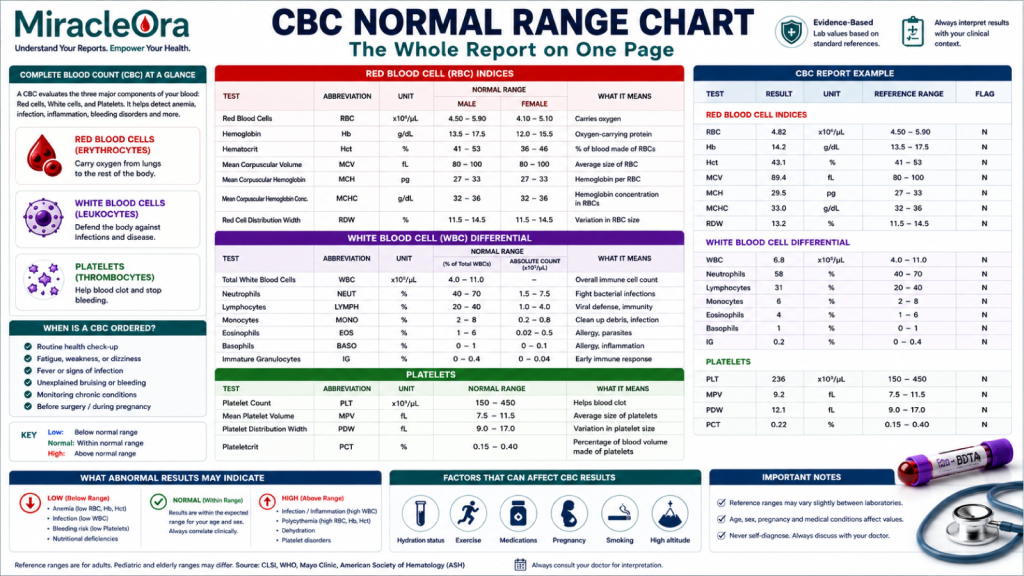
A quick-reference table of common adult ranges
The values below are widely cited adult reference ranges from Cleveland Clinic (RBC, hemoglobin, hematocrit, WBC, platelets, MCV, MCH, MCHC, RDW) and StatPearls (the differential). They are here to show you the general scale of each number, not to judge your result. Your lab's ranges, printed on your own report, are the only ones you should measure yourself against.
| Measurement | Commonly cited adult range | What it generally reflects |
|---|---|---|
| RBC | 4.0 to 5.4 million/mcL (female), 4.5 to 6.1 million/mcL (male) | Number of oxygen-carrying red cells |
| Hemoglobin (Hgb) | 11.5 to 15.5 g/dL (female), 13 to 17 g/dL (male) | Oxygen-carrying protein in red cells |
| Hematocrit (Hct) | 36 to 48% (female), 40 to 55% (male) | Share of blood made of red cells |
| MCV | 80 to 100 fL | Average red cell size |
| MCH | 27 to 31 pg | Average hemoglobin per red cell |
| MCHC | 32 to 36 g/dL | Hemoglobin concentration in red cells |
| RDW | 12 to 15% | How much red cell size varies |
| WBC | 4,000 to 10,000 cells/mcL | Overall immune activity |
| Neutrophils | about 40 to 60% of WBC | Often rise with bacterial infection |
| Lymphocytes | about 20 to 40% of WBC | Often rise with viral infection |
| Platelets | 150,000 to 400,000/mcL | Blood clotting |
Ranges vary by lab, age, sex, and testing method. Sources: Cleveland Clinic, Complete Blood Count; StatPearls, Normal and Abnormal Complete Blood Count With Differential (NCBI); MedlinePlus, Complete Blood Count.
The part most guides skip: a flag is not a diagnosis
This is the idea we most want you to leave with, because it is the one that saves people from needless fear.
A single value outside the reference range very often does not mean anything is wrong. MedlinePlus, the patient-education service of the U.S. National Library of Medicine, states it directly: "If any of your levels are abnormal, it doesn't always mean you have a medical condition that needs treatment. Diet, activity level, medicines, having a menstrual period, not drinking enough water, and other factors can affect the results. Talk with your provider to learn what your results mean."
There are a few reasons one flagged line is weak evidence on its own:
- Reference ranges are built from a population, not from you. By design, a small percentage of perfectly healthy people fall just outside them. A value a hair past the edge is common and often meaningless.
- Everyday factors move your numbers. Hydration, a recent meal, exercise, a menstrual period, stress, the time of day, and some medications can all nudge results.
- Trends beat snapshots. Doctors usually care far more about how a number is changing across several tests than about one reading in isolation. This is exactly why self-diagnosing from a single sheet is misleading: you are reading one frame of a film.
- The whole picture matters. Your doctor interprets the CBC alongside your symptoms, your history, your other test lines, and sometimes a repeat test. No single row is read alone.
The honest takeaway: scanning a lab sheet for red flags and then searching each one online is a reliable way to frighten yourself over numbers that a clinician would glance at and set aside. The report is a tool for your doctor, not a verdict about your health.
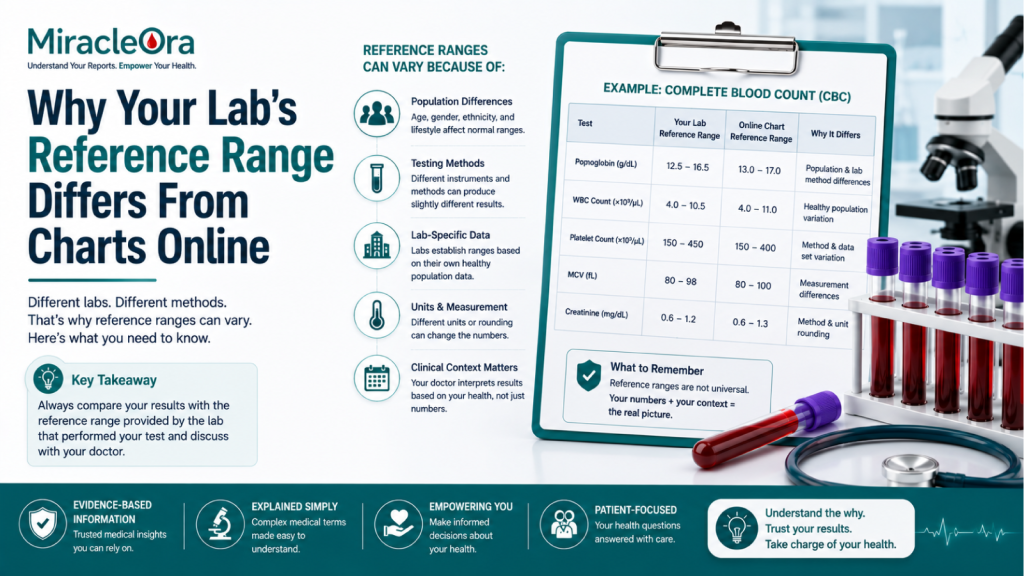
Why your reference range may differ from a chart online
If you compare your result to a generic chart and reach a different conclusion than your report's flag, the chart is usually the problem. Cleveland Clinic notes that normal ranges vary based on the lab performing the test and on your age, among other factors, and StatPearls repeats throughout that "all are lab-specific in practice." Different labs use different equipment, methods, and local populations, so their ranges genuinely differ.
Standalone rule to remember: compare your value to the range printed on your own report, not to a generic chart online. That single habit prevents most avoidable CBC panic.
When a CBC result genuinely needs prompt attention
Most out-of-range flags are not emergencies. But some situations do warrant reaching your doctor or seeking care promptly, and this general list is not a substitute for professional judgment:
- Any result your doctor or the lab has specifically told you to watch or act on.
- A markedly low or falling platelet count together with unusual bruising, tiny red skin spots, or bleeding that will not stop.
- A very low hemoglobin together with symptoms such as chest pain, shortness of breath, fainting, or a racing heart.
- A very high or very low white cell count together with high fever, severe illness, or signs of serious infection.
- Any severe symptom (trouble breathing, chest pain, confusion, uncontrolled bleeding), regardless of what the numbers say, is a reason to seek urgent care.
If in doubt, call your doctor and describe both your numbers and how you feel. That combination, not the sheet alone, is what guides real decisions.
Frequently asked questions
What does the "H" or "L" next to my result mean?
It means the value is above (H, high) or below (L, low) the lab's reference range. It is a statistical flag, not a diagnosis. It tells you the number is outside the typical band, not why, or whether it matters for you. Your doctor interprets it with your history and symptoms.
Can a value be abnormal even if I feel completely fine?
Yes, and this is common. Reference ranges are built so that a small share of healthy people naturally fall outside them, and everyday factors like hydration, diet, exercise, and timing can shift results. As MedlinePlus notes, an abnormal level does not always mean a condition needing treatment. Discuss it with your provider.
Do I need to fast before a CBC?
For a CBC on its own, fasting is usually not required. However, blood draws are often ordered in a panel with other tests (such as glucose or a lipid profile) that do require fasting. Follow the specific instructions your doctor or lab gives you, since those are tailored to the exact tests being run.
Which reference range should I trust, my report's or an online chart?
Your own report's range. Labs differ in equipment, methods, and the population they serve, so ranges are lab-specific. Comparing your value to a generic online chart is one of the most common reasons people worry over a result that their own lab, and their own doctor, would read as fine.
Can I diagnose myself from my CBC?
No. A CBC is one input a doctor combines with your symptoms, history, other tests, and often a repeat draw. A single sheet, read alone, cannot diagnose you and frequently misleads. Use this guide to understand the words, then let your doctor interpret the meaning.
Medical disclaimer: This article is provided by MiracleOra for general educational purposes only. It is not medical advice, diagnosis, or treatment, and it does not interpret any individual person's results. Reference ranges vary by laboratory, age, sex, and testing method. Always compare your results to the range printed on your own report and discuss what they mean with a qualified healthcare professional who knows your medical history. If you have severe or worsening symptoms, seek urgent medical care. See our full Medical Disclaimer.