This article is general health education, not medical advice. It cannot interpret your specific result. See our Medical Disclaimer.
Blood Test Abnormal but You Feel Fine? What That Can Mean
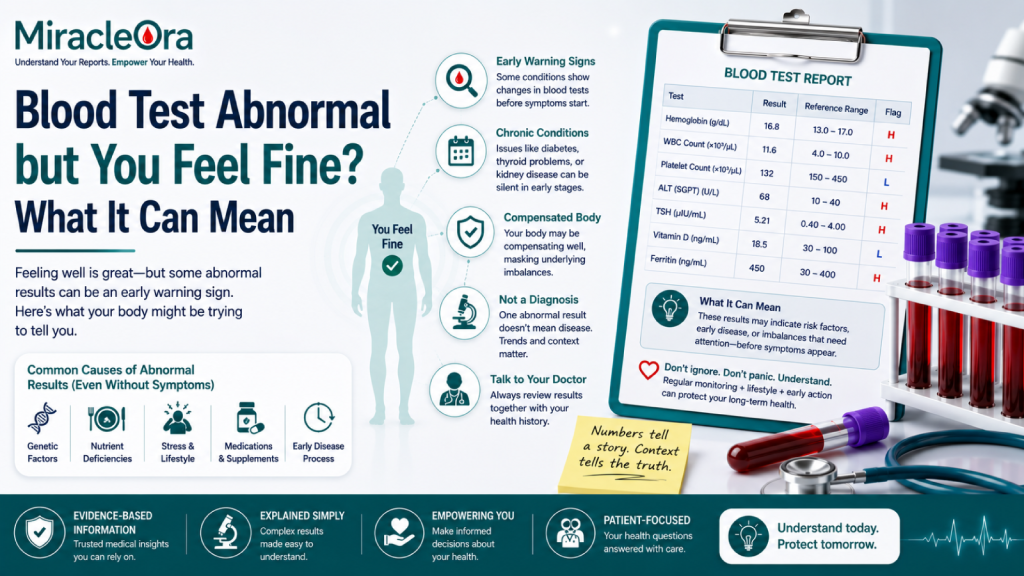
Short answer: yes, this is common, and it is often unremarkable. A reference range is a statistical band covering most, not all, healthy people, so healthy results fall outside it regularly. But "common" is not the same as "ignore it." Some conditions are genuinely quiet in their early stages, which is part of why blood tests are ordered in people who feel well at all. The right response to a flagged value with no symptoms is neither panic nor dismissal. It is a short conversation with the doctor who ordered the test.
That balance is the whole of this page. Reassurance that tells you to forget the result is not honest reassurance, and urgency that tells you to act now on an unexplained flag is not honest either.
Why the arithmetic almost guarantees it
Laboratories define a reference range by measuring a test in a group of apparently healthy people and publishing the band that covers the central 95 percent of them. The remaining 5 percent are healthy too. They simply sit outside the band.
That has an immediate consequence: roughly one healthy person in twenty is flagged on any single measurement. A complete blood count reports many separate lines. Run enough independent measurements on one well person and the chance that every line lands inside its band gets smaller, not larger.
MedlinePlus, the patient education service of the U.S. National Library of Medicine, puts the practical version plainly: an abnormal level does not always mean you have a medical condition needing treatment, and diet, activity level, medicines, having a menstrual period and not drinking enough water can all affect results. Mayo Clinic Press makes the same point for lab results generally, noting that an out-of-range value is a prompt for context rather than a verdict.
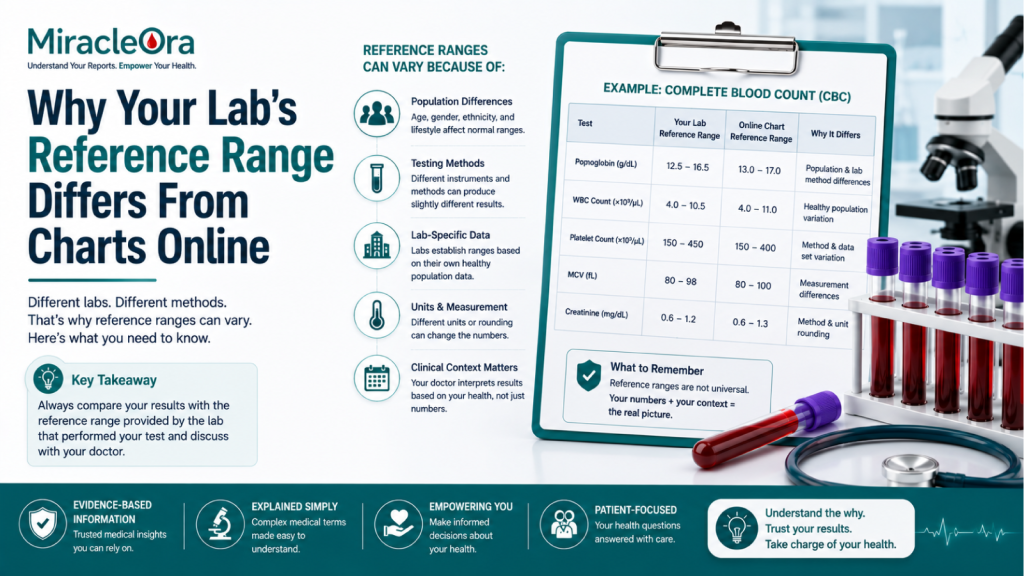
If you also found an online chart that disagrees with your report, that is a separate source of confusion and we untangle it in why your lab's reference range differs from charts online.
What tends to get flagged in a person who feels well
These are categories, not diagnoses, and none of them describes your result. They are the situations most often behind an isolated flag on a blood count:
- Hydration at the time of the draw. Hemoglobin and hematocrit are measured against plasma volume. Being relatively dehydrated concentrates them; being well hydrated dilutes them. Neither changes the amount of hemoglobin in your body.
- A recent or resolving infection. White cell counts, and the balance between neutrophils and lymphocytes, can stay shifted for a while after you feel better. We look at what that balance reflects in high neutrophils and low lymphocytes.
- Recent exertion or acute stress. Both commonly raise white cell counts temporarily.
- A borderline red cell index. MCV, MCH and RDW are calculated numbers. A small shift can cross a line while everything else on the report is unremarkable, and the pattern between them matters far more than any one crossing.
- A sample effect rather than a body effect. Platelets can clump in the collection tube, which some analyzers count as a falsely low platelet number. A laboratory may repeat the test or examine a blood film to check.
- Medications and supplements, several classes of which affect white cells or platelets.
- Being at the edge of the range for you. Some people simply run slightly above or below the population band throughout their lives, which becomes obvious only once several results exist.
Symptoms are a poor detector, and this is the honest counterweight
Here is the part that gentler articles leave out. Feeling fine is genuinely reassuring, but it is not a test. A number of conditions produce measurable changes before they produce anything a person notices. That is precisely why routine screening exists, and why an abnormal result in a well person is worth a doctor's eyes even when the odds favor a benign explanation.
This does not mean you should assume the worst. It means the strength of "but I feel fine" as evidence is limited, and it should not be the reason you skip the follow-up your doctor suggests. Equally, it should not be inverted into alarm: the great majority of isolated, marginal flags in well people resolve into nothing on a repeat test.
The workable stance is unglamorous. Do not diagnose yourself from the sheet, do not discard the sheet, and let the person with your history read it.
What your doctor will usually do next
In practice, an out-of-range value in someone who feels well tends to lead to one of a few steps:
- Nothing, with an explanation. The value is marginal, the rest of the report is consistent, and the clinical picture is clear.
- A repeat test. Often the most informative option, because it separates a one-off from a pattern. Many flags disappear on the second draw.
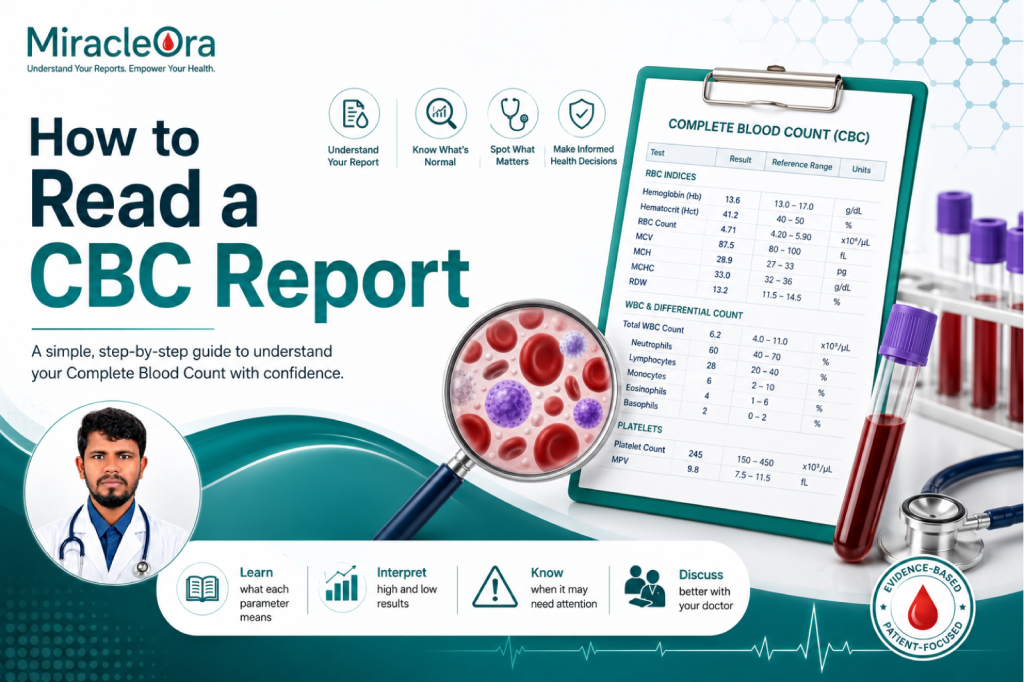
- Reading the neighboring lines. Blood results are interpreted as a set. A single low value means something different depending on what sits beside it, which is the logic behind our line-by-line walkthrough, how to read your CBC report.
- A targeted follow-up test aimed at a specific question the pattern raises.
- Watchful monitoring over months, where the trend is the information.
Waiting for that conversation is often the hardest part. If your report has arrived before your appointment, our note on how long CBC results take and why the wait varies explains the timings involved.
What not to do with an unexplained flag
- Do not search each flagged line separately. Reading one value at a time, out of context, reliably produces the most frightening interpretation available rather than the most likely one.
- Do not start or stop a medication, supplement or diet on the strength of a lab line. That includes iron, which is not a self-prescribed response to a number.
- Do not compare yourself to a chart written for a different laboratory. Use the range printed on your own report. The letters beside your values are explained in what an H or L flag means.
- Do not conclude the test was wrong. Sample and analyzer effects exist, but deciding which applies is a laboratory judgment.
When to seek care despite feeling fine
Contact your doctor promptly, rather than waiting for a routine appointment, if:
- The laboratory or your doctor flagged the result as critical, or asked you to act on it.
- A hemoglobin or platelet value is markedly outside the range rather than sitting near the edge.
- Several related values moved in the same direction at once.
- You are pregnant, immunosuppressed, receiving chemotherapy, or being monitored for a known blood condition. In those situations a flagged count is interpreted against a different threshold.
- You develop symptoms after the test: unexplained bruising, tiny red spots on the skin, bleeding that will not stop, persistent fever, marked breathlessness, chest pain, fainting or a racing heart.
Any severe symptom, including difficulty breathing, chest pain, confusion or uncontrolled bleeding, is a reason to seek urgent care immediately, whatever the numbers say.
Frequently asked questions
Can a blood test be abnormal with no symptoms at all?
Yes, and it is common. Reference ranges cover about 95 percent of a healthy reference group, so healthy people fall outside them regularly. Everyday factors including hydration, recent exertion, a resolving infection and some medications also shift values without making anyone feel unwell.
Does feeling fine mean the result is nothing?
Not on its own. Feeling well is reassuring but it is not a diagnostic test, and some conditions are quiet early. That is why the result belongs in a short conversation with your doctor rather than being either acted on alone or discarded.
Should I retest immediately at a different lab?
Discuss it first. Repeating at a different laboratory introduces platform differences into the comparison, so doctors often prefer a repeat at the same lab when they want to judge a trend.
How long should I wait before following up?
Follow the instruction on your report or from your clinic. If none was given, contacting the ordering doctor for guidance is reasonable rather than waiting indefinitely.
Will an abnormal result mean more tests?
Sometimes, and often the "more test" is simply the same test repeated. Further testing is aimed at a specific question the pattern raises, not at everything at once.
Can anxiety about the result change my next blood count?
Acute stress is among the everyday factors described as raising white cell counts temporarily. It is one more reason a single reading is read cautiously and a trend is trusted more.
Medical disclaimer: This article is provided by MiracleOra for general educational purposes only. It is not medical advice, diagnosis or treatment, and it does not interpret any individual person's results. Reference ranges vary by laboratory, age, sex and testing method. Always compare your results to the range printed on your own report and discuss what they mean with a qualified healthcare professional who knows your medical history. If you have severe or worsening symptoms, seek urgent medical care. See our full Medical Disclaimer.