This article is general health education, not medical advice. These are commonly cited population ranges, not a judgment on your result. See our Medical Disclaimer.
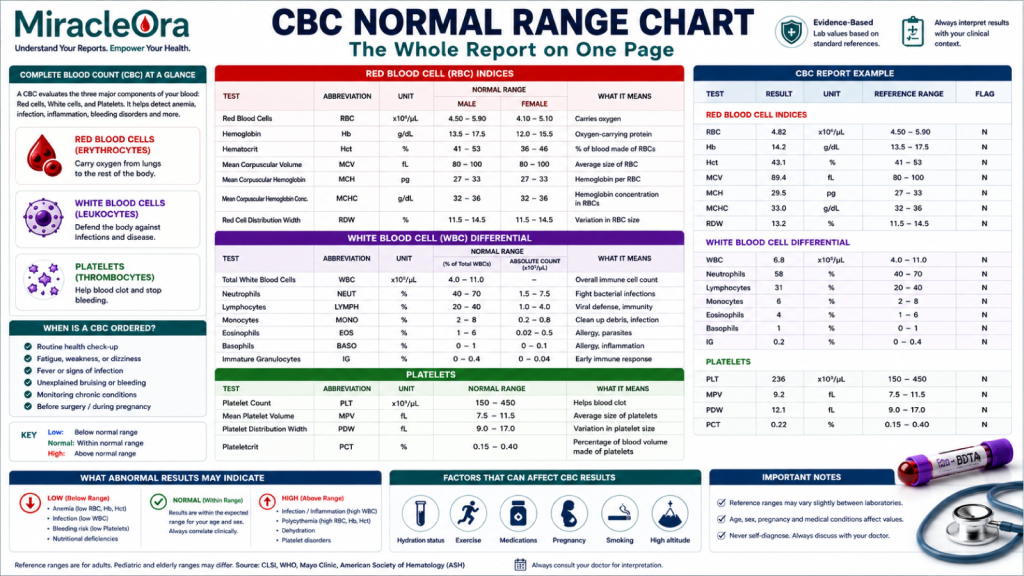
Your CBC, One Page: the Complete Reference-Range Table
This page collects the commonly cited adult reference values for a complete blood count in one place, with each table attributed to a named source. It exists because most charts online print numbers with no traceable origin, and a number with no origin is not something anyone should measure themselves against.
Read the five rules below before any table. They are what make a chart safe to use.
How to use this chart
- Check your units first. The same platelet count appears as 150,000/µL on one report and 150 x 10⁹/L on another. Comparing across unit systems is the most common way to frighten yourself over nothing. There is a conversion table further down.
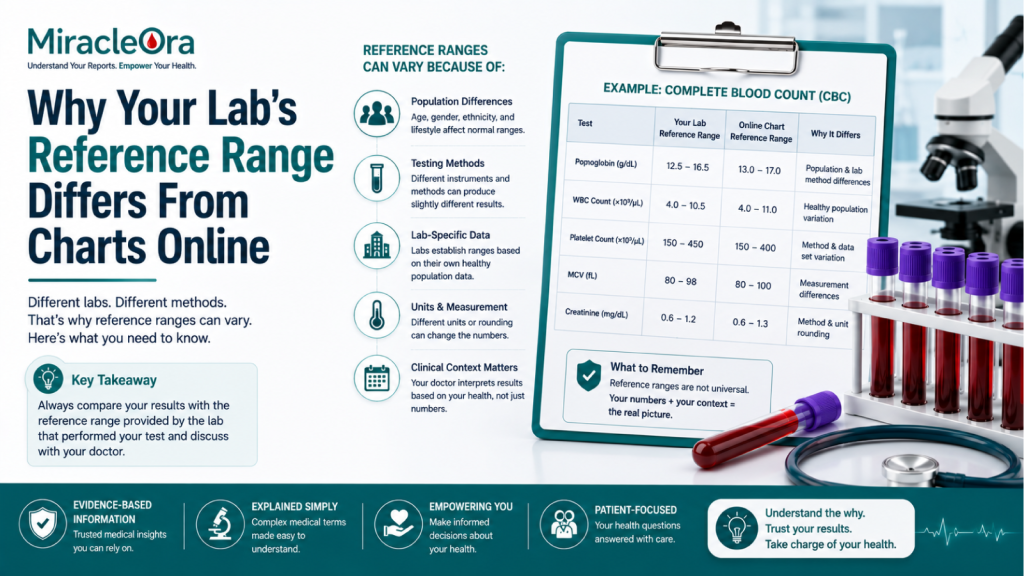
- Your own report's range wins, always. A reference range is a property of the laboratory that produced it, not a property of your body. The band printed beside your result is the one your value was actually judged against. Why they differ is explained in why your lab's reference range differs from charts online.
- Outside the range is not a diagnosis. Reference ranges are built to cover roughly the central 95 percent of a healthy reference group, so healthy people fall outside them regularly. The flag letters themselves are decoded in what an H or L flag means.
- This chart is for adults. Children's ranges differ substantially and change with age, and pregnancy has its own ranges because plasma volume rises. Do not apply the tables below to either situation.
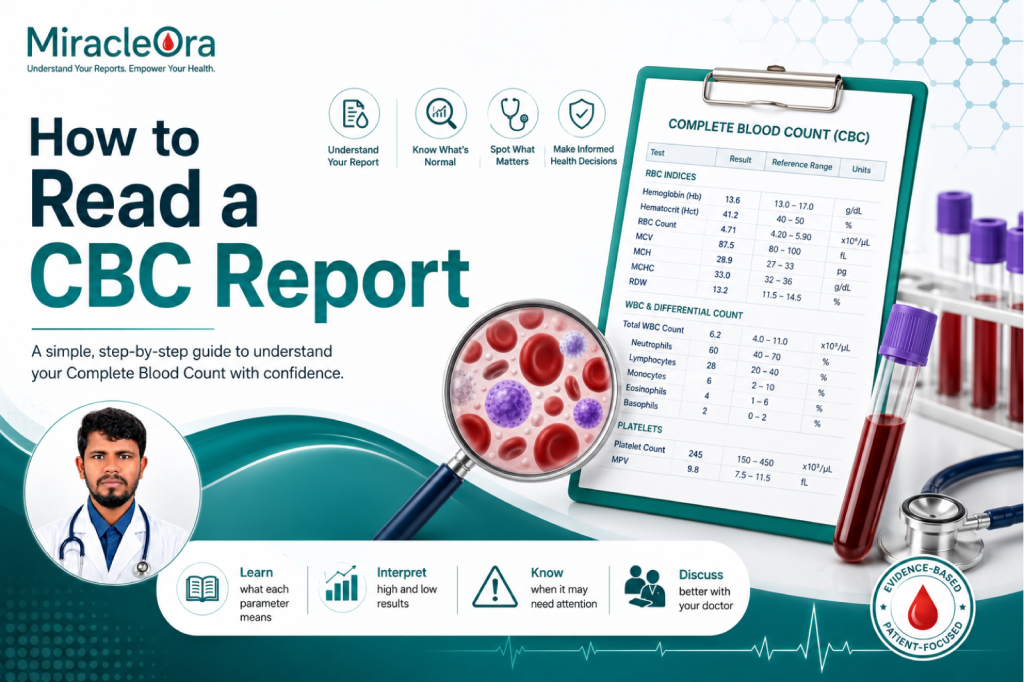
- Read the pattern, not the line. Blood values are interpreted as a set, alongside your history and symptoms. The line-by-line walkthrough is how to read your CBC report.
Red blood cells, hemoglobin and hematocrit
| Measurement | Commonly cited adult range | What it reflects |
|---|---|---|
| RBC (red blood cell count) | 4.6 to 6.2 million cells/µL (adult men); 4.2 to 5.4 million cells/µL (adult women) | How many oxygen-carrying red cells are present |
| Hemoglobin (Hgb, Hb) | 13 to 18 g/dL (adult men); 12 to 16 g/dL (adult women) | The oxygen-carrying protein inside red cells |
| Hematocrit (Hct, PCV) | 40% to 54% (adult men); 36% to 48% (adult women) | The share of blood volume made up of red cells |
Source: NIH/NCBI StatPearls, "Normal and Abnormal Complete Blood Count With Differential." Ranges are lab-specific in practice.
Hemoglobin is the number most people look at first, because it is the value used to identify anemia. What "low" actually means, and why it depends on far more than the number, is covered in is your hemoglobin low.
The red cell indices
These are calculated rather than counted. They describe the size and hemoglobin content of your red cells.
| Measurement | Commonly cited adult range | What it reflects |
|---|---|---|
| MCV (mean corpuscular volume) | 80 to 100 µm³ (equivalent to fL) | Average red cell size |
| MCH (mean corpuscular hemoglobin) | 27 to 32 pg per red cell | Average hemoglobin per cell |
| RDW (red cell distribution width) | approximately 11.5% to 15% | How much red cell size varies |
| MCHC (mean corpuscular hemoglobin concentration) | 32 to 36 g/dL | Hemoglobin concentration relative to cell volume |
Sources: MCV, MCH and RDW from NIH/NCBI StatPearls, "Normal and Abnormal Complete Blood Count With Differential." MCHC from Cleveland Clinic, "Complete Blood Count (CBC)." The StatPearls chapter does not state an MCHC range.
The indices are read together. A raised RDW beside a normal MCV, for example, describes a mixed population of cell sizes hiding behind an unremarkable average, which is why the indices are never judged one at a time.
White blood cells and the differential
| Measurement | Commonly cited adult range | What it reflects |
|---|---|---|
| WBC (total white blood cell count) | 4,500 to 11,000 cells/µL | Overall immune activity |
| Neutrophils | 40% to 60% of the white count, or 1,500 to 8,000 cells/µL | Commonly rise with bacterial infection, inflammation and stress |
| Lymphocytes | 20% to 40%, or 1,000 to 4,000 cells/µL | Associated with viral infections and immune responses |
| Monocytes | 2% to 8%, or 200 to 1,000 cells/µL | Certain infections and inflammatory conditions |
| Eosinophils | 0% to 4%, or 0 to 500 cells/µL | Allergic conditions and parasitic infections |
| Basophils | 0.5% to 1%, or 0 to 200 cells/µL | The smallest fraction, rarely raised alone |
Source: NIH/NCBI StatPearls, "Normal and Abnormal Complete Blood Count With Differential."
Two notes that matter more than the numbers. First, whether your report carries this breakdown at all depends on what was ordered, since a plain blood count reports only the total. Second, the percentage and the absolute count can move in opposite directions: if the total white count falls while neutrophil numbers hold steady, the neutrophil percentage rises without anything happening to your neutrophils. Clinicians generally work from the absolute counts.
Platelets
| Measurement | Commonly cited adult range | What it reflects |
|---|---|---|
| Platelet count (PLT) | 150,000 to 400,000/µL | Cell fragments involved in clotting |
Source: NIH/NCBI StatPearls, "Normal and Abnormal Complete Blood Count With Differential."
A count below the range is called thrombocytopenia and above it thrombocytosis. Both are descriptions, not diagnoses. Platelet numbers can also be affected by clumping inside the collection tube, which some analyzers read as a falsely low count and which laboratories check for. Where the platelet trend genuinely matters day to day, doctors watch the direction of travel across several results rather than any single reading.
Mean platelet volume (MPV) and platelet distribution width (PDW) appear on many reports. Their reference ranges vary enough between analyzers that the band printed on your own report is the only one worth using.
Units, and how the same value can look completely different
| Measurement | You may see | Also written as |
|---|---|---|
| Cell counts (WBC, platelets) | cells/µL, /mcL, cells/mm³ | x 10⁹/L (divide the per-microliter figure by 1,000) |
| Red cell count | million cells/µL | x 10¹²/L |
| Hemoglobin | g/dL | g/L (multiply the g/dL figure by 10) |
| Hematocrit | % | L/L (a proportion, so 45% appears as 0.45) |
| MCV | fL | µm³ (the same magnitude) |
| MCH | pg | (no common alternative) |
A platelet count of 250,000/µL and one of 250 x 10⁹/L are the same result. Every abbreviation on the report is decoded in CBC abbreviations decoded.
Why no single chart can be universal
This page states its sources, and it should also state its limits.
Peer-reviewed work establishing complete blood count reference values in healthy adult populations has repeatedly found that appropriate reference intervals differ between populations, and international guidance directs laboratories to establish or verify their own ranges rather than adopting a universal set. Sex, age, altitude, pregnancy, analyzer platform, reagents and the demographics of the reference group all feed in.
So a chart like this one is useful for a single purpose: understanding the general scale of each measurement, so the vocabulary on your report stops being opaque. It is not a yardstick for your own result. That yardstick is printed on your own report, and interpreting it is your doctor's work, not a chart's.
When a value should prompt a call
Contact your doctor promptly rather than waiting if:
- A value was reported to you as critical, or you were asked to act on it.
- A result sits markedly outside the range printed on your own report, rather than near an edge.
- Several related values moved in the same direction at once.
- You are pregnant, immunosuppressed, receiving chemotherapy, or being monitored for a known blood condition, since those situations use different thresholds entirely.
- You have symptoms alongside the result: unusual bruising, tiny red spots on the skin, bleeding that will not stop, persistent fever, marked breathlessness, chest pain, fainting or a racing heart.
Seek urgent care immediately for difficulty breathing, chest pain, confusion, fainting or uncontrolled bleeding, whatever any chart says.
Frequently asked questions
What is a normal CBC range?
There is no single universal set. The tables above give commonly cited adult values from NIH/NCBI StatPearls and Cleveland Clinic, but every laboratory establishes or verifies its own ranges, so the band printed on your report is the one that applies to your result.
Are CBC ranges different for men and women?
Yes, for the red cell measurements. Commonly cited ranges for red blood cell count, hemoglobin and hematocrit run higher for adult men than for adult women.
Do children have the same ranges?
No. Children's blood counts differ substantially from adults' and change with age, so an adult chart is the wrong comparison for a child's result. This page is adult-only.
What about pregnancy?
Pregnancy has its own ranges. Plasma volume rises during pregnancy and dilutes the red cell measurements, so values that would be flagged outside pregnancy can be expected within it.
My value is just outside the range. Is that a problem?
Being marginally outside a range is common and often unremarkable, because reference intervals are built to cover about 95 percent of a healthy group. How far outside, in which direction, alongside what else, and compared with previous results are all part of the reading, and that reading is clinical.
Why does this chart differ from the one on my report?
Because your laboratory built or verified its ranges using its own instruments, reagents and reference population. Neither chart is wrong. Yours is the one your result was compared against.
Medical disclaimer: This article is provided by MiracleOra for general educational purposes only. It is not medical advice, diagnosis or treatment, and it does not interpret any individual person's results. The values above are commonly cited population reference ranges from the sources named beneath each table, and they vary by laboratory, age, sex, pregnancy status and testing method. Always compare your results to the range printed on your own report and discuss what they mean with a qualified healthcare professional who knows your medical history. If you have severe or worsening symptoms, seek urgent medical care. See our full Medical Disclaimer.