This article is general health education, not medical advice. It does not interpret any individual result. See our Medical Disclaimer.
What Is a Peripheral Blood Smear, and Why Was One Ordered?
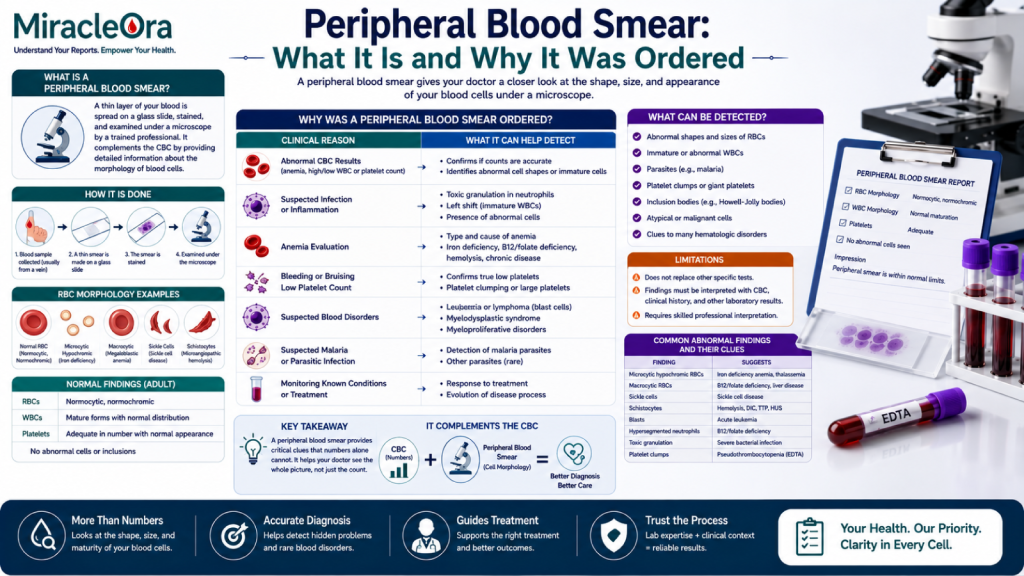
A peripheral blood smear is a drop of your blood spread thinly on a glass slide, stained, and examined under a microscope. Cleveland Clinic describes it as a test used to look at red cells, white cells and platelets directly, assessing their size, shape and structure. It is commonly added after a complete blood count when a value falls outside the range or the analyzer flags something for review. A smear appearing on your report is a step in the process, not a finding and not a diagnosis. What it showed, and what that means for you, can only be interpreted by the clinician who ordered it, against your own report's laboratory-specific reference ranges.
What a smear actually is
A complete blood count is produced by an automated analyzer. The machine counts cells and measures their average properties extremely fast, and it is very good at it. What it cannot do is look.
A smear puts a human eye, or in some laboratories a digital imaging system reviewed by a human, on the cells themselves. Instead of "your average red cell volume is 84 fL", a smear can describe what the cells look like: whether they vary in size, whether their shape is unusual, whether the white cells include forms that are normally rare in circulating blood, whether platelets are present in expected numbers and whether they have clumped together in the tube.
That is the entire difference. A count describes quantity and averages. A smear describes appearance.
The thing most articles leave out: your doctor may not have ordered it
This is the fear behind the search. Someone reads "peripheral smear" on a report they did not expect it on and assumes a person looked at their case and grew concerned.
Often that is not what happened. There are two quite different routes to a smear:
| Route | Who triggered it | What it implies |
|---|---|---|
| Laboratory review criteria | The analyzer and the lab's standing rules | Automatic. The instrument raised a flag, or a value crossed a threshold in the lab's own review protocol, and the sample went for a slide review without anyone reviewing your case |
| Clinician request | The doctor who ordered your test | Deliberate. Your clinician wanted the cells looked at, usually alongside a specific question |
Published work on this distinction exists: a three-institution study indexed in PubMed Central examined clinician-ordered peripheral blood smears specifically, and reported that they carry low reimbursement and variable clinical value, with suggestions for operational efficiency. The framing of that research, separating clinician-ordered smears from those the laboratory generates itself, reflects how routine the laboratory-triggered route is.
So the honest answer to "does a smear mean they found something" is: it means the sample met a criterion for being looked at. Those criteria are deliberately broad, because it is better to look at slides that turn out unremarkable than to miss ones that do not.
What a smear can show that a count cannot
Testing.com, Cleveland Clinic and other patient-facing sources describe the smear as an examination of the size, shape, color and distribution of red cells, white cells and platelets, including the presence of immature or abnormal-looking cells. In practice that covers several categories:
- Red cell appearance. Variation in size and shape, paleness, and unusual forms. This connects directly to the RDW value on your count, which measures how much red cell size varies. That relationship is explained in high RDW with a normal MCV.
- White cell appearance. Whether the cell types present match what an automated differential reported, and whether forms not usually seen in circulating blood are present. The difference between a plain count and one with a differential is covered in CBC versus CBC with differential.
- Platelet appearance and number. Including whether platelets have clumped together.
- Anything the analyzer flagged as needing a human eye.
A smear can also identify certain infections that are visible inside or among the cells, which is why it remains a core test in parts of the world where those infections are common.
The smear result that means the machine was wrong
One of the most common reasons a smear gets added is also the least alarming, and it deserves its own section because it is so poorly known.
Platelets can stick together inside the collection tube, usually as a reaction to the anticoagulant in the tube rather than anything happening in your body. An automated analyzer reads a clump as one large object rather than many platelets, so the reported platelet count comes out falsely low. The analyzer flags the sample, a slide is reviewed, and the reviewer can see clumping directly.
In that situation, the smear did not find a disease. It found a laboratory artifact, and it corrected a number that would otherwise have caused unnecessary worry. This is a genuine and routine function of slide review: confirming that a flagged value is real before anyone acts on it. It is the same principle behind why two labs can give you different numbers, where the measurement process itself is part of the result.
How to read the smear section of your report
Smear comments are written for clinicians and read strangely to everyone else. They are descriptive terms, not diagnoses. Words describing cell size, shape and variation are observations about appearance, in the same way "tall" is an observation about a person.
Two rules make that section safe to read:
- A descriptive term is not a condition. The same appearance can arise from several very different situations, and the smear is interpreted alongside your count, your history and your symptoms.
- Search results for a single smear term are the least reliable reading you can do. Isolated terms pull up the most serious conditions they are associated with, which is not how a clinician reads them.
If the comment includes anything you do not understand, write it down exactly as printed and ask the clinician who ordered the test. That is not a delay tactic. It is the only route to an answer that applies to you. The rest of the report is decoded in how to read your CBC report and CBC abbreviations decoded.
What we cannot tell you
We can explain what a smear is and how it fits into the process. We cannot tell you what yours showed, what it means, whether it is reassuring, or whether more tests are needed. Anyone online who offers to do that from a description of your report is guessing, and on this subject guessing is harmful.
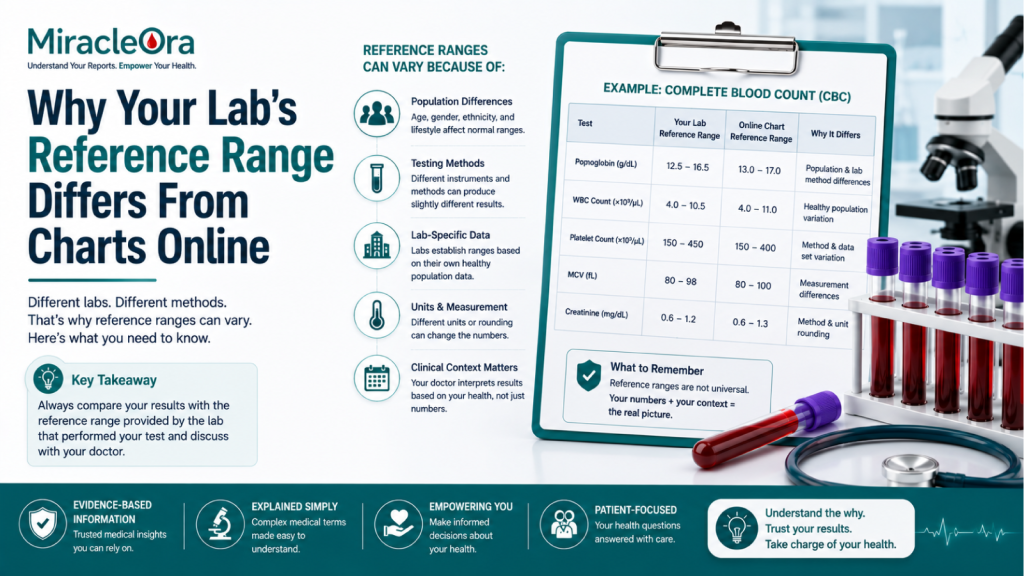
Reference ranges and review criteria are both laboratory-specific. The band printed beside each value on your report is the one your result was judged against, not any chart, including the one on this site.
When to contact your doctor rather than wait
Contact your doctor promptly if:
- A result was reported to you as critical, or you were asked to act on it.
- The smear comment or a value is markedly outside what your report describes as expected.
- You were told to book a follow-up and have not been able to.
- You are pregnant, immunosuppressed, receiving chemotherapy, or being monitored for a known blood condition.
- You have symptoms alongside the result: unusual bruising, tiny red spots on the skin, bleeding that will not stop, persistent fever, drenching night sweats, unexplained weight loss, marked breathlessness or fainting.
Seek urgent care immediately for chest pain, difficulty breathing, confusion, fainting or uncontrolled bleeding, whatever any report says.
Frequently asked questions
Does a blood smear mean something is seriously wrong?
Not by itself. Many smears are triggered automatically when an analyzer flags a sample or a value meets the laboratory's standing review criteria, without anyone assessing your case first. Others are requested deliberately by a clinician. Either way, the smear is a look, and what it showed is for your doctor to interpret.
What is the difference between a CBC and a peripheral blood smear?
A CBC is an automated count that reports how many cells there are and their average measurements. A smear is a microscope examination of what those cells look like: their size, shape, structure and whether unusual forms are present.
Do I need to prepare for a blood smear?
It usually uses the same sample already collected for your blood count, so there is generally nothing extra to do. Follow whatever instruction your clinic or laboratory gave you.
How long does a blood smear take?
It adds time to the count because a slide has to be prepared, stained and reviewed by a person, and reviewer availability varies by laboratory. Your laboratory or clinic can tell you what to expect for their turnaround.
My smear report has words I do not recognize. Should I look them up?
Write them down exactly and ask the clinician who ordered the test. Individual smear terms are descriptive observations that carry different weight in different contexts, and searching a single term tends to surface the most serious condition it can be associated with rather than the most likely explanation for you.
Medical disclaimer: This article is provided by MiracleOra for general educational purposes only. It is not medical advice, diagnosis or treatment, and it does not interpret any individual person's results or smear findings. Reference ranges and laboratory review criteria vary by laboratory, age, sex, pregnancy status and testing method, so always compare your results to the range printed on your own report and discuss what they mean with a qualified healthcare professional who knows your medical history. If you have severe or worsening symptoms, seek urgent medical care. See our full Medical Disclaimer.