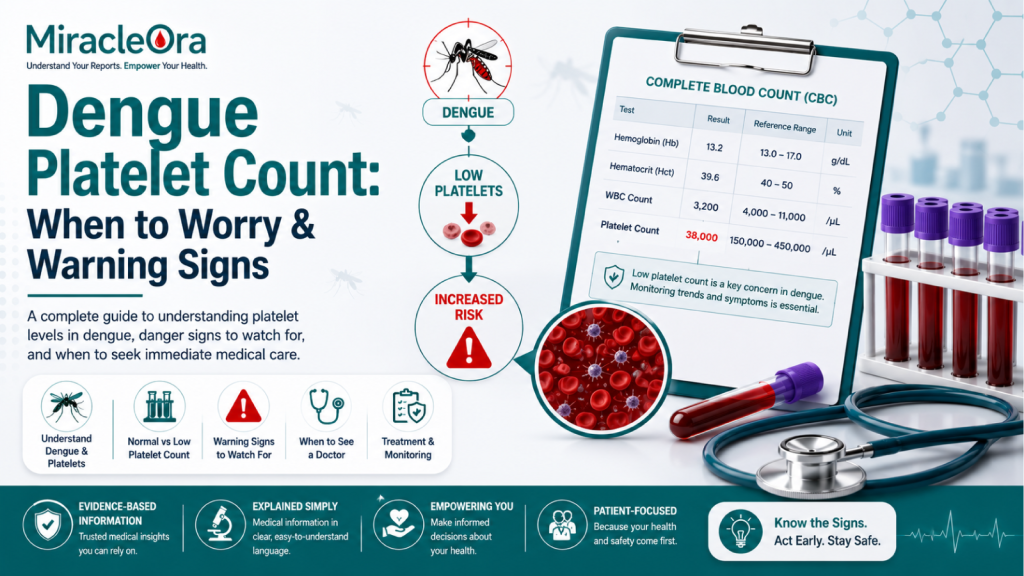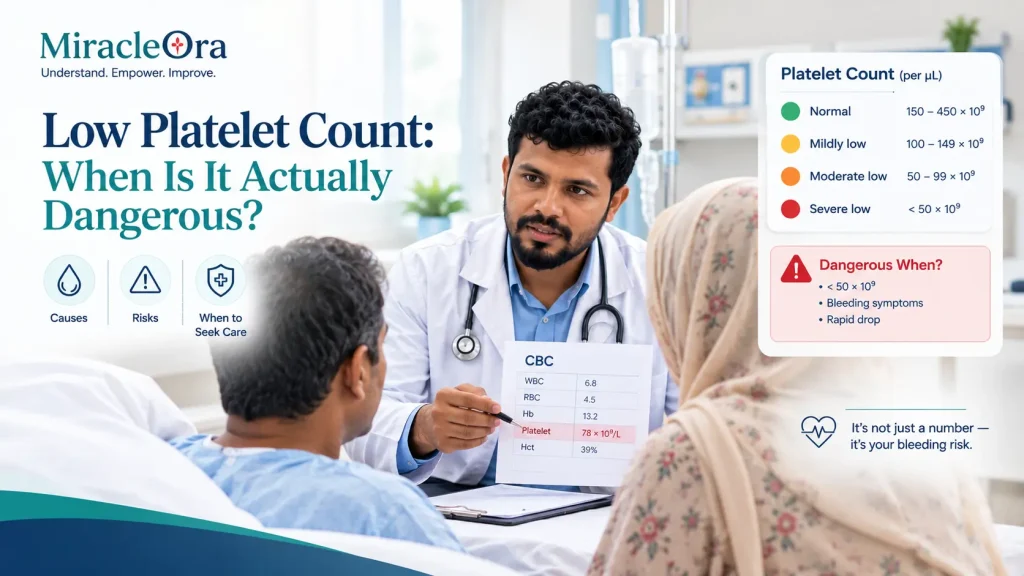
The question everyone arrives with is a number question. Mine says 90,000, or 60,000, or 140,000. At what point is that dangerous?
The honest answer, and the one this whole cluster is built on, is that the number is one input and it does not decide on its own. A stable person with a low count and no bleeding is in a different situation from someone with a higher count who is bleeding, vomiting or in pain, and the difference is not visible on the report.
That is not a way of avoiding the question. It is the actual shape of the answer, and the rest of this page is the parts of it that are publishable.
What the report is counting
Platelets are the cell fragments involved in clotting. The CBC counts them, usually per microliter of blood, and prints a reference interval beside the result.
MedlinePlus, in its Medical Encyclopedia entry “Platelet count” (review/update date 2 February 2025), states: “The normal number of platelets in the blood is 150,000 to 400,000 platelets per microliter (mcL) or 150 to 400 × 10⁹/L.”
The same page adds the sentence that most reports do not: “Normal value ranges may vary slightly. Some labs use different measurements or may test different specimens. Talk to your health care provider about your test results.”
That caveat matters more than it looks. A result flagged low against one laboratory’s interval is not automatically flagged against another’s, which is why comparing a friend’s report to yours tells you very little. The general point is worked through in why your lab’s reference range is different, and what the H and L flags on a blood test mean covers what the flag itself is actually saying.
The two directions
Below the interval. MedlinePlus states: “A low platelet count is below 150,000 (150 × 10⁹/L).” The condition has a name, thrombocytopenia, and the page describes it as resulting from one of three mechanisms: insufficient production in the bone marrow, destruction in the bloodstream, or destruction in the spleen or liver. It names cancer treatments, medicines and autoimmune disorders among the common causes.
That three-way split is worth holding on to, because it explains why two people with the same count can be told completely different things. The count says how many are there. It does not say why.
Above the interval. MedlinePlus states: “A high platelet count is 400,000 (400 × 10⁹/L) or above,” and that “A higher-than-normal number of platelets is called thrombocytosis. It means your body is making too many platelets.” It lists iron deficiency, infections, surgery, cancer, certain medicines, bone marrow diseases and spleen removal among the causes.
The high direction is the neglected one, and it surprises people that iron deficiency appears on that list, because iron deficiency is a red cell story in most people’s minds.
The one figure MedlinePlus itself attaches to risk
There is a single sentence on that page that speaks directly to the question this article is named after, and it is worth quoting rather than paraphrasing.
MedlinePlus states: “If your platelet count is below 50,000 (50 × 10⁹/L), your risk for bleeding is higher. Even every day activities can cause bleeding.”
That is a statement about risk, not a threshold for action, and the distinction is the whole point. It does not say what to do, it does not say when to go to a hospital, and it does not say that a count above that figure is safe. It says that risk is higher below it.
This site publishes no transfusion threshold and no urgency cutoff of its own, and that is deliberate rather than an omission. A number published as a line to cross is read by someone sitting just above it as permission to wait, and that reader is the one it would harm. The decision about what a given count means for a given person, with their history, their medicines and their symptoms, belongs to the clinician who ordered the test.
Why symptoms carry as much weight as the count
The framing this cluster is built on, and which this site’s page on platelet counts in dengue sets out in more detail, is that a falling count in someone who is unwell is a different object from a stable low count in someone who feels fine.
What clinicians look at alongside the number:
- Whether it is falling, and how fast. One reading is a point. Two readings are a direction, and the direction is often more informative than either value.
- Whether there is bleeding, and of what kind.
- How the person is otherwise. Fever, pain, vomiting, dehydration, confusion.
- What else is on the report. A low platelet count alongside normal red and white cells is a different picture from one where all three lines are low.
- What medicines the person takes, since MedlinePlus names medicines among the common causes.
None of that is available to a web page, and it is why the honest position is not that the number does not matter, but that the number is incomplete.
Before you assume the number is real
One thing worth knowing before anything else: a low platelet result is sometimes a property of the sample rather than of the person. Platelets can clump in the collection tube, and an analyzer that cannot count a clump reports a lower number than is actually circulating. The usual response is a repeat test and a look at the blood film, and what a peripheral blood smear report means covers what that examination is.
If your repeat came back normal and nobody explained why, that is a common and under-explained experience rather than a mystery. Ask whether clumping was seen.
Feeling completely fine with a low number
This is a very common combination and it is not a contradiction. An abnormal blood test when you feel fine works through why: reference intervals are built so that a proportion of perfectly healthy people fall outside them, and a result slightly outside an interval is a statistical event before it is a medical one.
That does not mean a flagged platelet count should be ignored. It means the flag is a prompt to have it interpreted rather than a verdict to be decoded at home.
What this page cannot do
No page can triage you, and this one is not trying to. It cannot see your report, your symptoms, your history or your medicines, and the sentence it would take to be genuinely useful in an emergency is exactly the sentence that would be dangerous when applied to the wrong reader.
What MedlinePlus itself publishes is above, quoted and dated. What your own report says is on the page in front of you, and how to read a CBC report covers how to find and read the platelet line and the interval printed beside it. What either of those means for you is a question for the clinician who ordered the test, and if you are bleeding, unwell, or the count is falling, that is a conversation to have now rather than at the next appointment.
The short version
- MedlinePlus (2 February 2025) puts the normal range at 150,000 to 400,000 per microliter, and notes that ranges vary between labs.
- Low is below 150,000; high is 400,000 or above. Three mechanisms can produce a low count and the number does not say which.
- MedlinePlus states that below 50,000 the risk of bleeding is higher. That is a statement about risk, not an instruction.
- The trend, the symptoms and the rest of the report matter alongside the value.
- A low result can be a clumping artefact. A repeat test and a blood film answer that.
- No page can decide this. Bring the report to the person who ordered it.