A hemoglobin result that would have been unremarkable a year ago gets flagged during pregnancy, or a result that has not changed suddenly gets discussed at an appointment. Both are common and neither is a good reason to panic before the conversation happens.
The reason both happen is that pregnancy changes both the number and the interval it is read against, and the two changes are separate.
Why hemoglobin falls in a normal pregnancy
This is the piece most articles skip, and it explains more than any threshold would.
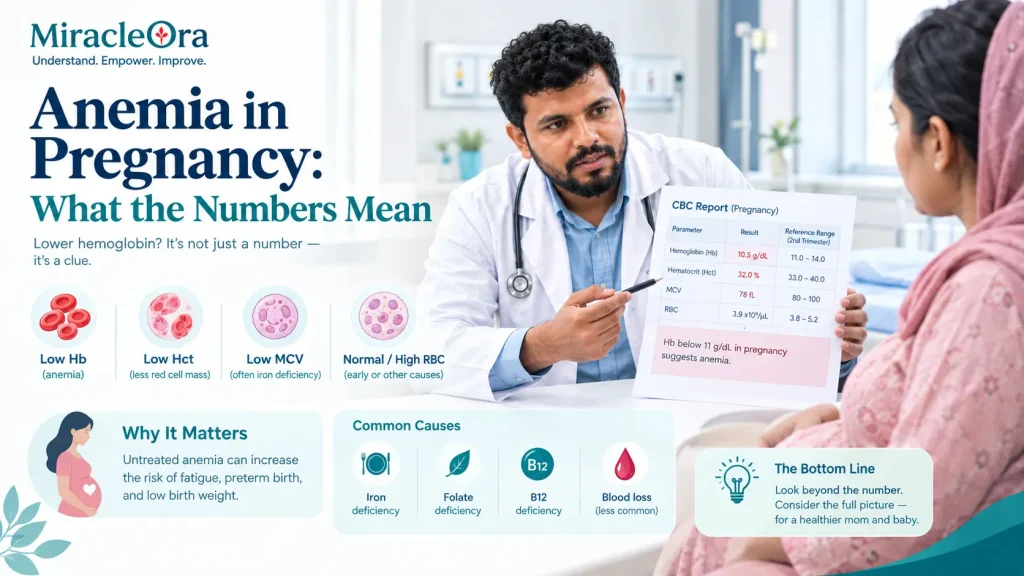
During pregnancy, the volume of plasma, the liquid part of blood, increases substantially. The number of red cells also increases, but not by as much. The result is that the red cells are carried in more fluid than before, and hemoglobin, which is a concentration, reads lower even though the total quantity of hemoglobin in circulation has gone up.
Nothing has been lost. The same amount of hemoglobin is being measured in a larger volume.
This is why a falling hemoglobin during pregnancy is an expected finding rather than an automatic problem, and why it is read against a different interval than the same person's result would be outside pregnancy. This site's page on CBC normal values in pregnancy covers what else on the report shifts for the same reason, and hemoglobin versus hematocrit covers why both measurements move together when the dilution is what changed.
The general principle behind reading a result against the right interval, rather than against a number you found somewhere, is set out in why your lab's reference range is different.
What WHO publishes
The World Health Organization's fact sheet "Anaemia", dated 10 February 2025, defines the condition as follows: "Anaemia is a condition in which the number of red blood cells or the haemoglobin concentration within them is lower than normal."
On who is most affected, WHO identifies "children under 5 years of age, particularly infants and children under 2 years of age, menstruating adolescent girls and women, and pregnant and postpartum women."
On scale, the fact sheet states: "Globally, it is estimated that 40% of all children aged 6–59 months, 37% of pregnant women and 30% of women 15–49 years of age are affected by anaemia."
That last figure is the one worth sitting with. Anaemia in pregnancy is not a rare or exotic finding, and being told you have it places you in a very large group rather than an alarming one. It still needs following up, because the reason matters, but the framing that it is unusual is simply wrong.
Why this page publishes no cutoff
WHO published a document titled "Guideline on haemoglobin cutoffs to define anaemia in individuals and populations" on 5 March 2024. We opened its overview page on 2026-08-28 and confirmed the title, the publisher and the date. The overview did not carry the numeric thresholds, and our retrieval did not reach the full guideline document, so no cutoff from it appears on this page.
That is stated plainly because the alternative would be to publish a number from memory or from a secondhand summary, and on this subject a wrong number is worse than no number.
There is a second reason, independent of the retrieval. A pregnancy hemoglobin cutoff is not a single figure that applies uniformly: what counts as low is read differently at different points in pregnancy, and the interval printed on your own report is the one your care team is working from. A number read here and applied to a report from another laboratory, at another stage, is a comparison between things that were not built to be compared.
The number that matters for you is the one your own report carries, read against the interval printed beside it, by the person providing your antenatal care.
What WHO lists as causes
The same fact sheet states: "Anaemia may be caused by several factors: nutrient deficiencies, inadequate diet (or the inadequate absorption of nutrients), infections, inflammation, chronic diseases, gynaecological and obstetric conditions, and inherited red blood cell disorders."
MedlinePlus, in its Medical Encyclopedia entry "Anemia" (review/update 29 January 2026), lists a similar spread: iron deficiency, vitamin B12 deficiency, folate deficiency, certain medicines, destruction of red blood cells, chronic diseases, inherited forms, pregnancy, bone marrow problems and blood loss.
Two things follow from those lists.
Pregnancy appears as a cause in its own right, which is the dilution effect described at the top of this page.
Everything else on the list is still possible during pregnancy. Being pregnant does not exclude any of the other causes, which is why a low result is investigated rather than attributed to the pregnancy by default. The types of anemia covers how the blood count itself starts to separate them, and ferritin covers the measurement most often used to look at iron stores, along with the reasons a ferritin result needs context to interpret.
Symptoms, and why they are unhelpful here
MedlinePlus lists tiredness, headaches, difficulty concentrating, irritability, appetite loss and numbness in the extremities among early symptoms, progressing to pale skin, shortness of breath and brittle nails as anemia worsens.
The difficulty in pregnancy is obvious once you see the list. Tiredness, breathlessness and difficulty concentrating are extremely common in pregnancy for reasons that have nothing to do with anemia.
So symptoms are a poor guide in this specific context, in both directions. Feeling exhausted does not establish anemia, and feeling fine does not exclude it. That is precisely why the blood count is done routinely rather than in response to how someone feels, and why your hemoglobin might be low covers the wider set of explanations that a result opens up.
What this page will not do
No supplement, no dose, no diet, no target level.
This is the site's standing line across the whole anemia cluster and it applies with particular force in pregnancy, where a general recommendation reaches a reader who is under someone's active care and may substitute for a conversation that is already scheduled. The cause determines the response. Whether anything is needed, and what, is a decision for your obstetrician or midwife with your full record in front of them.
If you have been told your hemoglobin is low, the useful next step is not a search result. It is to ask, at the appointment you already have, what the value was, what interval it was read against, and what if anything follows.
The short version
- Hemoglobin falls in normal pregnancy because plasma volume rises more than red cell mass. Nothing was lost.
- WHO (10 February 2025) estimates 37% of pregnant women worldwide are affected by anaemia. It is common, not exotic.
- No haemoglobin cutoff is published here. Our retrieval did not reach WHO's 2024 guideline document, and the interval that matters is the one printed on your own report.
- WHO and MedlinePlus both list many causes. Pregnancy is one of them, and it does not exclude the others.
- Symptoms overlap almost completely with ordinary pregnancy, in both directions.
- The interpretation belongs to the clinician providing your antenatal care.