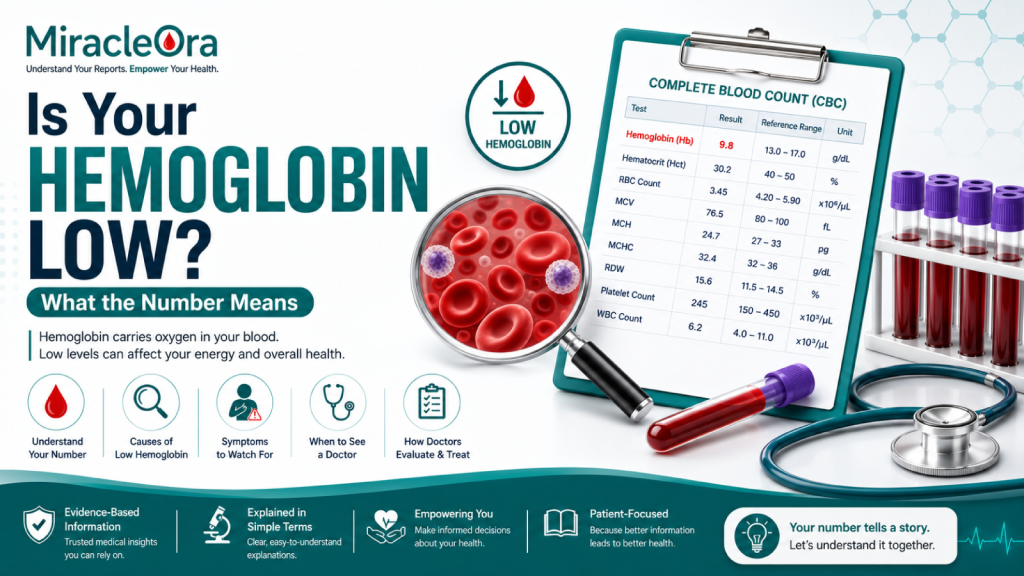
Hemoglobin is the oxygen carrying protein inside red blood cells, reported as a weight per volume of blood, usually g/dL. Hematocrit is the share of your blood volume that red cells occupy, reported as a percentage. They sit next to each other on a complete blood count because they describe the same red cells from two directions. The part most pages leave out: on an automated analyzer, hemoglobin is measured and hematocrit is usually calculated from other values, which is exactly why the two almost always move together.
This is general health education, not medical advice. It cannot tell you what your own results mean. Both values belong with the clinician who ordered the test.
What Each One Actually Measures
| Hemoglobin | Hematocrit | |
|---|---|---|
| What it describes | The oxygen carrying protein in red cells | The proportion of blood volume made up of red cells |
| Usual unit | g/dL (or g/L) | percent |
| Typical adult figures, Clinical Methods | 14 to 18 g/dL men, 12 to 16 g/dL women | 40% to 54% men, 36% to 48% women |
| How the lab produces it | Measured directly | Usually calculated on automated counters |
Sources: Clinical Methods, chapter on hemoglobin and hematocrit, and StatPearls (both on the NCBI Bookshelf), which gives the same adult hematocrit figures of 40% to 54% in males and 36% to 48% in females.
Those figures are typical published values, not your range. Your report prints its own reference interval, set from your laboratory’s instruments and population, and that is the one your result was flagged against. The abbreviations themselves, Hb and Hct among them, are decoded in CBC abbreviations explained.
One Is Measured, the Other Is Usually Calculated
This is the difference that explains almost everything else on this page.
Hemoglobin is measured chemically. As Clinical Methods describes the standard assay, “all forms of hemoglobins are converted to the colored protein cyanomethemoglobin and measured by a colorimeter.” The instrument reads the color of your lysed sample and reports a concentration.
Hematocrit can be measured directly, by spinning blood in a tube until the red cells pack at the bottom and reading the height of the column. But on the analyzers most laboratories run today, it is derived instead: “Automated cell counters calculate the hematocrit by multiplying the red cell number (in millions/mm3) by the mean cell volume (MCV, in femtoliters).”
So a modern report may show you one measured value and one computed from the red cell count and average cell size. That is not a shortcut or a lower grade of number, it is how the instrument works, and knowing it changes how you read the pair.
The Rule of Three, and What It Is For
Because the two describe the same red cells, the relationship between them is close to fixed. Laboratory scientists use it as a quick internal check called the rule of three. A 2017 article in Clinical Laboratory Science, the journal of the American Society for Clinical Laboratory Science, puts it as “the hemoglobin number is 1/3 (i.e. 33%) of the hematocrit number,” and adds a second relation, that “the RBC (without powers of 10) is 1/3 of the HB value.”
In practice that means a hematocrit of about three times the hemoglobin is the expected pattern. A 2019 study in PLoS One comparing a threefold conversion against a spun micro-hematocrit in pregnant women reported a correlation coefficient of 0.91 and an intraclass correlation coefficient of 0.94, describing the two as “identical within inherent imprecision of both methods.”
This is a laboratory quality tool, not a self-check. It tells the laboratory whether its own numbers are internally consistent. It does not tell you anything about your health, and doing the arithmetic on your own report will not add information the clinician does not already have.
When the Rule Does Not Hold
The same 2017 article notes that the rule of three “will NOT hold in instances of hypochromia, spherocytosis, or spurious results,” and that it serves as “a quick quality assessment to detect those circumstances.”
Read that carefully, because the list contains two very different kinds of thing. Two of the items are genuine red cell characteristics: cells that carry less hemoglobin than their size suggests, and cells that are shaped differently from normal. The third is a measurement problem in the sample itself.
That is why a mismatch between your hemoglobin and hematocrit is a prompt for the laboratory and the clinician to look further, not a finding you can interpret at home. It may lead to a repeat sample, a look at the cells under a microscope, or nothing at all. What it is not is a diagnosis, and it is not something to rank as good news or bad news from the outside.
Both Move With Your Plasma Volume
Neither value counts red cells in your body. Both describe red cells relative to the fluid they are suspended in, so anything that changes the fluid moves both numbers.
Clinical Methods is direct about it: “If a patient is severely dehydrated, the hemoglobin and hematocrit will appear higher than if the patient were normovolemic; if the patient is fluid overloaded, they will be lower than their actual level.”
This is the reason pregnancy has its own thresholds. StatPearls notes that pregnant patients may have a lower hematocrit due to hemodilution, the plasma volume expansion that comes with pregnancy. It is also why the circumstances of the blood draw are worth mentioning at the appointment, a point covered in how dehydration affects blood test results and in more depth for the percentage itself in understanding hematocrit on your report.
Hemoglobin vs Hematocrit on the Same Report: So Why Print Both?
If the two track each other so closely, the obvious question is why a report carries both at all. Three honest reasons, and none of them is that one is better than the other.
They are used differently by different bodies. The World Health Organization defines anemia by hemoglobin alone in its 2024 cutoffs. The American College of Obstetricians and Gynecologists, in Practice Bulletin 233 (2021), defines anemia in pregnancy by either value: hemoglobin below 11 g/dL or hematocrit below 33% in the first trimester, 10.5 g/dL or 32% in the second, and 11 g/dL or 33% in the third. A clinician reading against a particular standard needs the value that standard uses.
They cross-check each other. That is the rule of three above, and it is a real safeguard against a bad sample reaching a decision.
They come from the same run anyway. The analyzer produces the red cell count and the cell size regardless, so the derived percentage costs nothing extra.
For which value gets compared against which threshold at which age, our sourced chart of hemoglobin cutoffs by age, sex and pregnancy sets them out together.
Reading the Pair on Your Own Report
Three things are true of both numbers at once. Each is a concentration, so hydration moves it. Each is compared against your laboratory’s own interval, not a chart online. And each is one point in time rather than a direction of travel, which is why earlier reports are useful to bring along.
If one of the two is flagged and the other is not, that is a question for the clinician rather than a puzzle to solve at home. The value can sit a fraction inside its interval while its partner sits a fraction outside, and where a number falls relative to its own limits is part of what a clinician weighs. For the hemoglobin side of that conversation, reading your own hemoglobin number covers what a single value can and cannot settle. Cleveland Clinic’s standing advice for anyone with a condition that affects hemoglobin is to call their provider any time symptoms worsen.
Frequently Asked Questions
Is hematocrit just hemoglobin times three?
It is close to that in practice, and laboratories use the relationship as a consistency check. The 2017 Clinical Laboratory Science article states the hemoglobin number is about one third of the hematocrit number, and a 2019 PLoS One study found strong agreement between a threefold conversion and a spun hematocrit in pregnant women. It is an internal check for the laboratory, not a calculation to make decisions from.
Which test is better for detecting anemia?
Neither is a replacement for the other, and the standard being applied decides which is used. WHO’s 2024 anemia cutoffs are stated in hemoglobin. ACOG’s Practice Bulletin 233 gives both a hemoglobin and a hematocrit threshold for each trimester of pregnancy.
Why is my hematocrit flagged when my hemoglobin is normal?
That combination is a reason to ask the clinician who ordered the test, not something to interpret alone. Both values sit against their own reference intervals, and laboratories investigate mismatches between the two as part of routine quality checks, since the rule of three does not hold when red cells are unusual or the sample is affected.
Does drinking water before a blood test change these numbers?
Both values depend on plasma volume. Clinical Methods states that in severe dehydration hemoglobin and hematocrit appear higher, and in fluid overload they appear lower, than they otherwise would. Whether to eat, drink or do anything else before a test is a question for the laboratory or the clinician who requested it, since instructions differ by test.
Do hemoglobin and hematocrit have the same reference range for everyone?
No. Published adult figures differ by sex, and MedlinePlus notes that a normal range varies with the laboratory used and with age, race and sex. Pregnancy and childhood have separate thresholds again. The interval printed on your own report is the one that applies to your result.
Medical disclaimer: This content is for general education only and is not a substitute for professional medical advice, diagnosis, or treatment. It cannot interpret your individual results. Talk to a qualified healthcare provider about your own results and your symptoms. See our full Medical Disclaimer.