Ferritin is the protein that stores iron, and a ferritin blood test is used as an indirect measure of how much iron is held in the body. It is also an acute-phase protein, which means inflammation, infection and some chronic conditions raise it independently of iron. That second fact changes how the number is read: the World Health Organization publishes two different thresholds for the same test, one for apparently healthy people and a higher one for people with infection or inflammation. Which applies to any individual result is a clinical judgment, not a lookup.
This is general health education, not medical advice. It cannot tell you what your own result means. A ferritin result belongs with the clinician who ordered it.
What a Ferritin Blood Test Measures, and Why It Is Added to a Blood Count
MedlinePlus, the patient service of the US National Library of Medicine, defines it simply: “Ferritin is a protein that binds to iron and stores it in your body.” The test measures the level of that protein in blood as an indication of stored iron. MedlinePlus lists the reasons it is ordered, including checking iron levels and helping to investigate hemochromatosis, iron deficiency anemia, liver disease and restless legs syndrome, as well as monitoring chronic conditions that affect iron.
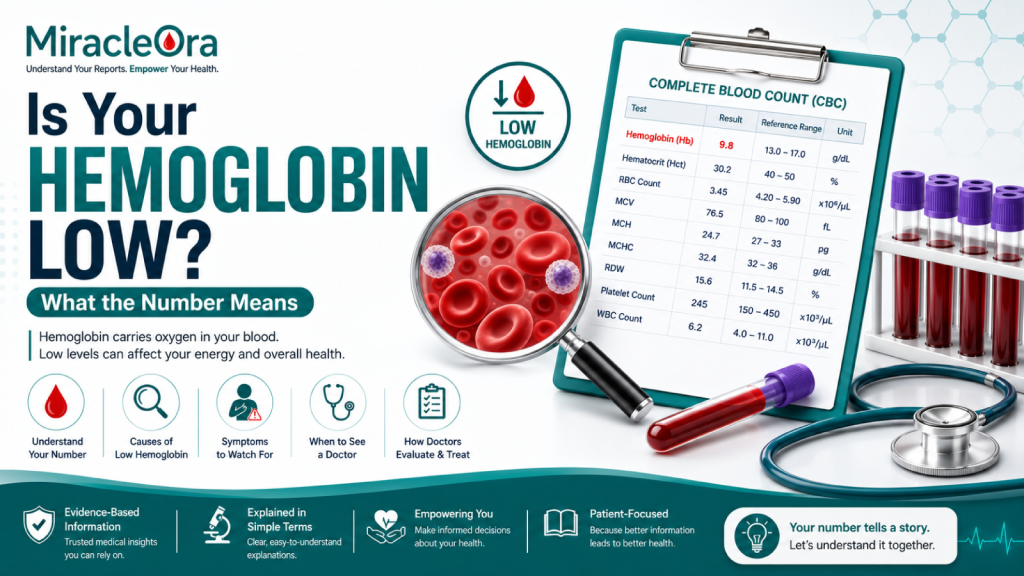
That is usually why it arrives after a complete blood count rather than with the first one. A CBC reports hemoglobin and the red cell indices, which describe the cells; ferritin describes the store those cells draw on, which is why reading a CBC report does not close the iron question on its own. Ferritin is not part of a standard CBC, so it usually appears as a separately requested line with its own reference interval and its own flag. If yours carries a letter, what H and L mean on a blood test covers the notation.
The One Thing That Makes Ferritin Hard to Read
Ferritin does two jobs, and the second interferes with the first.
The WHO guideline states the underlying relationship with a condition attached: “In the absence of inflammation, the concentration of plasma/serum ferritin is positively correlated with the size of the total body iron stores.” That condition is doing real work in the sentence.
StatPearls, on the NCBI Bookshelf, gives the other half in its chapter on iron deficiency and microcytic hypochromic anemia: “Ferritin is also an acute-phase reactant, and its levels may be elevated in chronic disease, inflammatory states, and malignancy.”
Put those together and the consequence follows. When inflammation is present, ferritin can be pushed upward by something that has nothing to do with iron, so a normal or high ferritin does not by itself rule out low iron stores in someone with inflammation. That is not a hedge. It is the acknowledged limitation of the test, and it is why guideline bodies write separate thresholds for that situation rather than one number for everybody. Inflammation and infection show up elsewhere on a blood count too, a point covered in what a CBC can and cannot say about infection.
WHO’s Thresholds Come in Two Columns
The World Health Organization’s Guideline on use of ferritin concentrations to assess iron status in individuals and populations (2020) sets cut-off values by age group and by whether infection or inflammation is present. These are its figures for iron deficiency.
| Group | Apparently healthy | With infection or inflammation |
|---|---|---|
| Children under 5 years | below 12 µg/L | below 30 µg/L |
| Individuals 5 years and older | below 15 µg/L | below 70 µg/L |
WHO’s table also gives a first trimester value of below 15 µg/L for pregnant women. A pregnancy result belongs with the obstetric team following the pregnancy.
Look at what the two columns do. A ferritin of 40 µg/L in an adult sits above WHO’s healthy threshold of 15 and below its inflammation threshold of 70. The printed number has not changed. The comparison has. That is why WHO recommends inflammation is measured at the same time: “In areas of widespread infection or inflammation, serum ferritin should be assessed with the concurrent measurement of two acute phase response proteins, CRP and AGP.”
The same guideline gives figures at the other end. In apparently healthy adults, WHO states that a ferritin above 150 µg/L in menstruating women and above 200 µg/L in men and non-menstruating women may indicate a risk of iron overload. In non-healthy adult populations, a concentration exceeding 500 µg/L may indicate a risk of iron overload or other disease.
A note on units. WHO reports ferritin in µg/L; many laboratories print ng/mL. The two are numerically identical, so 15 µg/L and 15 ng/mL are the same concentration.
A Different Body Publishes a Different Number
WHO’s thresholds are written for assessing iron status in individuals and populations, including public health surveillance. Clinical practice sources set cut-offs for a different purpose, and the numbers differ accordingly.
StatPearls states that “absolute iron deficiency is diagnosed when serum ferritin is less than 30 ng/mL or transferrin saturation is less than 20%,” and reports that a ferritin below 30 ng/mL is 92% sensitive and 98% specific for absent bone marrow stores of iron. That 30 is not WHO’s 15, and neither figure is wrong. They come from different bodies answering different questions.
There is no single ferritin number that means iron deficiency everywhere, for everyone, in every context. Thresholds differ by the body publishing them, by age, by pregnancy and by whether inflammation is present, and a page that gives one number as though it were universal has quietly dropped three of those four variables.
A Threshold Is Still Not Your Laboratory’s Reference Interval
Everything above is a cut-off: one number, one direction, published by a named body for a stated purpose.
Your report prints something different. A laboratory reference interval has two ends, and it is built from your laboratory’s own instruments and the population it serves. MedlinePlus notes that reference ranges vary, and adds a caution specific to this test: “If your ferritin results are not normal, it does not always mean you have a medical condition that needs treatment.”
So the interval printed beside your ferritin is the one your result was flagged against, and it may not match WHO’s 15, or StatPearls’ 30, or a chart you found elsewhere. Why those printed intervals differ between laboratories is set out in why your lab’s reference range differs from charts online.
What a Ferritin Result Does Not Tell You
It does not name a cause, in either direction.
On the low side, MedlinePlus says a lower than normal ferritin “may mean you have iron deficiency anemia, or another condition related to low iron levels,” and low stores can arise for reasons that are investigated in completely different ways. The hemoglobin side of the same picture is covered in our pillar on what a low hemoglobin means.
On the high side, MedlinePlus states that a higher than normal ferritin “can be caused by having too much iron in your body,” and also lists inflammation, autoimmune disorders, liver disease, cancer, obesity, alcohol use disorder and hyperthyroidism among the causes. We are not ranking that list by likelihood, because a ranking drawn from a population cannot tell an individual reader which item applies to them.
When to Raise It, and the Limit of This Page
MedlinePlus’s own guidance on ferritin results is direct: “If you have questions about your results, talk with your provider.”
That is the escalation language a named source publishes for this test, and it is deliberately the only escalation language on this page. No web page can triage a reader, and a page that ranks symptoms as urgent from a list it invented is doing something worse than nothing. If something is worrying you now, that judgment belongs to a clinician or an emergency service.
Worth bringing to the appointment: the report itself with its interval and units, any earlier ferritin results, and whether you had an infection or an inflammatory condition around the time of the draw. That last one decides which of WHO’s two columns is even the right comparison.
Frequently Asked Questions
What does a ferritin blood test measure?
MedlinePlus describes ferritin as “a protein that binds to iron and stores it in your body,” and the test measures the level of that protein in blood as an indirect indication of stored iron. WHO adds the condition that matters: in the absence of inflammation, serum ferritin is positively correlated with the size of total body iron stores.
Can I have low iron with a normal ferritin?
That is the situation the guidelines are written around. StatPearls states that ferritin is an acute-phase reactant whose levels may be elevated in chronic disease, inflammatory states and malignancy, and WHO sets a higher iron deficiency threshold of below 70 µg/L for adults with infection or inflammation, against below 15 µg/L for apparently healthy adults. Whether either applies to your result is a clinical judgment, and WHO recommends that markers of inflammation, CRP and AGP, are measured alongside ferritin.
What ferritin level is considered low?
It depends on the source and the situation. WHO’s 2020 guideline gives below 12 µg/L for children under 5 and below 15 µg/L for people aged 5 and over when apparently healthy, and below 30 µg/L and below 70 µg/L respectively when infection or inflammation is present. StatPearls gives a clinical cut-off of less than 30 ng/mL for absolute iron deficiency. Your laboratory prints its own interval, and that is the one your result was compared against.
What can raise ferritin apart from iron?
MedlinePlus lists inflammation, autoimmune disorders, liver disease, cancer, obesity, alcohol use disorder and hyperthyroidism among causes of a higher than normal ferritin, alongside having too much iron in the body. It also notes that an abnormal ferritin does not always mean a condition that needs treatment. Which, if any, applies to a given result is for the clinician who ordered the test.
Medical disclaimer: This content is for general education only and is not a substitute for professional medical advice, diagnosis, or treatment. It cannot interpret your individual results. Talk to a qualified healthcare provider about your own ferritin result and your symptoms. See our full Medical Disclaimer.