A plain white cell count gives you one number. The differential breaks that number into the types of cell it is made of, and it is the part of the report that people scan, fail to understand, and then worry about.
MedlinePlus, in its Medical Encyclopedia entry "Blood differential test" (review/update date 3 February 2025), describes the reason it exists: "This test is done to diagnose an infection, anemia, or leukemia. It may also be used to monitor one of these conditions or to see if treatment is working."
If your total count is what is flagged rather than the breakdown, what a high white blood cell count means is the page for that, and this one is the map of the lines underneath it. The difference between a CBC and a CBC with differential covers why you may or may not have this section on your report at all.
How the breakdown is produced
MedlinePlus describes the method: "A blood sample is needed. A lab specialist takes a drop of blood from your sample and smears it onto a glass slide. The smear is stained with a special dye, which helps tell the difference between various types of white blood cells."
Modern laboratories usually do this by automated analyzer and go to the slide when something needs a closer look, but the principle is the same. The cells are distinguished by how they appear once stained, which is why the categories are morphological ones.
The five lines, and the figures MedlinePlus gives
MedlinePlus publishes the following reference percentages:
- "Neutrophils: 40% to 60%"
- "Lymphocytes: 20% to 40%"
- "Monocytes: 2% to 8%"
- "Eosinophils: 1% to 4%"
- "Basophils: 0.5% to 1%"
- "Band (young neutrophil): 0% to 3%"
Six entries rather than five, because bands are counted separately. A band is an immature neutrophil, and a report that lists them is telling you something about how fast neutrophils are being released.
As always with laboratory figures, the interval printed beside your own result is the one to read against, not a figure found elsewhere. Why your lab's reference range is different explains how those intervals are established and why two correct laboratories can print two different ones.
The percentage trap
This is the single most useful thing on this page, and it catches almost everyone.
A percentage is a share of a total, so it moves when the total moves, even if the cell type itself has not changed at all.
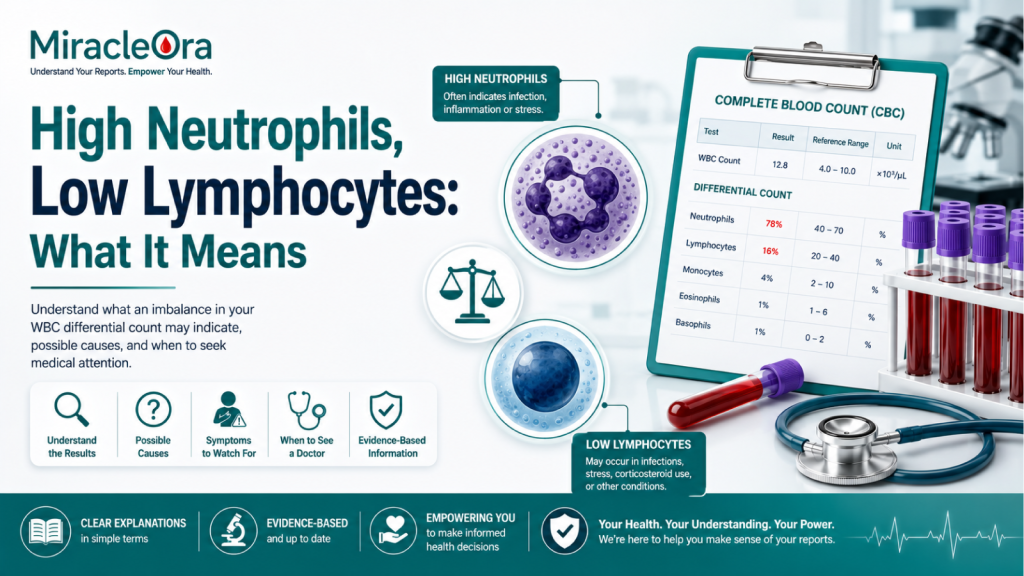
Consider a person whose lymphocyte count has not changed by a single cell, while their neutrophils have risen sharply. The lymphocyte percentage falls, because the same number of lymphocytes is now a smaller share of a larger total. The report shows a low lymphocyte percentage. Nothing happened to the lymphocytes.
This is why laboratories report absolute counts alongside percentages, and why clinicians read the absolute number when it matters. A flagged percentage is not the same finding as a flagged absolute count, and the two can point in different directions on the same report.
The most common place this shows up is the pattern this site covers in high neutrophils with low lymphocytes, where the percentages move in opposite directions largely because they are shares of the same total.
What each line is, and what MedlinePlus associates with it
The following are MedlinePlus's own association lists, reproduced as what that document publishes. A list of conditions in which a value has been observed is not a list of things you have, and every one of these lines can move for ordinary reasons.
Neutrophils. The largest share in most adults, and the line most associated with bacterial infection. MedlinePlus states that high neutrophil percentages may suggest acute infection, inflammation, stress, eclampsia, gout, leukemia, myeloproliferative diseases, rheumatoid arthritis, rheumatic fever, thyroiditis, trauma or smoking. Decreased percentages can reflect aplastic anemia, chemotherapy, viral infections, radiation or severe bacterial infection.
Two entries there are worth pausing on. Stress and smoking are on the raised list, which is why an unexplained neutrophil elevation is often not mysterious at all. And severe bacterial infection appears on the decreased list, which is the opposite of the simple rule most people carry, because a severe enough demand can outstrip supply.
Lymphocytes. The line most associated with viral infection. MedlinePlus states that increased lymphocyte percentages may indicate chronic bacterial infection, hepatitis, mononucleosis, tuberculosis, lymphocytic leukemia, multiple myeloma or viral infections, and that decreased levels can result from chemotherapy, HIV or AIDS, leukemia, radiation, sepsis, steroid use or aging.
Monocytes. The least explained line on the report. MedlinePlus states that elevated monocytes may suggest chronic inflammatory disease, leukemia, parasitic infection, tuberculosis or viral infection.
Eosinophils. The allergy and parasite line. MedlinePlus states that increased eosinophils can indicate Addison disease, allergic reactions, cancer, chronic myelogenous leukemia, collagen vascular disease, hypereosinophilic syndromes or parasitic infection.
Basophils. The smallest number on the report, often zero or one percent. MedlinePlus states that increased basophils may result from post-splenectomy status, allergic reactions, chronic myelogenous leukemia, collagen vascular disease, myeloproliferative diseases or chickenpox, and that decreased basophils can indicate acute infection, cancer or severe injury.
A basophil percentage of zero is not a finding. The reference interval starts near zero, and with so few cells involved the measurement carries very little information at the low end.
The total, for context
MedlinePlus's separate "WBC count" entry (review/update 3 February 2025, updated by Warren Brenner, MD) gives the figure the differential divides up: "The normal number of WBCs in the blood is 4,500 to 11,000 WBCs per microliter (4.5 to 11.0 × 10⁹/L)."
It states that "A low number of WBCs is called leukopenia. A count less than 4,500 cells per microliter (4.5 × 10⁹/L) is below normal," and that "A higher than normal WBC count is called leukocytosis."
Among the causes of a high count it lists "Certain drugs or medicines, Cigarette smoking, After spleen removal surgery, Infections, most often those caused by bacteria, Inflammatory disease, Leukemia or Hodgkin disease, Tissue damage, Pregnancy, Severe emotional or physical stress."
Pregnancy and severe stress on that list are the two that most often explain an otherwise puzzling result.
Why the pattern matters more than any single line
The differential is not five independent tests. Its value is in the shape.
A neutrophil-predominant picture and a lymphocyte-predominant picture point in broadly different directions, which is the observation the whole cluster is built on. But the same page notes that stress, steroids and smoking shift the same lines, which is precisely why the shape is a starting point rather than a conclusion. Can a CBC detect infection works through what the count can and cannot establish about an infection.
The other half of the pattern is what the rest of the report shows. White cell changes read differently alongside normal red cells and platelets than alongside abnormal ones, and how to read a CBC report covers finding those lines.
What to do with a flagged line
Bring the whole report, not the flagged percentage. Ask whether the absolute count is also outside its interval, because that is the question the percentage cannot answer. Mention recent illness, recent vaccination, medicines including steroids, smoking, and pregnancy, because all of them appear on MedlinePlus's own lists.
And treat a repeat test as ordinary. A single differential is a snapshot of a system that changes hour to hour.
The short version
- The differential splits the white cell count into its types. MedlinePlus (3 February 2025) publishes the reference percentages.
- Percentages are shares. One line moving can shift another without anything happening to it. Read the absolute counts.
- Bands are immature neutrophils and are counted separately.
- MedlinePlus's association lists are long and include ordinary causes: stress, smoking, pregnancy, steroids.
- A zero basophil percentage is not a finding.
- The pattern across the lines, read with the rest of the report, is what a clinician uses.