A raised white cell count is one of the most common abnormal results there is, and it produces one of the most specific fears.
The distinction that fear turns on has a name. A count can be reactive, meaning the body is responding to something, or it can reflect a problem in the cells themselves. Those are different things, and clinicians separate them routinely.
This page is about how that separation is made and, just as importantly, why it is not something a reader can perform on their own report. This cluster's pillar, what a high white blood cell count means, covers the wider question of what raises a count at all.
What leukocytosis means
StatPearls, in the chapter "Leukocytosis" by Victoria Mank and Robert B. Killeen (last update 15 June 2026), gives a definition that carries a detail worth noticing: "Leukocytosis refers to an age-appropriate increase in the white blood cell (WBC) count."
Age-appropriate. What counts as raised is read against the interval for that person, which is one reason a child's report and an adult's are not comparable. The interval printed on your own report is the one that applies, and why your lab's reference range is different covers where those come from.
MedlinePlus's Medical Encyclopedia entry "WBC count" (review/update 3 February 2025) gives the adult reference figure as "4,500 to 11,000 WBCs per microliter (4.5 to 11.0 × 10⁹/L)" and states that "A higher than normal WBC count is called leukocytosis."
Most raised counts are reactive
Before the distinguishing features, the base rate, because it is the most useful thing on this page.
MedlinePlus lists the causes of a high count as: "Certain drugs or medicines, Cigarette smoking, After spleen removal surgery, Infections, most often those caused by bacteria, Inflammatory disease, Leukemia or Hodgkin disease, Tissue damage, Pregnancy, Severe emotional or physical stress."
Nine items. Seven of them are ordinary. Smoking, pregnancy, stress, medicines, infection, inflammation and tissue damage all raise a white cell count without anything being wrong with the white cells themselves. The blood is doing what it is supposed to do.
That does not make the remaining possibilities unimportant. It does mean that a raised count, on its own, is a weak signal in the direction people fear most, and a strong signal that something has prompted a response.
The features that separate the two
StatPearls describes the distinction as drawn primarily through clinical patterns rather than through the count alone.
On the reactive side, the chapter describes a leukemoid reaction, a reactive process, as producing "a neutrophil count greater than 50,000 cells/µL without a myeloproliferative neoplasm" and characteristically showing "predominantly mature neutrophils," resolving with treatment of the underlying cause.
On the other side, it states that malignant leukocytosis involves "increased blast cells and other immature leukocyte precursors" with "persistently elevated WBC counts until definitive therapy is completed."
StatPearls lists the following as indicators of benign reactive leukocytosis:
- An identifiable trigger: recent infection, inflammation, stress or medication use.
- Stability: a modest, stable neutrophilia appropriate for serial outpatient monitoring.
- A resolution pattern: a transient elevation that resolves when the inciting factor is addressed.
- Absence of concerning findings: no circulating blasts, normal morphology on peripheral smear, and clinical stability without systemic symptoms.
Read that list carefully and notice what it requires. A trigger you may not know about. A trend, which needs more than one test. Resolution, which needs time to pass. And morphology on a peripheral smear, which requires someone to look at your cells under a microscope.
None of those four is available from a single number on a single report. That is the honest reason this page cannot tell you which category you are in, and it is a better reason than any disclaimer.
Maturity, which is the underlying idea
The distinction StatPearls draws rests on one idea that is worth having in plain language, because it explains why the smear matters so much.
A reactive process produces more of the cells the body already makes, and those cells are mature. The factory is running faster; the product is normal.
A malignant process produces cells that should not be in the bloodstream, in particular blasts, which are early precursors that normally stay in the bone marrow until they have matured.
So the question is not only how many cells there are, but what kind. An analyzer counts. A person looking at a stained slide can say what the cells look like. What a peripheral blood smear report means covers that examination and the vocabulary its report uses.
This is also why a very high count is not automatically the more worrying finding. StatPearls's own leukemoid reaction figure, a neutrophil count above 50,000 without a myeloproliferative neoplasm, is a reactive process at a number that sounds alarming.
Why the differential is part of the answer
Which cell line is raised narrows the field considerably.
MedlinePlus's "Blood differential test" page (review/update 3 February 2025) associates high neutrophil percentages with acute infection, inflammation, stress, eclampsia, gout, leukemia, myeloproliferative diseases, rheumatoid arthritis, rheumatic fever, thyroiditis, trauma and smoking, and increased lymphocyte percentages with chronic bacterial infection, hepatitis, mononucleosis, tuberculosis, lymphocytic leukemia, multiple myeloma and viral infections.
The same page reports band cells, immature neutrophils, at a reference of "0% to 3%", which is the routine part of a report that speaks directly to the maturity question above.
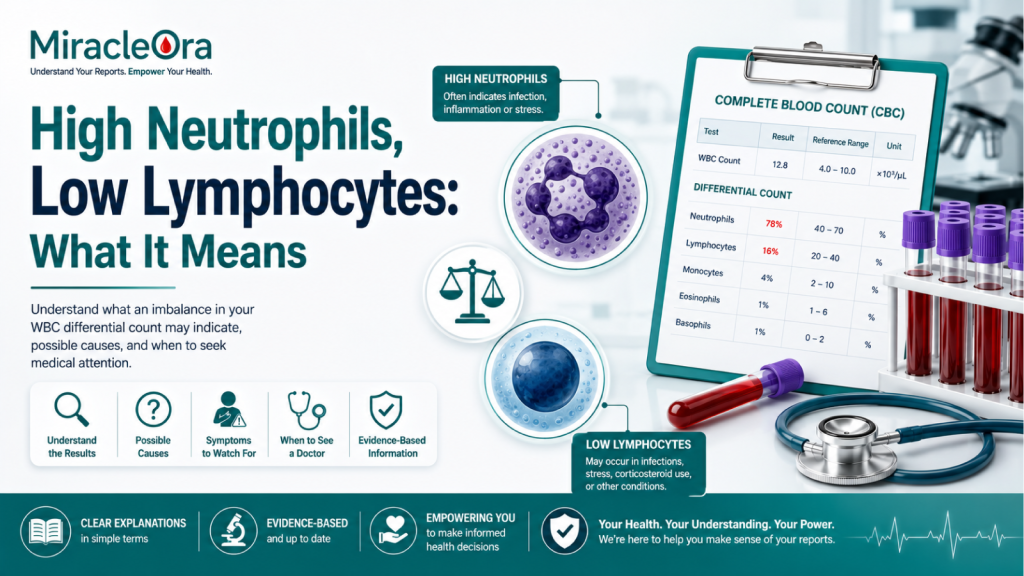
This site's page on high neutrophils with low lymphocytes covers the most common pattern in detail, and can a CBC detect infection covers what the count can and cannot establish about an infection specifically.
The single most informative thing you can supply
Not a symptom and not a number. A previous result.
StatPearls's indicators lean heavily on trajectory: stable versus persistent, transient versus continuing. A clinician with one reading is working with a point. A clinician with two readings has a direction, and direction is what most of the reactive-versus-otherwise distinction actually turns on.
If you have had blood tests before, bring them, even old ones.
Feeling fine with a raised count
Very common, and StatPearls's own list includes "clinical stability without systemic symptoms" among the reassuring features.
It is also true that reference intervals are built so that a proportion of healthy people fall outside them, which is why an abnormal blood test when you feel fine is such a frequent experience. A mildly raised count in someone who is well, with an obvious trigger, is the commonest version of this whole situation.
That does not close the question. It sets the tone for a routine follow-up rather than an emergency.
The short version
- StatPearls (15 June 2026) defines leukocytosis as an age-appropriate increase in the white cell count.
- MedlinePlus's cause list is nine items and seven are ordinary: smoking, pregnancy, stress, medicines, infection, inflammation, tissue damage.
- Reactive processes produce mature cells; malignant ones put blasts and immature precursors into the blood.
- StatPearls's reassuring features are an identifiable trigger, stability, resolution, and a normal smear with no blasts.
- Three of those four need a trend or a microscope. Neither is on your report.
- Bring old results. Trajectory is what the distinction mostly rests on.