The absolute neutrophil count (ANC) is the actual number of neutrophils in a set volume of blood, not their share of the white cells. It is worked out from the total white cell count and the neutrophil percentage, with band cells added in MDCalc's version of the formula. Clinicians read the absolute number because a percentage can move while the real count stays the same.
If your report prints neutrophils twice, once as a percentage and once as a count, this page explains why, how the two relate, and why the second one carries the weight. What the number means for you is a question for the doctor who ordered the test, who reads it against your laboratory's own interval and your history.
What neutrophils are
Cleveland Clinic's page on neutrophils (updated 21 March 2025, read 11 September 2026) describes them as a type of white blood cell and the body's first line of defense against infections. It gives the normal range in a healthy adult as 2,500 to 7,000 neutrophils per microliter of blood, and it calls a low count neutropenia and a high count neutrophilia.
MedlinePlus's blood differential page (review date 3 February 2025, read 11 September 2026) gives the neutrophil share of the white cells as 40% to 60%, and band cells, which it describes as young neutrophils, as 0% to 3%. Its WBC count page (same review date, read the same day) adds the caveat that normal value ranges may vary slightly among different labs.
Those are two different measurements: a count of cells and a share of a total. Everything below follows from the difference.
How the absolute neutrophil count is calculated
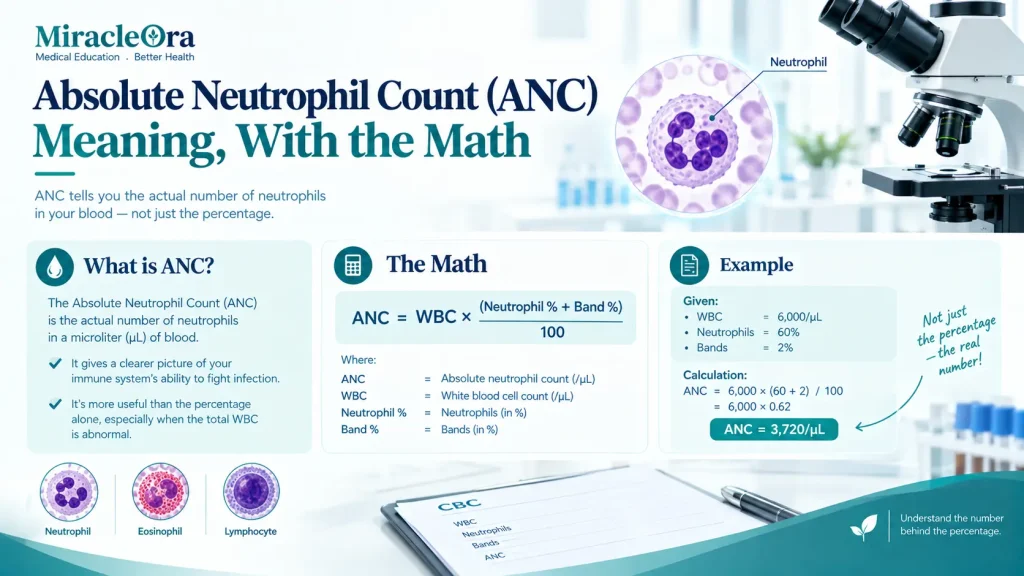
MDCalc's ANC calculator (read 11 September 2026) gives the formula as 10 × WBC count in thousands × (% PMNs + % bands). PMNs are the mature neutrophils, often printed on reports as "segs" or "polys"; bands are the younger form.
Written in everyday terms, that is:
ANC = total white cell count × (neutrophil % + band %) ÷ 100
Some reports print the absolute neutrophil count on its own line, so there is nothing to calculate. If yours prints only percentages, that arithmetic recovers the count. If there is no band line, the calculation uses the neutrophil percentage alone.
A worked example, with invented numbers for illustration only:
- Total white cell count: 6,000 per microliter
- Neutrophils: 55%
- Bands: 2%
- ANC = 6,000 × (55 + 2) ÷ 100 = 3,420 per microliter
MDCalc's version gives the same answer: 10 × 6 × 57 = 3,420.
The percentage trap
A percentage is a share of a total. When the total changes, or when another cell type grows or shrinks, the percentage moves even if the number of neutrophils has not changed at all.
Three illustrative reports, invented to show the arithmetic:
| Report | Total WBC (per µL) | Neutrophil % | ANC (per µL) |
|---|---|---|---|
| A | 8,000 | 45% | 3,600 |
| B | 3,000 | 60% | 1,800 |
| C | 12,000 | 30% | 3,600 |
Report B has the highest neutrophil percentage of the three and the lowest absolute count. Reports A and C carry exactly the same number of neutrophils, yet C's percentage sits well below MedlinePlus's 40% to 60% share, because another cell type has grown and diluted it.
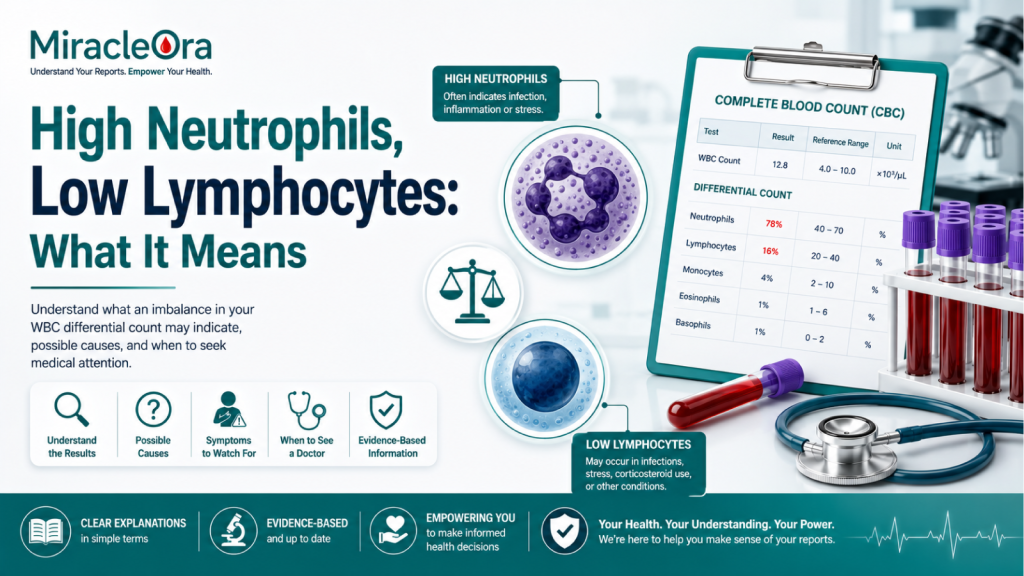
This is also why a high lymphocyte percentage and a low neutrophil percentage can appear together on a report: they are two slices of the same total, so when one grows the other shrinks. The high neutrophils, low lymphocytes pattern covers that relationship, in the opposite direction.
For the neutrophil question, the absolute number is the line that matters, and it is the one a clinician reads first.
Same number, three different units
A second source of confusion on real reports is the unit. The same count can be printed in several ways:
| Written as | Meaning | The same count |
|---|---|---|
| per µL | cells in one microliter | 1,500/µL |
| per cumm | cells in one cubic millimeter | 1,500/cumm |
| × 10⁹/L | billions of cells per liter | 1.5 × 10⁹/L |
| × 10³/µL | thousands of cells per microliter | 1.5 × 10³/µL |
A microliter and a cubic millimeter are the same volume, so those two are identical. To go from "per microliter" to "× 10⁹/L", divide by 1,000.
That is why two sources that look as though they disagree are giving the same figure. StatPearls' neutropenia chapter by Preeti Rout, Samuel B. Reynolds and Patrick M. Zito (last updated 7 June 2024, read 11 September 2026) states that the standard circulating neutrophil count should be greater than 1.5 × 10⁹/L. St. Jude's patient page on ANC (reviewed August 2026, read 11 September 2026) states that a normal ANC for a healthy child is greater than 1,500 cells per microliter. Different units, one number.
What the published categories say
StatPearls classifies neutropenia by ANC as mild at 1.0 to 1.5 × 10⁹/L, moderate at 0.5 to 1.0 × 10⁹/L, severe below 0.5 × 10⁹/L, and agranulocytosis below 0.2 × 10⁹/L. St. Jude uses the same bands in per-microliter terms and adds a "profound" category below 100 cells per microliter.
| Category | StatPearls (× 10⁹/L) | Same in per µL |
|---|---|---|
| Mild | 1.0 to 1.5 | 1,000 to 1,500 |
| Moderate | 0.5 to 1.0 | 500 to 1,000 |
| Severe | below 0.5 | below 500 |
| Agranulocytosis | below 0.2 | below 200 |
Three honest caveats about those numbers:
- Sources do not share one interval. Cleveland Clinic's healthy adult range starts at 2,500 per microliter; StatPearls and St. Jude put the neutropenia line at 1,500. Both are published, and neither replaces the interval your laboratory printed. Why your lab's reference range differs from charts online explains how those intervals are set.
- Ancestry changes the picture for some people. StatPearls describes Duffy antigen null neutropenia, formerly termed benign ethnic neutropenia, as a neutrophil count below 1,500 per microliter without an increased infection risk. It calls it a diagnosis of exclusion and one of the most common causes of neutropenia in people of African, Arabic, Yemenite Jewish and West Caribbean descent.
- A category is not a verdict. Where a result falls is read by the clinician together with the cause, the trend and how the person actually is.
When a low ANC comes with a fever
This is the one situation on this page where waiting is the wrong choice.
StatPearls describes febrile neutropenia, a fever in someone with neutropenia, as a medical emergency requiring immediate evaluation. The National Cancer Institute's page on infection and neutropenia (reviewed 23 January 2020, read 11 September 2026) lists a fever of 100.5 °F (38 °C) or higher among the signs of infection to report. St. Jude advises contacting a health care provider or going to the emergency room right away for a fever or other signs of infection in a child with a low ANC.
If you have been told your neutrophil count is low and you develop a fever, go to hospital or contact your doctor straight away rather than waiting for a routine appointment.
A note for dengue season in Bangladesh
In Bangladesh, a CBC ordered during a fever may be part of the dengue question. The CDC's clinical page on dengue (updated 24 February 2026, read 11 September 2026) lists leukopenia, a low white cell count, and thrombocytopenia, a low platelet count, among the common laboratory findings. It notes that during recovery the white cell count usually starts to rise, followed by the platelet count.
The WHO frames danger in dengue by symptoms rather than by a count. Its dengue fact sheet (21 August 2025, read 11 September 2026) lists the warning signs of severe dengue as severe abdominal pain, persistent vomiting, rapid breathing, bleeding gums or nose, fatigue, restlessness, blood in vomit or stool, being very thirsty, pale and cold skin, and feeling weak, and says people with these severe symptoms should seek care immediately.
If any of those signs appear, go to hospital. Dengue platelet counts and the warning signs covers the platelet side of the same report.
Where the ANC sits on your report
The ANC comes from the differential, the breakdown of white cells by type. Not every CBC includes one, and the difference between a CBC and a CBC with differential explains how to tell which you had.
If it is the total white count that is flagged high rather than the neutrophils, what a high white blood cell count means covers that side of the question.
What to ask the doctor
- Is the absolute neutrophil count printed on my report, or does it need calculating?
- Which interval does this laboratory use, and in which unit?
- Is this one result, or part of a trend? Previous reports help here, even old ones.
- Could a recent illness or a medicine explain the result? No medicine should be stopped or changed on the strength of a blood result and a web page; that is the prescriber's decision.
Frequently Asked Questions
What does absolute neutrophil count mean?
It is the number of neutrophils in a set volume of blood, such as per microliter, rather than their share of all white cells. Cleveland Clinic (updated 21 March 2025) gives a healthy adult range of 2,500 to 7,000 per microliter, and laboratories print their own interval, which is the one that applies to your report.
How do you calculate ANC?
MDCalc gives the formula as 10 × WBC count in thousands × (% neutrophils + % bands). In everyday terms, multiply the total white cell count by the neutrophil and band percentages added together, then divide by 100. A count of 6,000 with 55% neutrophils and 2% bands gives an ANC of 3,420 per microliter.
Why can the neutrophil percentage be flagged when the absolute count is not?
Because a percentage is a share of a total. If the total white cell count rises, or another cell type such as lymphocytes grows, the neutrophil share shrinks even when the number of neutrophils has not changed. That is why clinicians read the absolute number.
What ANC level is dangerous?
StatPearls (last updated 7 June 2024) classifies neutropenia as mild at 1,000 to 1,500 per microliter, moderate at 500 to 1,000, and severe below 500, and describes fever with neutropenia as a medical emergency. What a particular result means is decided by the doctor who ordered the test. With a low count and a fever, go to hospital or contact your doctor straight away.
The short version
- The ANC is a count of neutrophils, not a share. MDCalc: 10 × WBC in thousands × (% neutrophils + % bands).
- A neutrophil percentage can move while the absolute count stays put, so the absolute line is the one that matters.
- 1,500 per microliter, 1,500 per cumm and 1.5 × 10⁹/L are the same number.
- StatPearls grades neutropenia as mild, moderate, severe and agranulocytosis; your lab's interval and your doctor decide what your result means.
- A low ANC with a fever is an emergency. In dengue, the WHO warning signs mean go to hospital.